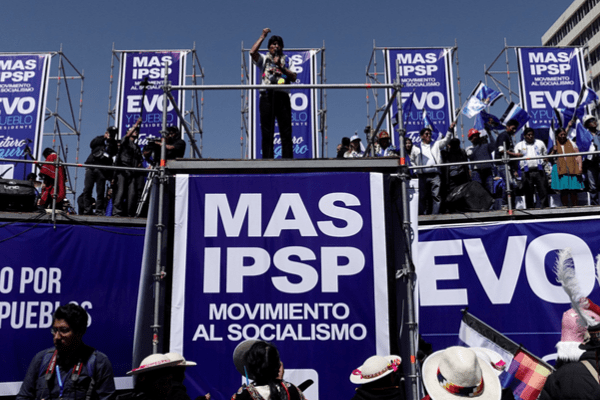
At Bolivia’s largest museum, perched on a hill in an isolated Andean village, one item stands out. It is a replica of a makeshift football covered in white cloth that Bolivia’s President Evo Morales used to play with as a small child, in between school lessons and herding llamas on the chilly plateau.
The $7.2m museum is dedicated to explaining the extraordinary rise of Mr Morales — Latin America’s longest-sitting president — from a childhood being raised in a hut on the breezy shores of Lake Poopó to spending nearly 14 years as president. He now runs the country from a 25-storey presidential palace he built in the capital La Paz.
Mr Morales was one of a generation of leftwing leaders who came to power in the first decade of the century and surfed the wave of the China-led commodities boom to push more redistributive policies.
The bright hopes that many of his peers raised have since been dashed. In Brazil, former president Luiz Inácio Lula da Silva is in jail after being convicted of corruption and the economy has suffered a traumatic fall. The unravelling of Hugo Chávez’s revolution in Venezuela has led to one of the biggest peacetime economic collapses.

Bolivia, however, has continued to prosper, even after commodity prices fell. During Mr Morales’s time in office, the country’s gross domestic product has quadrupled.
“I would never vote for anyone else,” says Walter Vilca, a quinoa and potato farmer from Orinoca, standing outside the wattle-anddaub hut where his “brother president” grew up.
He adds that Mr Morales has brought stability to a once-divided country — Bolivia’s presidency had five office-holders in the five years before he took office. Mr Morales also produced tangible improvements in the day-to-day lives of poor Bolivians like himself, fuelling a new sense of dignity.
“I played with a cloth ball like him. Now, we have a football pitch with synthetic grass here, and food every day,” says Mr Vilca. “We have all we need.”
But as he prepares to run on October 20 for an unprecedented fourth term as president — after what critics believe was a bungled attempt to get around constitutional term limits — Mr Morales faces a series of profound questions.

There are warning signs that the strong economic run could be running out of steam — last year’s 4.2 per cent rise in GDP, according to government statistics, was partly the result of an unsustainably high budget deficit. And in a country where many young people only remember him as president, the 59-year-old leader is facing growing criticism that he is becoming autocratic.
Opponents say he holds sway over the courts and accuse members of his government of corruption. With no named heir-apparent, some allies worry about a cult of personality around Mr Morales — the sort of uncritical admiration that finds expression in expensive museums and shiny presidential palaces.
“Politics is not a profession, it is a lasting passion for the people,” Mr Morales tells the Financial Times, adding that “it is a request from the Bolivian people” that he runs again. “People tell me, ‘Evo, if you do well, we’ll do well’.”
Comments like these have alienated a section of the president’s support. While political opponents warn about the risks to Bolivia’s democracy. “If we continue with Señor Morales as president, we will go from authoritarianism to dictatorship,” says Carlos Mesa, a former president and his main election challenger.
“Bolivia is not on the path to becoming Venezuela,” says a foreign diplomat in La Paz. “But its democratic credentials are definitely being tested.”
Mr Morales is ethnically an Aymara — one of Bolivia’s main groups, which make up roughly two-thirds of its 11m population. He was the first indigenous president of a country traditionally ruled by members of the small group of white citizens or the larger minority of mestizo Bolivians, whose ancestry includes Europeans and indigenous people. Until Mr Morales took office, the indigenous majority were often treated as second-class citizens.
It was his connection to the rural poor, those such as Mr Vilca, that secured his first presidential term with 54 per cent of the vote. He built on that to win again in 2009 with 64 per cent of the vote after the constitution was changed to allow immediate re-election. In 2014, he had the support of 61 per cent of voters.
Those victories were built on a strong economy. The commodity price boom that began in 2003 lifted Bolivia and much of the rest of the region. Yet while neighbours Argentina and Brazil struggled after commodity prices started to fall in 2014, Bolivia has grown at an average of 4.9 per cent a year between 2006 and 2018. The IMF forecasts the Andean nation’s GDP will grow 4 per cent this year, which would once again be the fastest rate in South America.
Unlike other members of Latin America’s “pink tide” of leftwing governments, where economic mismanagement has undermined many of the earlier gains, Bolivia has run prudent macroeconomic policies for much of Mr Morales’s presidency. His government has been more adept than most in the region at managing the commodities windfall.
In gas and mineral-rich Bolivia, the basis of Mr Morales’s economic model — which critics dub a form of “state capitalism”— was to renationalise resources and redistribute tax receipts in order to fuel internal consumption.