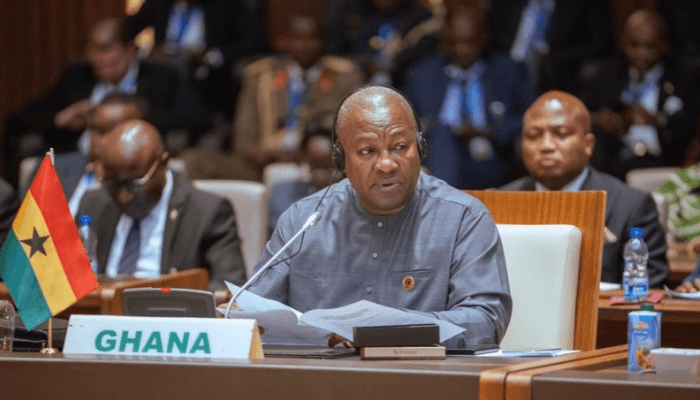
President John Dramani Mahama has stated that Africa’s call for reparations is no longer a fragmented discussion but a unified continental demand. Speaking at the 7th Mid-Year Coordination Meeting of the African Union (AU) in Malabo, Mahama, Ghana’s President and the AU’s Champion for Reparations, presented a progress update on the AU’s 2025 Theme of the Year, “Justice for Africans and People of African Descent through Reparations.”
“Africa’s call for reparative justice is no longer a whisper—it is a unified demand grounded in historical truth, moral clarity and our unwavering commitment to dignity,” Mahama said. He emphasised that reparations must transition “from public discourse to state policy”, calling on African governments to embed reparations into their domestic priorities, diplomatic engagements, and legal frameworks.
Mahama welcomed the AU Executive Council’s recent decision to extend the Union’s focus on reparations for a decade, from 2026 to 2036. He said the decision would enable Africa to “sustain the momentum for the realisation of this noble cause” while developing coordinated strategies to mobilise resources for national and continental implementation.
Reparations, Mahama argued, are fundamental to Africa’s development, sovereignty, and cultural identity. “Restitution to the African, therefore, is restoration of our full human dignity,” he said. He added that the movement seeks to “speak of history on African terms, of healing deep civilisational wounds and of restoring to African peoples our rightful agency in shaping our past, present and future.”

He linked reparations to Africa’s economic transformation, noting that such measures could fund the modernisation of infrastructure, enhance education and healthcare systems, and rebuild economies to competitive standards. Rejecting symbolic gestures, Mahama said Africa’s position is for “full and comprehensive restitution”, which should include financial compensation for historical exploitation, technology transfer to close industrial gaps, and the creation of transparently managed reparations funds to support education, cultural restoration, and economic empowerment initiatives
Mahama acknowledged the challenges facing the reparations agenda, citing the reluctance of former colonial powers to acknowledge liability or commit resources. He said that achieving results would require sustained advocacy, strategic partnerships, and a unified African position in global forums.
Highlighting the importance of international alliances, Mahama pointed to ongoing collaboration with the Caribbean Community (CARICOM). He also announced that Ghana and Togo will co-sponsor a high-level event on reparations at the United Nations General Assembly (UNGA) in September 2025 to advance Africa’s case for justice.
“We call upon all nations, within and beyond Africa, to partner with us in shaping a more just and equitable world for the sons and daughters of the motherland,” Mahama stated. He reaffirmed Ghana’s commitment to the AU agenda, adding, “As we do more to correct historical wrongs, we are reasserting our full humanity. We are reaffirming our sovereignty. We are reigniting the flame of dignity that has always burned within the African soul.”