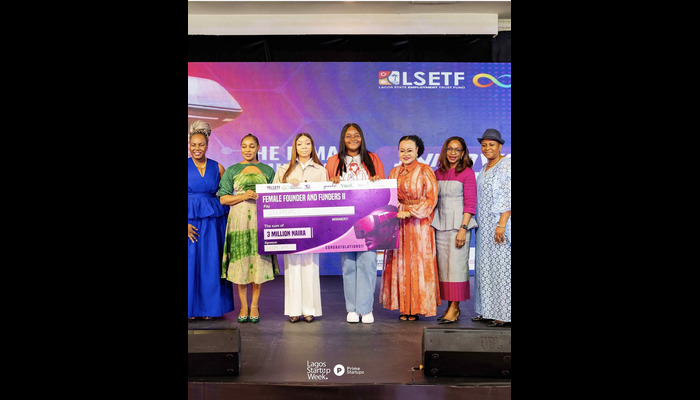
Wakamedics, a mobile fertility clinic founded by Victoria Duru has emerged as winner of the flagship pitch competition at the Female Founders and Funders Demo Day, held during the 10th anniversary of Lagos Startup Week.
The demo day hosted by the Ministry of Wealth Creation in partnership with Lagos state employment trust fund (LSETF), GIZ and other stakeholders, praised the startup for its social impact, affordability, impact of females and grassroots strategy.
The event underscored a resounding message that women are not just participants in Nigeria’s innovation economy but are essential partners.
Duru’s innovative approach to fertility care for underserved women earned her the top spot, edging out other startup entrepreneurs in education, transport, health, and sustainable fashion.

“I resigned from my job just to have a child”, she shared emotionally during her pitch. “Like myself, 30 to 50 percent of women trying to conceive are going through depression and pain”.
”That personal experience birthed Wakamedics, Nigeria’s first mobile fertility clinic aimed at democratising access to fertility diagnostics and care”.
Read also: Here are Nigeria’s top 5 most funded agtech startups
Breaking barriers in fertility health

According to Duru, Wakamedics offers mobile diagnostic services, fertility education, and telemedicine support targeting low-income and remote communities.
She noted that it delivers services at a fraction of the cost charged by conventional fertility clinics through partnerships with naturopathic clinics, community nurses, churches, and grassroots health workers.
“We want more women to achieve pregnancy on their own through knowledge, community, and early diagnostics,” Duru said.
“Wakamedics’ goal is to reach 5,000 women by 2027, starting with Lagos and Ogun States”, she noted.
Other startups delivered impressive pitches addressing pressing societal challenges. They are:
VarsityScape, founded by Grace Idiare which is a cohort-based EdTech platform addressing Nigeria’s higher education bottleneck. VarsityScape helps organisations deliver practical, future-ready training. The startup aims to onboard 500 academies and 100,000 learners, monetising through subscriptions and transaction fees.
“We’re not telling young people to skip university. We’re helping them gain market-relevant skills—and even helping universities reach more students”.
Autogirl, by Chinazom Arinze touted as Nigeria’s ‘Airbnb for Cars’, is a digital vehicle rental marketplace enabling individuals and businesses to rent idle cars for income.
Through its Auto Women Empowerment Programme, it has trained women as mechanics and drivers, actively tackling gender gaps in the automotive sector.
Hub pharm Africa, by Temitope Kareem is a healthtech platform offering personalised chronic care management using AI. It connects patients with pharmacists, doctors, and mental health professionals, especially for rare or hard-to-source medication. The startup runs a subscription model and partners with HMOs with a goal to reach remote areas in Africa.
The other is Zibima, founded by Fatima Yusuf, a sustainable fashion brand which recycles waste materials into multifunctional footwear and clothing. Zivima has trained over 370 African women, sold to eight countries and grown profit margins from 15 percent to 55 percent as part of its eco-conscious entrepreneurship.
Read also: FCMB commits to flexible financing for small businesses
Driving inclusive innovation and leadership in Nigeria
Held under the theme, ‘Driving Inclusive Innovation and Leadership in Nigeria’, the forum brought together policy makers, funders, and ecosystem leaders to reflect on the structural shifts needed to advance female entrepreneurship.
Ashley Emanuel, COO of Semicolon and a programme supporter, emphasised the urgency of changing the status quo:
“There’s a problem, women are still underrepresented as founders, investors, CTOs. Until we fix sexism, support programmes like these remain critical.”
She urged female entrepreneurs to embrace visibility, “You are the role models be visible and change the narrative for those who come after you”.
Mope Abudu, investor and programme partner, highlighted the need for merit-based access not tokenism, “This is not about ticking boxes. It’s about being in the room because your ideas and innovations earn you a place there”.
She called on local investors especially women, to back female founders, saying, “African capital must rise to support African innovation”.
Read also:Adtech startup visits ARCON, seeks support to revolutionize advertising
Representing GIZ Digital Transformation Centre, Gbeke Oshinowo described the initiative as a bold step toward digital and gender equity aligning with GIZ and EU gender strategies. She noted that the programme had supported 17 female founders and 22 aspiring funders.
Lagos state creating a supportive ecosystem for startup founders
Pedro Adebajo, acting board chair of LSETF described Lagos as a city of over 20 million where traditional employment cannot do it alone. She reiterated the state’s ecosystem approach of funding, training, networking and mentoring.
The speakers agreed that the world of investment and technology is not a man’s world but battleground of ideas where brilliance knows no gender, therefore inclusive innovation is not just an ideal but an imperative.
According to the Oyinkan Osiyemi of the Ministry of Wealth Creation, “Through women and youth-centered policies of inclusivity, gender equality programs, we are committed to ensuring that every woman and every young person in Lagos can reach their full potential”.
“The Lagos State Government remains deeply committed to nurturing female-led innovations through Lagos State’s Employment Trust Fund, and other state-led platforms, we are intentionally removing barriers so that more women can access funding, build capacity, and connect with local and global markets”.
“We are building a future where women are not just participatory in the economy, but active partners in our economy”.