The Federal Government has issued a seven-day ultimatum to traders operating under the Iddo Bridge in Lagos to leave the place, citing severe safety concerns and structural deterioration of the bridge caused by their activities.
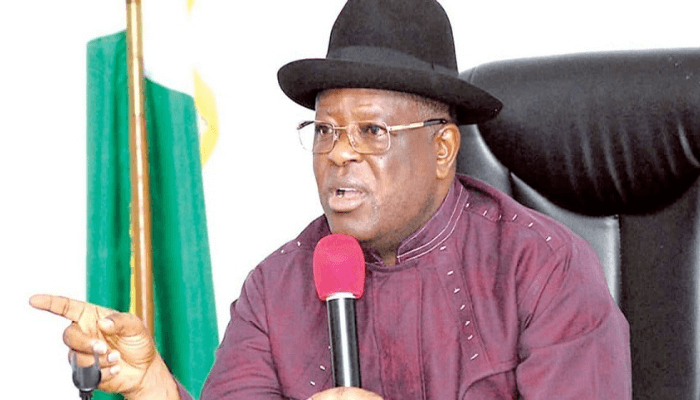
David Umahi, the minister of works, gave the directive during an on-the-spot inspection of the bridge on Wednesday, warning that no relocation plans would be made for the affected traders.
Umahi stated that such illegal activities, which include storage and sale of inflammable chemicals, has resulted in fires and structural damage to the bridge.

“They are destroying the bridge, and you are talking about moving them? If You move them, other people will go and burn another bridge so that they will be moved,” the minister said.
He said the same evacuation order would be extended to other bridges across Lagos where similar trading activities take place.
The Iddo Bridge rehabilitation, awarded to Julius Berger in 2024 for approximately N5 billion, has encountered delays, partly due to structural impairments caused by human activities. Umahi disclosed that trucks with excess height have damaged the bridge deck due to low headroom, while activities from makeshift shops have further compromised the structure.
“A section of this bridge had a headroom of about 3.0 meters, as against the 5.6 meters minimum that is allowed,” he said. “We have a lot of big trucks hitting on the deck, which is very dangerous, and it poses a lot of problems to the structural integrity,” he added.
Despite these constraints, Umahi affirmed that the bridge’s core structural elements remain intact. “It’s only the cover to the structural elements that are affected. The structural elements’ integrity are quite there and are very high,” he assured.

Read also: FG to close down Marine Bridge for 60 days
He announced that milling of the bridge deck would occur only on weekends—Fridays through Sundays—to reduce traffic disruptions. Installation of expansion joints, however, will necessitate night-time weekday closures. Umahi directed Julius Berger to submit a revised method statement and closure schedule, which will be communicated within, at least, seven days’ notice to the public.
The minister firmly ruled out any review of the contract sum, saying, “they must know that I’m not going to change the rates because it’s been long we mobilized them, and we expected the job to have finished.”
To resolve the height clearance issue, the ministry plans to excavate road sections to achieve the required 5.6 meters headroom, alongside the installation of speed humps and reflective warning signs.
The inspection team proceeded to Marine Bridge, also known as the Ijora Marine-Apapa Link Bridge—where further safety-critical repair works are scheduled.
Controller of Works in Lagos, Olukorede Kesha, explained that ongoing repairs would replace 50 defective expansion joints and bearings over a two-kilometre stretch of the bridge. She outlined diversion plans for both light and heavy vehicles, urging articulated trucks to avoid the repair zone entirely and use alternative routes via Costain and Iganmu.
Umahi, in response, confirmed the ministry’s approval for full closure of the Marine Bridge for 21 days to allow for the safe lifting of bridge spans for bearing replacement. “This is not just about the surface; we’re lifting an entire span, some up to 50 meters long—to change bearings that are over 450 kg in weight,” he said, adding, “if it weren’t that serious, we wouldn’t advocate for a full closure.”
Read also: Lagos Govt. threatens to demolish illegal structures on highbrow Banana Island
He stressed that the closure must be preceded by clear public communication: “We must announce the date of closure, deploy a detailed method statement, provide a traffic diversion drawing, and offer contact lines for public engagement. This is a civilized society; we respect Lagosians.”
Umahi praised Julius Berger’s technical expertise, particularly in delicate infrastructure works like those on the Eko and Marine bridges. He revealed that similar assessments would be conducted at the Independence Bridge, adding, “if I find no structural defects, I will declare it a permanent work.”
The Minister said the nature of future maintenance would determine whether full or partial closures are necessary. “Some maintenance can be done without closing roads. Others, like this, require full access to key elements,” he explained.