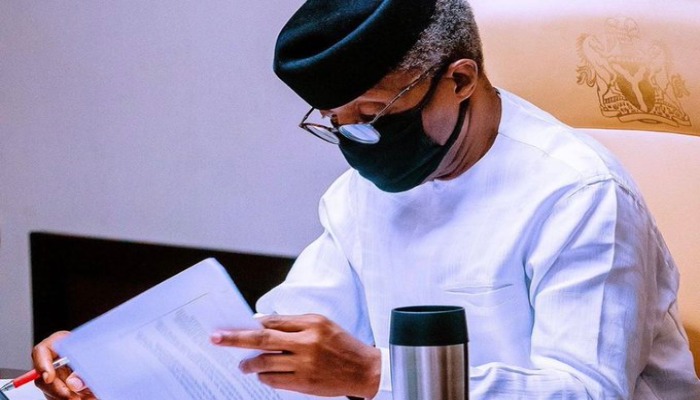
Vice President Yemi Osinbajo has called on the international community to work together to solve the issues of secret corporate ownership and the whole issue of beneficial ownership, which he says aids corruption and illicit financial flows
Osinbajo speaking at a global webinar with the theme “. Combating Corruption and Illicit Financial Flows New Measures and Strategies”, said “corruption remains a scourge to our development aspirations and has become for us in the developing world, an existential issue”
The Vice President who advised that the war against corruption must be democratized added that “Many of our citizens are interested in the fight against grand corruption.
“Grand corruption as you know cripples the economy. But they also want to see action in what would be regarded as petty corruption – in their interfaces with government officials either in the search for certifications, approvals of any kind, licenses, and all of that. Many want to see that corruption at that level is tackled effectively. And I think that we must begin to look at innovative ways of doing so”
He declared that breaking the wall of secret corporate ownership is crucial “because secrecy around corporate ownership is implicated in our underdevelopment. Although anonymous companies are not always illegal, nevertheless secrecy provides a convenient cover for criminality and corruption”

The Vice President said Nigeria’s experience shows that anonymous corporate ownership covers a multitude of sins including conflict of interests, corruption, tax evasion, money laundering, and even terrorism financing.
READ ALSO: Osinbajo inaugurates Eko fashion cluster for MSMEs
At the May 2016 London Anti-Corruption Summit, President Muhammadu Buhari committed to establishing a public register of the beneficial owners of all companies operating in Nigeria.
Following that commitment, Nigeria joined the Open Government Partnership (OGP) in December 2016 and subsequently submitted a National Action Plan prioritizing the establishment of an all-encompassing and publicly accessible register.
Since then, Nigeria has been working on the process of amending its corporate law to implement these measures and mandate the disclosure of beneficial interest in a company’s shares and prescribe punitive measures for failure to disclose.
He, however, warned that the country must be mindful of the challenges dogging advocacy for stemming IFFs, promotion of asset recovery and return to victim countries, and enforcement of beneficial ownership disclosure not just in our country but globally.

“We note, for example, the resistance of some countries to stemming illicit financial flows, curbing tax evasion, support asset return to countries of origin and we note that laws passed in some developed countries to mandate beneficial ownership disclosure do not set examples for best practice as they do not cover territories and dependencies where most of the stolen assets from developed countries end up.
“I sincerely hope this regional webinar will advance the advocacy further and bring up innovative solutions to these internationally shared concerns.
Osinbajo noted that there is no magic bullet to ending corruption, stemming IFFs or promoting asset recovery and return.
“We simply must work hard at it and be determined to succeed. We must make corruption expensive for those who engage in it and send the unequivocal message that corruption simply does not pay.
“We must also make all members of the international community see the benefit of shared prosperity and inclusive growth and development. It is the unenviable but noble task of ICPC and other anti-corruption agencies to make corruption unattractive to its disciples and facilitate new approaches to stemming IFFS and promoting asset recovery and return.
READ ALSO: COVID-19 has made Nigerians extremely poor- Osinbajo
“As you ruminate on the key issues to dominate the UN General Assembly Special Session on Corruption in 2021, I urge you to come up with concrete proposals for Nigeria to take to the UN and also for all of our colleagues in the region, to take to the United Nations to begin to positively shape policy in a way and manner that best promotes the interest of our country and region.
He also called for the protection of “whistle-blowers – persons who come forward with information against corruption. We must protect those who are ready to fight against corruption and who are prepared to do so without necessarily disclosing their identities and even those who are ready to disclose their identities.
“The thing that we must take note of is that corruption fights back. And it is fighting back and it has the resources to do so.
He noted that unscrupulous individuals are paid to use social media platforms to make outrageous allegations against persons perceived to be fighting corruption.
“The technique is not new, the idea is to tie everybody with the same tar so that you cannot recognize the truly corrupt or the truly corrupt activity, and the genuine whistle-blowing is discredited as a result. And because our court system is slow, they count on the possibility that these victims may not pursue litigation or prosecution: you must devise a new legal strategy to ensure that this dirty trick not only fails but are penalized.
“The fight against corruption is nuanced and hydra-headed, it is not going to get easier by the day, as a matter of fact, it will get more difficult by the day and many will become discouraged in standing up against corruption. But it is our duty both as individuals and institutions especially in developing countries where corruption has such a devastating effect, to ensure that we prioritize the fight against corruption and continually device new ways and new approaches even as the hydra-headed problem itself continue to manifest in different ways.”