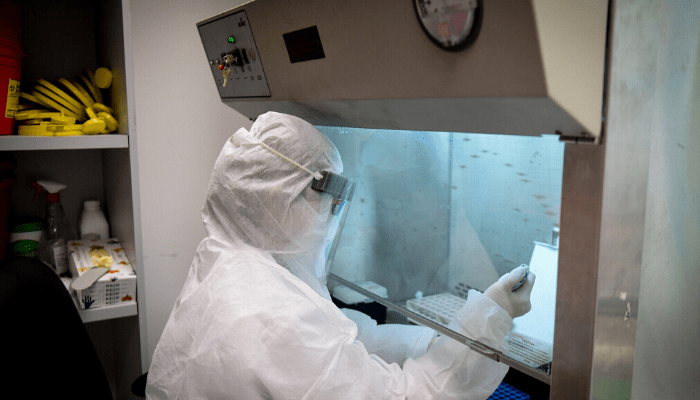
The Nigerian Centre for Disease Control,(NCDC) said it now has the capacity to test 3000 cases per day as it improves sample collection through 20 health care facilities in Lagos, in partnership with the Lagos state government. The goal is to increase the number of tests conducted daily for the novel coronavirus, COVID-19 across the country.
Chikwe Ihekweazu, the director general of the NCDC said this during the Presidential Task Force press briefing in Abuja on Wednesday.
“We are really trying to change our strategy and test more people. The testing capacity in our labs have increased and the bottleneck now is getting the samples from the right people.”
Ihekweazu said the need to address this bottleneck informed the decision to set up the facilities in Lagos. He also informed that active case search is ongoing in Lagos and Abuja to collect samples from people with respiratory infection.
Twenty healthcare facilities have been set up in Lagos to collect samples of people with acute respiratory symptoms. The director general also noted that most of the capacity to conduct 3,000 tests will be focused on Lagos and Abuja where efforts are being made to get more people tested.

Ihekweazu also said the agency would publish Wednesday its short to long-term testing strategy.
Read also: COVID-19: Abians urged to follow NCDC instructions to prevent spread of virus in state
“We are going to introduce all of that and make it completely public so that people can understand what to do and what the bottlenecks are.”
He further stated that surveillance is being intensified in various healthcare centres and hospitals around Lagos and the Federal Capital Territory to collect samples of people with an acute respiratory infection, adding: “In Abuja, in certain communities we are going door to door to collect samples of people that have acute respiratory infection, we are also doing this in Lagos.”
Patients with acute respiratory symptoms were advised to call the agency. “Call centres have improved dramatically,” said Ihekweazu.
Speaking on the global shortage of personal protective equipment (PPE) like masks he noted that healthcare workers would get priority while pointing out that the scarcity was an opportunity for local manufacturers to scale their production capacity in response to the health and economic problem the crisis had presented.
Ihekweazu expressed regret that the government cannot supply masks to everyone in Nigeria right now, but will prioritise health care workers.“Everybody is looking for the same thing. The world was not prepared for a pandemic of this scale, so we have to prioritise a certain part of our population,” he said.

Speaking further he said, “A lot of the Personal Protective equipment are produced in the countries that need it themselves. Some countries have banned the exportation of some of these PPE. So the demand is very high, even with a lot of resources so many countries cannot meet up with the demand.
“We are looking for local manufacturers of some of these equipment. Every hand sanitiser procured by the government is manufactured locally. There is an opportunity for the industry to scale up their production of masks, and protective equipment as long as it meets safety requirements that we have.”
In every crisis there is an opportunity to really scale up. I have a feeling that the need for PPE has come to stay and if you develop a production line there, a health and economic problem would have been solved.
On NCDC’s newly published guidelines on use of face masks, the Director General further recommended that the general public use improvised cloth masks rather than a medical mask. He however, advised that every cloth mask be washed at least once a day and guidelines on its use be strictly followed.
Osagie Ehanire, Minister of Health while during his briefing said that previously, only contacts of confirmed cases, people with travel history exhibiting respiratory symptoms could be tested. The minister had said the reason was due to the scarcity of reagents.
Ehanire informed that all persons with fever and respiratory infection of unknown cause can also be tested. And urged all persons fitting in the case definition to wear marks, isolate themselves, call the NCDC toll free lines and comply with invitation for testing and isolation.