Nigeria’s listed sugar sweeteners spent over 70 percent of revenue on direct cost mid-year 2019, with top-line and input costs expected to remain pressured going forward on continued smuggling and possible higher raw sugar prices.
A dive into earnings scorecards of listed players – Dangote Sugar Refinery Plc and McNichols Plc, revealed that these firms have been grappling with higher costs over the years, with mid-year direct cost margin averaging 75 and 80 percent respectively, in the last five years.
Expressed as a percentage, direct cost margin indicates what portion of each revenue naira accounting for only those expenses incurred for production of goods and services.
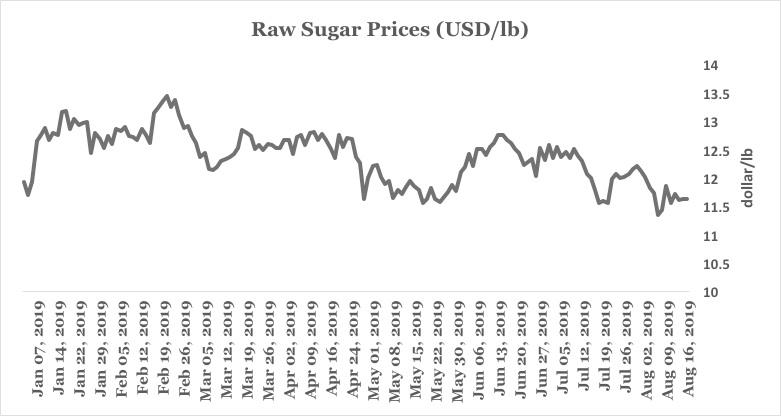
Both companies saw contraction in cost of sales in the review period, thanks to relative stability in raw sugar prices that traded within the band of $11.55 and $13.44 per bushel (lb.) in the period. Raw sugar prices/lb. up 9 basis points to $11.64 last Friday, according to data sourced from Bloomberg.

But a deeper look into the numbers showed the industry leader – Dangote Sugar- direct cost jumped 13 percent in second quarter of the year impacted by higher raw materials amid stable sugar prices, while McNichols in similar quarter had some 21 percent cut.
“We anticipate cost pressure will remain given expected increase in raw sugar prices,” said analysts at Lagos-based CSL Stockbrokers in a note to clients.
According to them, sugar prices will trend upwards for the rest of the year due to cuts in supply from major producers like Brazil as they now divert capacity into production of Ethanol due to better margin.
The Nigerian sugar industry is an oligopolistic market dominated by three players – Dangote Sugar Plc, Golden Sugar Limited and BUA Sugar Limited with a total refining capacity close to 2.8 million metric tonnes (MMT).
Despite over 50 years of existence, the industry is stuck at infant stage, supplying less than seven percent of national demand, according to estimates by USDA Foreign Agricultural Service (FAS).

The 10-year National Sugar Master Plan (NSMP) drives the country’s sugar industry, aiming to locally produce about 1.79 MMT of sugar by 2020
The plan, approved in 2012, is meant to facilitate Nigeria’s domestic sugar production, predicated on backward integration programme (BIP), import regulation via quota and granting fiscal incentives to players.
However, Nigeria’s government policies such as NSMP designed to boost domestic sugar output is somewhat ineffective as the country still relies on major suppliers such as Brazil, United States and Thailand to meet local demand.
The country imported about 1.6 MMT of raw sugar from major producers in 2018 according to figures sourced from USDA FAS, with local production of about 80, 000MT way below 1.7MMT domestic consumption level.
The government’s backward integration programme (BIP) for sugar cane production is marred by weak infrastructure, poor policy formulation as well as implantation, limited funding and insecurity in some sugarcane producing areas.
In addition, high transport and production costs for hauling harvested sugarcane to the mills, coupled with low capacity building are set-backs.
The issue of land acquisition has also been a threat to domestic sugar production expansion. Sugarcane farms are transitioning into residential housing developments, which experts say is making it difficult for private investors to acquire lands for sugar processing facilities.
Smuggling along Nigeria’s porous border, flooding and insecurity in raw sugar producing regions, collapsing infrastructures and logistic turbulences staged by Apapa Gridlock dampens growth prospects of sugar makers.
Perhaps, if Nigeria’s Central Bank doubles efforts in its fight against smugglers it may provide respite for players struggling with weaker margins and dwindling profit.
Sales proceeds of Dangote Sugar, the country’s largest processor with over 70 percent market share, dipped 4 percent half-year 2019, while that of McNichols plunged 17 percent.
Analysts say revenue growth concerns will linger going forward, dampening full year outlook of industry listed players.
While shares of McNichols has gained 4.3 percent since January, Dangote Sugar hard hit by market rout, has shed 37 percent year long, underperforming the Lagos equity index has returned 14 percent losses.
The sugar industry is growing albeit lower pace and sub-sectors that rely on the industry for inputs are positioning themselves to meet growing demand, driven by population growth and increasing-middle class for consumer-oriented staples.
Israel Odubola