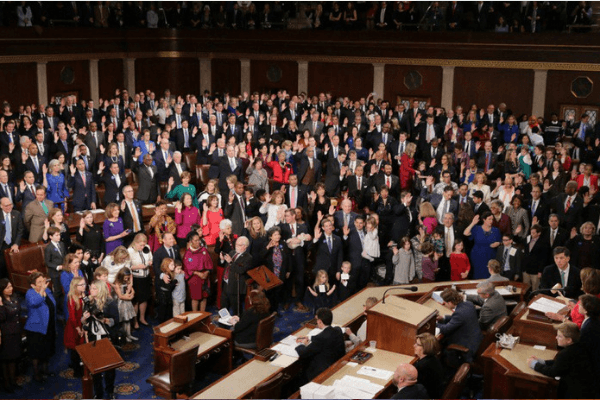
Nancy Pelosi reclaimed her role as speaker of the US House of Representatives on Thursday, as the new Democratic majority passed funding bills aimed at ending the partial shutdown of the government, but without money for a wall that Donald Trump has insisted is needed to end the impasse.
Ms Pelosi declared she would not hand the president any new money for his border wall and refused to rule out impeachment proceedings. Addressing the new Congress, she pledged to reach across the aisle to Republican lawmakers.
She said Democrats were offering Republicans — who still control the Senate — budget legislation to reopen the government, which would both “meet the needs of the American people” and “protect our borders”.
The US government remained partially shut for a 13th consecutive day on Thursday after the White House and Congress last month failed to agree on a bill to renew government funding.

The budget appropriations legislation passed on Thursday evening appears unlikely to be picked up by the Senate, where majority leader Mitch McConnell has stated that the upper house will not bring any legislation to the floor until the White House and Democrats agree on what is acceptable to both parties.
In an interview with NBC’s Today Show that aired earlier on Thursday, Ms Pelosi repeatedly insisted that any funding bill that included additional money for Mr Trump’s wall was a non-starter. “Nothing for the wall,” she stated firmly.
Like Ms Pelosi, Mr Trump has shown no signs of caving on his demand that any bill must include significant funding for a border wall, or at least steel slats. On Thursday afternoon, the president made a brief surprise appearance in the White House briefing room flanked by homeland security officials — the first time he had appeared at the briefing room podium.
Mr Trump, who did not take questions, congratulated Ms Pelosi and suggested the relationship between the White House and the new Democratic House speaker would be “a little bit different than people are thinking”.
However, he also insisted there would need to be funding for a wall, or at least a “barrier” of some kind. “You can call it a barrier. You can call it whatever you want,” the president said, adding that he had never seen as much support for his stance on border security as he had in the past week.

Ms Pelosi said: “I pledge that this Congress will be transparent, bipartisan and unifying.” In a speech that quoted Republican hero Ronald Reagan and paid homage to former Republican president George HW Bush, she added: “[We] will seek to reach across the aisle in this chamber and across the divisions in this great nation.”
Ms Pelosi’s return to leadership and Democrats’ control of the House marks a major turning point for Mr Trump’s relationship with Congress and the White House’s ability to push through legislation. It also marks the first time that his White House is likely to face significant congressional investigations as Democrats now control House committees with subpoena power.
While Ms Pelosi has previously played down the possibility of Democrats initiating impeachment proceedings against Mr Trump, saying as recently as this summer that impeachment was “off the table”, on Thursday she appeared less certain on the issue.
Asked on NBC whether she was willing to rule out impeachment, Ms Pelosi did not say no.
“We have to wait and see what happens with the Mueller report,” she said. “We shouldn’t be impeaching for a political reason and we shouldn’t avoid impeachment for a political reason. So we’ll just have to see how it comes.”
She said that indicting a sitting president, legally, was still “an open discussion”.
The new session of Congress will test Ms Pelosi’s control of the Democratic caucus, which includes the most diverse cohort of new Democratic lawmakers in history, with a record-breaking number of women and people of colour.
Among the new members are a tightly knit group of progressives led by Alexandria Ocasio-Cortez, the 29-year-old representing parts of the Bronx and Queens boroughs in New York City, who have demanded that party leaders take a stronger stance on issues such as climate change and do more to reduce income inequality and expand social benefits.
Already, there are faultlines forming within the party. Ahead of the new Congress being formed, at least two Democrats — Ms Ocasio-Cortez and Ro Khanna of California’s Silicon Valley — said they were prepared to vote against their party’s House rules package, which mandates that any increase in spending must be paired with either a matching increase in revenue or cuts elsewhere.
Ms Ocasio-Cortez and Mr Khanna have argued that those rules would damage Democrats’ ability to implement favoured social programmes such as “Medicare-for-all” — an assertion that allies of Ms Pelosi reject.
In her remarks to Congress, Ms Pelosi appeared to address this group of new lawmakers directly, crediting the incoming group of lawmakers with revitalising the Democratic caucus.
“When our new members take the oath, our Congress will be refreshed, and our democracy will be strengthened by the optimism, idealism and patriotism of this transformative freshman class,” she said.