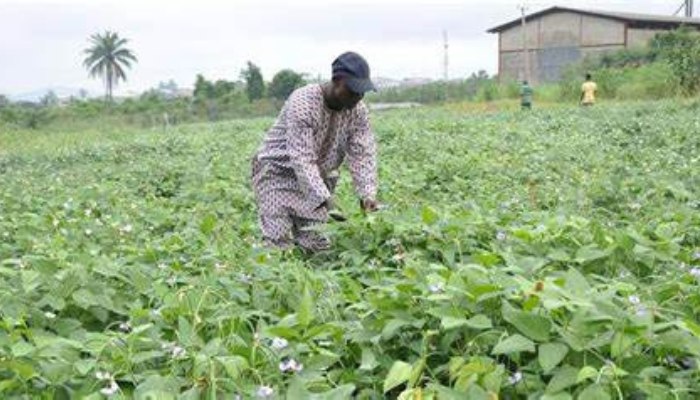
Experts in the country’s financial sector have hinged low agricultural productivity to inadequate finance for smallholder farmers in the country.
The experts who are from various Microfinance banks in the country made this known at a one-day symposium with the theme, ‘Serving the Agricultural Sector Through Micro-Banking’ also called for increase in budgetary allocation to the sector.
The experts noted that the increase in allocation would enable the government set aside funds in Microfinance banks to fund rural farming.
Some of the experts include Godwin Ehigiamusoe, founder and managing director of LAPO Microfinance bank limited, Rogers Nwoke, managing director and chief executive officer of Hasal Microfinance bank limited, Taiwo Joda, managing director and chief executive director of Accion Microfinance bank limited and Akin Lawal, managing director and chief executive officer of Nigerian Police Force Microfinance bank Plc.

The experts opined that agricultural activity which is the mainstay of the rural dwellers economy will remain unproductive to contribute meaningfully to food security if not adequately funded.
In his remark, Rogers Nwoke, who is also the national president of Nigerian Association of Microfinance Banks lamented that the sum of N220 billion initially set aside to Microfinance bank was however allegedly diverted to empower Micro, Small and Medium Enterprise (MSMEs) in the country.
He however urged the federal government to restate the N220 billion funds and refocus it to Microfinance banks as rural agricultural scheme to enable it lend more to rural farmers.
He said in 2012, Hasal Microfinance bank spent about 27 per cent of its portfolio on agriculture, and that the money would have been lost if not for the funding from the now defunct Millennium Development Goals.
Nwoke noted that Microfinance banks are willing to lend to farmers but they are however constrained by paucity of funds.

On his part, Taiwo Joda of Accion urged the central bank of Nigeria to increase its funding to agricultural sector. He opined that for agriculture to grow and improve in the rural areas there must be proper financing by the Microfinance banks.
He also advocated that the agricultural value chain must be broken down in departments of agriculture must be properly financed.
In his contribution, Godwin Ehigiamusoe, the founder and managing director of LAPO Microfinance bank, said Microfinance banks as a pro-poor financial institutions must invest in the rural economy where agricultural is the major occupation.
Ehigiamusoe, who listed some of the challenges militating against agricultural financing in Nigeria to include inadequate value chain financing, lack of agricultural insurance cover for farmers, interference and low pricing as well as low rotation of invested capital.
He however, called for the establishment of agricultural, lending structure.
The LAPO managing director recommended for institutional commitment, deepening the insurance services, greater engagement between the MFBs and the CBN development officers at the state level as solutions to the challenges.
He also recommended for the digitalisation of the delivery processes, strengthening the Agricultural value chain, continuous capacity building as well as involvement of agriculture cooperatives.
Also, Micheal Marx, long term expert, AFOS Foundation- Germany, urged the Central Bank of Nigeria to increase the loan ceiling for Microfinance banks from N500,000 to N10 million to compensate for inflation and allow for financing of farmer groups and value chain operations.
Marx, also want the central bank to offer refinance for term loans for one to three years in Naira to Microfinance banks to enable it lend for small equipment, without policy strings attached as well as to request Microfinance and Microfinance institutions to express their interest rates and charges as annual percentage rate.
IDRIS UMAR MOMOH, BENIN