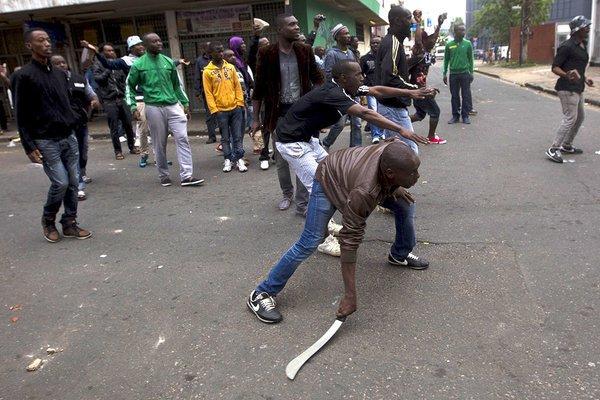
As discussions on the perennial xenophobic attacks against other Africans in South Africa continue across the continent, particularly in Nigeria, some observers say a very salient but inaudible factor fuelling the hatred is the culture of laziness among most Black South Africans living in the suburbs of the Southern African country. These Black South Africans who live in abject poverty, the observers say, are enraged by the opulent lifestyle displayed by foreigners, especially Nigerians.
The latest xenophobic attack on foreigners, particularly Nigerians, was preceded by the alleged extrajudicial killings of 20 Nigerians by yet-to-be-identified South African policemen in 2016, according to Abike Dabiri-Erewa, senior special assistant to President Muhammadu Buhari on Foreign Affairs and Diaspora.
“The latest gruesome killing of Tochukwu Nnadi by Police in South Africa is unacceptable to the people and government of Nigeria. The barbaric behaviour of the perpetrators is not only worrisome but unacceptable. This is a call for urgent attention by diplomatic authorities in Nigeria and South Africa,” Dabiri-Erewa said early January.
“The killing of Nnadi had brought to 20 Nigerians killed in South Africa through extrajudicial means in 2016 alone,” she said.
But Noah Ihiminre, a Nigerian living in Soweto who is currently holidaying in Edo State, told BDSUNDAY that if Nigerians are being mercilessly attacked in South Africa, they should share the blame since most of them like to deliberately flaunt wealth to intimate their hosts, who are already frustrated by high cost of living.
“You know most Nigerians like to announce themselves wherever they are; but sometimes that is difficult to help because Nigerians are very smart and they like to work hard for good living and South African ladies like that. If you go to the suburbs where these attacks are happening, Nigerian guys are the big boys there, with South African ladies now preferring them,” Ihiminre said.
“But some Nigerians are not humble in their relationship with host communities. Sincerely speaking, some Nigerians have no respect for even fellow Nigerians, all because they are living very well, forgetting that their uncontrolled lavish lifestyle is provoking hatred. I think if Nigerians in these areas learn simplicity and generosity, it will really go along away in minimizing the hatred,” he said.
He explained that the xenophobic attackers are ignorant of the contributions of Nigeria to the South African economy, arguing that if they had the slightest idea about it, there was the possibility that things would play out differently.
About 150 South African business organisations are currently operating in major sectors of the Nigerian economy.
Omonze Osemhenkhian, a Nigerian lady who lives in South Africa, however, told BDSUNDAY on phone that it would be unfair to ask Nigerians not to enjoy the labour of their hands simply because they are in a foreign land where doing so could spark envy and hatred, and even death.
“Some Black South Africans are really lazy; they like idling away. Do Nigerians stop them from working hard and living comfortably? Why blame Nigerians if your ladies find Nigerians more caring and opt for them?” she asked.
“Mind you, Nigerians are ready to do dirty jobs to make money. These category of South Africans simply can’t stand the audacity and tenacity of Nigerians living in their midst. They see Nigerians as threat because they have come to challenge their laziness. Nigerians engage in all sorts of artisan and menial jobs. They should work hard as Nigerians and stop the unnecessary hatred and killings,” she said.
Some Nigerians also blame the South African media for not reporting on Nigeria’s role in ending apartheid in the South Africa and also not doing enough in giving the citizens right information about Nigeria. With the type of news being spread, they said, most of the South African citizens have the impression that Nigerians are criminal who do not deserve to be treated with mercy.
For Vince Onyekwelu, a former British Police officer who lived and studied in South Africa, Nigerians living there must be ready to pay extra to live in urban areas rather than seeking accommodation in poor communities and ending up being attacked in such areas.
“I know things are tough. It is not easy to survive in South Africa. Unlike in Lagos and in Abuja where you have to compete with fellow Nigerians, over there you have to compete with Ghanaians, Congolese, black and white South Africans, and even fellow Nigerians.
“But when you stay inside the cities, you get a lot of protection. The police can come there to save you. But if you prefer to live in the suburbs of Pretoria, for instance, these are locations where a lot of people are not economically vibrant and then you find issue of jealousy because a foreigner just arrived few years ago and now has got a car or a barber shop. They want to find out why they that have been living in the country for over 30 years have none of these things. The dangers are there. When you compare the value of life with trying to save money by living in vulnerable areas, it is profitable to spend few more money. You can share a flat with another Nigerian.
“Nigerians in South Africa need to communicate more. The Igbo, the Yoruba, the guys from Edo, all have their state or town unions. So, they should continue to champion those unions to help one another when problem arises. When a Nigerian is arrested, it is the duty of these unions to find out why and sort out the problem. They must communicate and stay together.
“Yes, some foreigners commit crime and it is annoying when foreigners come to your country and try to mess it up. But the percentage of foreigners committing crime in South Africa is small. When you look at the percentage of Nigerians in South Africa who are doctors, engineers, teachers and nurses, you know that they are largely responsible professionals. But the fact that somebody is committing crime does not give you a right to take his life. Take the case to the police,” Onyekwelu said in a television programme monitored in Lagos.
He also debunked the allegations in some quarters that the South African Police (SAP) is not swift enough in responding to distress calls, arguing that the country’s police officers are highly trained and very professional.
“The South African police officers are also well equipped and they have the highest of the quickest response to crime. When it comes to Africa, the South African police is tops. When you call a police in South Africa within 5-10 minutes you can get a good response. They still have 111 as response number, unlike Nigeria where there is no such thing,” he said.
“Yes, we saw images where police officers were laughing when shops are being looted; that is unprofessional and saddening. But for someone to say SAP in general are not doing a good job, I will say no. Look at the level of violence and the people that were killed, compared to what happens in Nigeria even in peaceful protests where people are shot dead with live ammunitions,” he said.
Nigerian federal lawmakers who are angered by the xenophobic attacks against Nigerians have already threatened reprisals should the attacks continue, while berating the executive arm of government for not engaging the South African government seriously.
Trade Union Congress of Nigeria (TUC) has also expressed concern over the attacks, calling on the Nigerian government to immediately evacuate Nigerians to prevent further killings.
Speaking also on a television programme monitored in Lagos, Ikechukwu Anyere, president, Nigeria Union in South Africa, explained that during the last xenophobic attack mechanic workshops and the houses where the mechanics live were burnt down and property looted by the attackers.
“The latest attack that started last Sunday continued throughout the night; but it is important to note that this is no longer xenophobic because these people come in the night. If it is xenophobic or a protest at least, it should be done in the day; but they now go out in the night to loot shops. Most hoodlums here are criminals, but the police, from all indications, are on top of it. They are keeping law and order in the areas. To be honest, people are still going about their business, but there is still tension,” he said.
Reuters reported that about 100 shops were ransacked in Johannesburg overnight in the latest attack and looting incidents in South African cities. Doors and windows were smashed, and food and other items were strewn on the floor in stores believed to belong to immigrants in Jeppestown, an area in the central business district.