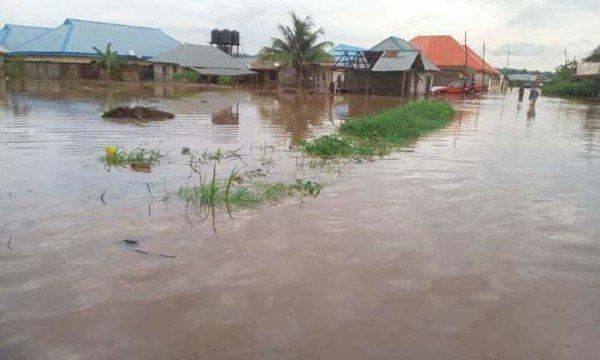
Rapid urban growth in Ajegunle-Ikorodu, a community in Lagos’ Agboyi-Ketu Local Council Development Area, has increased flood risk and weakened natural environmental protection, researchers at the University of Lagos have said.
A study presented this week shows that built-up areas in the community expanded by more than 500 percent between 1999 and 2022, while vegetation and water bodies steadily declined.
The findings were presented during a stakeholder consultation hosted by the Centre for Housing and Sustainable Development (CHSD) at the University of Lagos (UNILAG).
Researchers said the changes have left the low-lying community more exposed to flooding, extreme heat and related health risks.

Read also: Abia begins construction of 10 kilometre underground canal to check flooding in Aba
“Ajegunle-Ikorodu has experienced rapid land use change over the last three decades,” said Peter Elias, co-director of CHSD, while presenting the report alongside Olusegun Adeaga, head of the university’s Department of Geography.
He said the community’s elevation makes it highly vulnerable to prolonged flooding, which can sometimes last two to three months.
Drainage systems built years ago were designed to handle short-term flood events and are now struggling to cope with increased runoff caused by expanding buildings and paved surfaces, the researchers said.
The consultation was part of an ongoing research project titled ‘Ajegunle-Ikorodu Action Research for Climate Resilience’, conducted in partnership with the African Cities Research Consortium (ACRC) at the University of Manchester.

Read also: Ogun, Lagos communities brace up for Oyan Dam flooding as rainy season approaches
The forum, held at the Arthur Mbanefo Digital Research Centre in UNILAG, brought together academics, climate experts, urban planners and civil society representatives to review the draft Climate Hazard and Vulnerability Assessment Report.
Researchers said residents have already begun to adapt to the changing conditions. Some households have raised structures on makeshift flood platforms, while others have tried to redirect water through informal canal channels.
But they warned that such efforts cannot replace proper planning and infrastructure.
Among the key proposals discussed were expanding drainage systems, restoring wetlands and mangroves to strengthen natural flood protection, and creating a community-run flood monitoring system that can track hazards in real time.
During a panel discussion, Olumide Idowu, founder of the International Climate Change Development Initiative, said climate challenges in urban communities require cooperation between government agencies, researchers and residents.
He also called for stricter control of construction in flood-prone areas.
John Adesina of the University of Lagos’ Department of Architecture said restoring damaged ecosystems could help reduce flood impacts in vulnerable communities.
Experts at the meeting said Ajegunle-Ikorodu now faces a critical moment, where better urban planning, stronger infrastructure and environmental restoration will be needed to reduce climate risks in the years ahead.