Strategic Newsletter
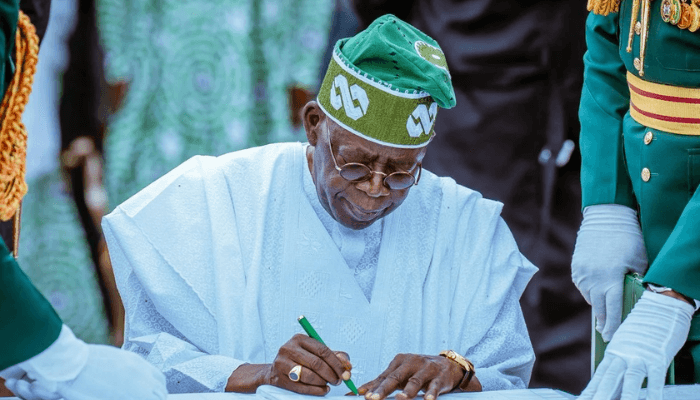
President Bola Tinubu, on Sunday, February 08, 2026, received a high-level delegation from United States Africa Command (AFRICOM) at the State House in Abuja, signalling a further deepening of security and defence cooperation between Nigeria and the United States.
The delegation, led by AFRICOM Commander General Dagvin Anderson, arrived at a sensitive moment in Nigeria’s counterterrorism campaign. It follows U.S. airstrikes against militant targets in Sokoto State in December 2025, the recent deployment of a small U.S. advisory team, and renewed concerns over Boko Haram-linked violence spreading beyond the North East into Nigeria’s North Central zone.
No dramatic announcements emerged from Sunday’s meeting. But the engagement signals something more consequential: Nigeria’s security fight is entering a more technical, intelligence-driven and internationally networked phase.

Read also: Navy deploys 328 US-trained marines to guard $16.6bn assets, boost Gulf of Guinea security
Who Was in the Room — and Why It Matters
President Tinubu was joined by National Security Adviser Nuhu Ribadu, Minister of Defence Christopher Musa, and Nigeria’s service chiefs. On the U.S. side were Chargé d’Affaires Keith Heffern and AFRICOM’s senior foreign policy adviser, Ambassador Peter Vrooman.
This was not a ceremonial courtesy call. It was a working-level strategic engagement involving those responsible for intelligence, operational planning and defence policy.
When service chiefs and foreign commanders meet in this configuration, discussions tend to centre on coordination frameworks rather than symbolism.

From Rome to Abuja
The meeting builds on earlier talks between Tinubu and General Anderson in Rome in late 2025, where intelligence cooperation featured prominently. Since then, the regional security environment has shifted.
On 3 February 2026, a small contingent of U.S. personnel arrived in Nigeria to provide what officials described as “unique capabilities”, including intelligence fusion and ISR — intelligence, surveillance and reconnaissance.
Though modest in size, that deployment marked a qualitative shift. It was not about increasing boots on the ground but about integrating sensors, analysis and operational planning.
Sunday’s meeting consolidates that trajectory.
The Sokoto Strikes and Their Signal
The dialogue also follows US kinetic strikes against militant camps in Sokoto on Christmas Day 2025. Those strikes disrupted insurgent networks and generated debate across West Africa.
Supporters viewed them as decisive actions against entrenched camps. Critics warned of escalation and sovereignty sensitivities. Either way, the operation altered the psychological terrain of the insurgency – signalling that remote sanctuaries were no longer beyond reach.
The Abuja talks suggest both governments are now focused less on episodic strikes and more on institutionalising coordination.
“U.S. officials continue to frame their role as enabling Nigerian forces rather than replacing them. The emphasis remains on Nigerian-led operations supported by ISR, training and technical assistance.”
What Was Discussed
Official statements confirm discussions centred on:
Counterterrorism cooperation
Regional stability
The evolving threat posed by Boko Haram and ISWAP
Intelligence sharing and operational integration
Absent were references to permanent basing or expanded combat roles.
U.S. officials continue to frame their role as enabling Nigerian forces rather than replacing them. The emphasis remains on Nigerian-led operations supported by ISR, training and technical assistance.
That distinction is politically significant in both capitals.
The Drone Refuelling Debate
Reports have surfaced that the United States has requested permission to establish a drone refuelling station in northeast Nigeria. While no formal confirmation has been issued, the proposal reflects the growing technological dimension of the partnership.
Such a facility would not resemble a traditional US military base. Rather, it would support long-range drone operations — potentially involving MQ-9 Reaper platforms — by extending mission endurance without permanent basing.
The logic is operational: persistent ISR coverage over remote forest corridors and border zones where insurgents move rapidly and exploit terrain.
In modern counterinsurgency, endurance and data persistence often matter more than troop density.
The Regional Logistics Architecture
Nigeria’s evolving cooperation should also be viewed within a broader West African framework.
Under the 2018 Defence Cooperation Agreement between the United States and Ghana, designated facilities at Air Force Base Accra and Kotoka International Airport were made available as “Agreed Facilities and Areas”. These support the West Africa Logistics Network (WALN), enabling deployment, training and equipment movement across the region.
This distributed-access model relies on smaller, flexible nodes rather than permanent large-scale bases.
Nigeria’s trajectory appears aligned with this approach — a light footprint but high technological integration.
Why ISR Has Become Central
Nigeria’s security history over the past decade reveals a recurring challenge: many attacks are preceded by warning indicators. The weakness lies less in detection than in speed.
The intelligence-to-action gap — delays between identifying threats and responding — has proved costly.
ISR assets compress that timeline. Persistent aerial surveillance, real-time data fusion and pattern-of-life analysis allow forces to:
Track militant movement
Identify staging areas
Disrupt logistics chains
Act before attacks materialise.
External support is therefore less about troop numbers and more about sensors, analytics and integration.
Sunday’s meeting reinforces that shift.
Sovereignty and Strategic Balance
Foreign military cooperation inevitably raises questions of sovereignty. Nigerian officials have consistently stressed that command authority remains national and that cooperation is partnership-based.
For Abuja, external support is acceptable only insofar as it strengthens domestic capability and preserves autonomy.
For Washington, Nigeria remains a security anchor in West Africa — a state whose stability influences the wider Sahel.
Maintaining a balance between assistance and independence will determine the durability of the relationship.
Read also: Nigeria, Israel pledge stronger partnership in security, health, technology
Three Emerging Trends
The meeting suggests three clear developments.
First, cooperation is becoming more technical. Intelligence fusion and ISR integration are now central to Nigeria–US engagement.
Second, Nigeria’s threat map is being reassessed. Violence extending beyond traditional insurgent theatres has prompted a nationwide recalibration.
Third, regionalisation is accelerating. Nigeria’s internal security challenges are increasingly seen within a broader Sahelian network of cross-border militant mobility.
Abuja is no longer just managing a domestic insurgency. It is operating within a regional security ecosystem.
A quiet but meaningful shift
The Tinubu–AFRICOM meeting did not produce dramatic headlines — and that may be deliberate.
Modern counterterrorism evolves through systems alignment rather than public declarations. Data-sharing protocols, ISR integration and command harmonisation often matter more than troop counts.
What Sunday’s engagement reflects is consolidation. Nigeria is not entering a new war. It is upgrading how it fights an existing one.
The success of this phase will depend on institutional absorption — how effectively Nigerian agencies integrate intelligence, accelerate response cycles and sustain professional standards under intensified operations.
Conclusion
Nigeria–U.S. security cooperation is moving into a more structured, technology-driven stage. The AFRICOM engagement confirms that the partnership is becoming systemic rather than episodic.
The stakes extend beyond immediate operations. The framework being shaped — centred on ISR, distributed logistics and intelligence fusion — could influence West Africa’s security architecture for years.
The challenge for Nigeria is to leverage enhanced cooperation while preserving strategic autonomy. The challenge for the United States is to enable it without overshadowing it.
The meeting at the State House may have appeared routine. Strategically, it signals a recalibration.
Nigeria’s counterterrorism fight is becoming faster, more integrated and more internationally networked.
And that marks a new phase.