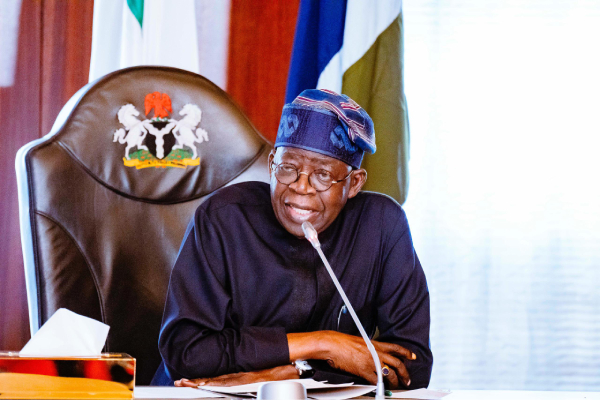
President Bola Tinubu on Wednesday raised concerns over Nigeria’s technological readiness for real-time transmission of election results, saying the country must critically examine its broadband capacity as it strengthens its electoral system.
Speaking at the State House in Abuja after signing the Electoral Act, 2022 (Repeal and Re-Enactment) Bill 2026 into law, Tinubu said the debate over electronic transmission of results must be grounded in Nigeria’s technical realities.
“In fact, for final results, you are not going to be talking to the computer; you are going to be talking to human beings who will announce the final results,” the President said.
“And when you look at the crux of various arguments, maybe Nigerians should question our broadband capability. How technically are we today? How technically will we be tomorrow to answer the call of either real-time or not?”

Tinubu emphasised that Nigeria’s electoral process remains largely manual, beginning from voting to vote counting and documentation of results.
“And as long as you appear personally, as a manual voter in any polling booth, a ballot paper is given to you manually, you decide in a corner and thumbprint the passing of your choice, you cast your votes, without hindrance and any interference, ballots are subsequently counted manually, sorted, and counted manually.
“It’s just the arithmetic accuracy that is to enter into Form EC8A. It’s the manual, essentially. The transmission of that manual result is what we’re looking at.
“And we need to avoid glitches, I’m glad you did, interference, unnecessary hacking in this age of computer inquisitiveness.”
He expressed optimism about Nigeria’s democratic future, adding, “Nigeria will be there. We will flourish. We will continue to nurture this democracy for the fulfillment of our dream for the prosperity and stability of our country.”

The President also stressed the importance of managing the electoral process in a way that strengthens public confidence and prevents disenfranchisement.
Tinubu signed the bill into law following its passage by the National Assembly on Tuesday after months of deliberations and intense debates over key provisions, particularly the transmission of election results ahead of the 2027 general elections.
The signing ceremony was attended by Godswill Akpabio, Senate president; Tajudeen Abbas, speaker of the House of Representatives, and Femi Gbajabiamila, chief of staff to the President.
Debate over the bill intensified in the Senate earlier in the week, with lawmakers sharply divided over Clause 60, which provides that manually completed Form EC8A may be used as the primary basis for result collation in the event of network failure.
Enyinnaya Abaribe, an opposition lawmaker, had called for a division on the clause, arguing against retaining manual transmission as a fallback option. The demand triggered heated exchanges in the chamber before the Senate eventually voted to retain the provision.
Fifty-five senators voted in support of the caveat allowing manual transmission where electronic transmission fails, while 15 senators opposed it.