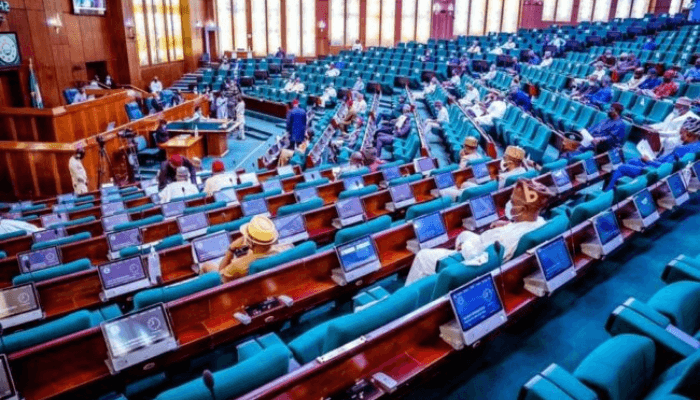
The House of Representatives Committee on National Security and Intelligence has described as “abysmal” the allocation to the intelligence sub-sector in the proposed N58.18 trillion 2026 budget, stating that the funding level does not reflect the Federal Government’s declared priority on national security.
Ahmad Satomi, Chairman of the Committee, expressed this concern during the 2026 budget defence session for agencies under the committee’s jurisdiction at the National Assembly on Wednesday.
Satomi, explained that of the N5.41 trillion defence and security envelope, the intelligence sub-sector, comprising the Office of the National Security Adviser and its agencies, the Department of State Services, the National Intelligence Agency, the Presidential Air Fleet and the National Institute for Security Studies, were allocated N664.1 billion for personnel, overhead and capital expenditure in 2026.
According to him, “Personnel costs account for N245.94 billion, overheads N131.27 billion, and capital expenditure N286.90 billion.

“These allocations are indeed very abysmal and do not seem to match the intent of the speech delivered by the President to the Joint Session of the National Assembly on December 19, 2025.”
The chairman also raised concerns over the state of intelligence training institutions across the country.
He disclosed that in 2024 the Committee visited training schools of the Department of State Services in Bauchi, Lagos and Enugu, as well as the training school of the National Intelligence Agency in Lagos.
“We were disheartened by the sorry state of the facilities in all the schools we visited,” he said, adding that the infrastructure observed could not, in its current condition, deliver world-class technical, psychological and sociological training to personnel in the intelligence services.
The chairman urged President Bola Tinubu to direct that intelligence training schools be given separate budget heads, similar to those of the Armed Forces and the police training institutions, with adequate provisions for their operations.
Satomi further appealed for enhanced funding and prioritisation of the intelligence sub-sector, arguing that releases under the 2025 budget had not demonstrated sufficient commitment to security and intelligence when measured against available information.

“One would have expected that if indeed the provision of welfare and security is the primary purpose of governance, then releases to the security sector should not be treated trivially,” he said.
The chairman further warned against what he described as resistance by some security and intelligence agencies to parliamentary oversight, noting that oversight should not be misconstrued as hostility or a witch-hunt.
Satomi said the legislature shares that constitutional mandate and would pursue accountability not through antagonism but through collaboration with the executive.
“A situation where security and intelligence agencies view the legislature as meddlesome interlopers whenever legislative committees try to carry out oversight of the security sector is counterproductive,” he said.
He argued that legislative scrutiny enables citizens to participate in security governance through their elected representatives, thereby fostering public trust, transparency and value for money in the execution of security-related programmes.
While commending the National Assembly for enacting legislation aimed at strengthening security governance, including reforms in counter-terrorism, cybercrime and financial intelligence, the chairman stressed that laws must be effectively implemented to achieve their intended objectives.
In his speech, Mohammed Sanusi, Permanent Secretary, Special Services, Office of National Security Adviser (ONSA) appealed for a supplementary budget to ensure timely and speedy response to national security issues.
He said this became more pertinent with the recent declaration of State of Emergency on National Security by President Bola Tinubu.
He highlighted some of the key challenges encountered by the Intelligence Community in the implementation of the 2025 Budget to include the envelop system of budgeting which he said constituted a lot of constrain in terms of resources allocation to the Intelligence Community.
He added that the irregular release of overhead cost; non-implementation of the releases of the 2025 appropriated overhead cost; and irregular release of foreign service personnel shortfall for 2024 due to forex differential, are among challenges.
While urging for more funding, Sanusi assured the National Assembly of commitment to transparency, accountability and effective resource management.