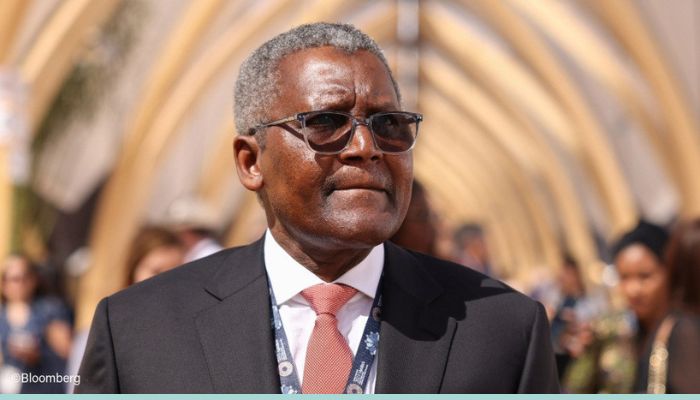
Aliko Dangote, President and Chief Executive of the Dangote Group, on Tuesday said that continued import dependence results in exporting jobs and importing poverty, as the Federal Government formally unveiled the Nigeria Industrial Policy (NIP) 2025 in Abuja.
Dangote, who spoke at the official launch of the policy, said while the government cannot directly create jobs, it can create the enabling environment for the private sector to invest, expand and generate employment.
“Governments cannot create jobs. They can only facilitate. We as entrepreneurs must risk our capital and create jobs, but importation of anything is importation of poverty and exporting of jobs out,” he said
He stressed that Nigeria, with its large market and strategic position in Africa, should not be importing products it has the capacity to produce locally. According to him, what remains critical is not just policy formulation or incentives, but deliberate protection of domestic industries.

“Nigeria is a very big market. Not only that it is a big market, this is a market where we’re supposed to be serving other African nations. But one thing that we need, Your Excellency, Mr. Vice President, since you are here, is not only the policies there, but if you look at the incentives that we have for people to invest in Nigeria, actually they are even over, you have actually given us much more than what we need.
“The only thing that is remaining, Mr. Vice President, is protection of the industries. Even if you give us money with zero interest, you give us free land, what’s the power? If there is no protection, there is no way any industry will thrive here. Because allowing importation and also, you know, importers would like to now have a field day.
Read also: Dangote signs $400m equipment deal to fast track refinery expansion
“But importation of anything is importation of poverty and exporting of jobs out. We can only create jobs if the policies are there. But the policies are there.
“They have given us whatever we need as entrepreneurs to risk our own capital and create jobs. And I can tell you, as we speak today, why should Nigeria be importing anything? We shouldn’t. We should just make sure that whatever we consume, we produce here,” he said

He warned that unchecked imports and dumping would undermine local manufacturers who contend with high production costs.
Dangote also identified power supply as the most urgent constraint to industrial growth, urging the government to convene a national retreat focused solely on resolving the country’s electricity challenges.
He also noted that many manufacturers spend more on self-generation through diesel and captive plants than on core production.
He described the situation where factories are forced to build primary and backup power plants as unsustainable, adding that resources should instead be invested in expanding production capacity.
The industrialist maintained that while imports should not be completely banned, they must take into account Nigeria’s structural disadvantages, including high interest rates of between 25 and 30 per cent and infrastructure deficits. He advocated the use of tariffs to prevent dumping and level the playing field for local producers.
Dangote further argued that strengthening local production would stabilise the naira, reduce inflation and lessen pressure on government finances, as job creation in the private sector would shrink the public sector burden.
Representing President Bola Ahmed Tinubu at the event, Kashim Shettima,Vice President said the Nigeria Industrial Policy 2025 marks a decisive shift from policy rhetoric to measurable productivity.
He described the policy as a working document designed to re-engineer Nigeria’s industrial base, unlock value across sectors and place production, competitiveness and job creation at the centre of national economic strategy.
According to him, the policy confronts longstanding structural weaknesses, including fragmented value chains, high production costs, infrastructure gaps and policy inconsistency.
“Nigeria’s industrial journey has, for too long, been constrained by structural weaknesses:
fragmented value chains, high production costs, infrastructure gaps, policy inconsistency, and limited coordination across government and industry.
“The Nigeria Industrial Policy confronts these realities honestly. It recognises that industrialisation is not an event; it is a process. A process that requires coherence across energy, trade, infrastructure, finance, skills, and innovation. A process that demands partnership between government and the private sector. And above all, a process that must be measured by outcomes, not intentions,” he said.
The new industrial roadmap prioritises strategic sector focus, value-chain development, MSME integration, infrastructure and energy alignment, as well as skills, technology and innovation.
Shettima said the administration would no longer measure success by the number of policies drafted but by factories opened, jobs created, exports expanded and value retained within the economy.
He added that the policy aligns with broader macroeconomic reforms, Nigeria’s trade ambitions under the African Continental Free Trade Area, and the government’s commitment to investment certainty and local content development.
The Vice President called on the private sector to invest responsibly, deepen value chains and partner with the government to build a productive economy, describing the policy as a compact between the state and industry.
“This policy therefore prioritizes, Strategic sector focus, anchored on Nigeria’s compara finished goods, MSME integration, ensuring that industrial growth is inclusive and widely shared; Infrastructure and energy alignment, recognising that factories cannot run on policy
alone;
“Skills, technology, and innovation, to prepare Nigerians for the industries of today and
tomorrow; and Clear implementation architecture, because policies fail not at conception, but at execution,” he stated.