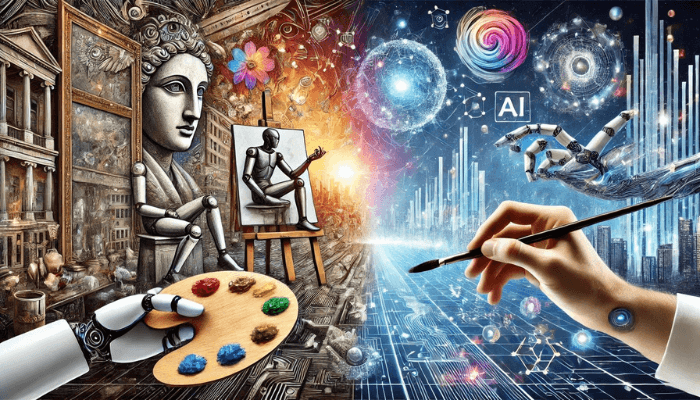
Artificial intelligence ( AI) is fast becoming the invisible infrastructure powering Nigeria’s creative economy, reshaping how films are produced, photographs are edited, and advertising campaigns are executed, as creatives and brands position to cut a slice of a $434.4 million AI market.
What was once an experimental tool is now being embedded into everyday business workflows. Nowhere is this shift more evident than in the creative and advertising industries, where AI is shortening production timelines, reducing labour costs, and optimising advertising spend as agencies and creators seek efficiency in a competitive market.
Nigeria’s AI market, currently valued at about $434.4 million, is projected to grow into a multi-billion-dollar industry by the end of the decade. The technology is also a core driver of the country’s broader digital economy, which is expected to reach $18.30 billion by 2026. Investor confidence is rising alongside this momentum, with AI-focused startups in Nigeria attracting more than $218 million in venture capital between 2023 and 2024, second only to South Africa on the continent.
Read also: Artificial Intelligence trends to watch in 2026

For filmmakers, the impact is already visible. Tasks that once took weeks, from pre-production planning to post-production editing, can now be completed in days.
Emmanuella Utomi, a producer working across film, television, documentaries, and commercials, said AI has fundamentally altered the economics of production.
“AI can help creatives eliminate weeks of prep and post, but it’s a double-edged sword. While it reduces costs, it also means a command can easily replace jobs that used to employ many people,” Utomi told BusinessDay
She pointed to the most recent holiday season as evidence of the shift, adding that, “This past Christmas, I saw fewer people going to studios for shoots. What circulated instead were AI-generated images, and they looked good.”
Utomi cited ‘Makemation,’ a Nigerian AI-driven film released last year, as proof that the technology is already shaping local storytelling.

Still, she warned of the risks, stating that, “Deepfakes are alarming, and regulation is either weak or nonexistent. AI should complement human creativity, not take over. Many AI-generated content still lack the human connection that traditional audiences respond to.”
In advertising, cost efficiency is the biggest driver of adoption. Brands using AI-generated models and visuals can avoid recurring expenses such as cast contracts, large production crews, and extended studio time.
According to Utomi, this makes AI-led campaigns appear cheaper and faster for clients, even as some brands continue to prioritise human presence to preserve emotional resonance and drive sales.
For models and performers, however, the transition has been unsettling.
Nneoma Collins, a professional model, said AI’s growing role in advertising has had mixed consequences.
“Authenticity isn’t being promoted anymore. Some brands prefer AI to run ads because they get good outcomes, but there’s no originality. Budget-wise, AI ads perform well, but in terms of market results, it’s a 50-50 chance,” she said.
Photographers and visual artists are also adapting. Victor Fagbola, CEO and lead photographer at Vencedor Photography, described AI as a productivity tool that enhances rather than replaces creative work. “A human can retouch an image in about 30 minutes. AI, with a human touch, can do nearly the same in five minutes,” he said.
Fagbola noted that his business has scaled faster since adopting AI-assisted workflows. “AI can’t replace humans or replicate emotion or authenticity. But creatives who refuse to learn it may lag, just like those who avoided the internet in Nigeria in the early 2000s,” he said.
Globally, Nigeria’s experience mirrors a wider industry shift. The Interactive Advertising Bureau (IAB) reports that more than half of advertising executives worldwide already use generative AI for creative development and audience targeting, with nearly all planning to expand its use.
Read also: Managing the generational gap at work using artificial intelligence (AI)
Another IAB report found that almost 90 percent of advertisers expect to use generative AI to build video ads, underscoring how quickly the tools are becoming standard in production workflows.
Yet, the acceleration comes with risks. The IAB has warned that many marketers have yet to invest adequately in brand safety frameworks, AI training, or risk management, even as challenges such as bias and hallucinations begin to affect live campaigns.
A 2024 Global Midyear Advertising Forecast projected that by 2029, AI would influence more than 94 percent of global advertising revenue, while other research reports estimated that AI-driven ads could account for over 80 percent of online advertising by 2025.
Major platforms including Google, OpenAI, Snap, Pinterest, and Reddit are already embedding AI tools into their advertising ecosystems, enabling faster content generation and more precise targeting. Despite this, concerns around creative control, content quality, and brand safety continue to slow adoption in some agencies.
For Nigeria’s creative industry, the debate is no longer about whether AI will be used, but how. “AI should assist, not decide. When used responsibly, the fusion of human insight and machine efficiency could unlock new possibilities, cutting costs without erasing the authenticity that gives creative work its value,” Fagbola said.