|
Getting your Trinity Audio player ready...
|
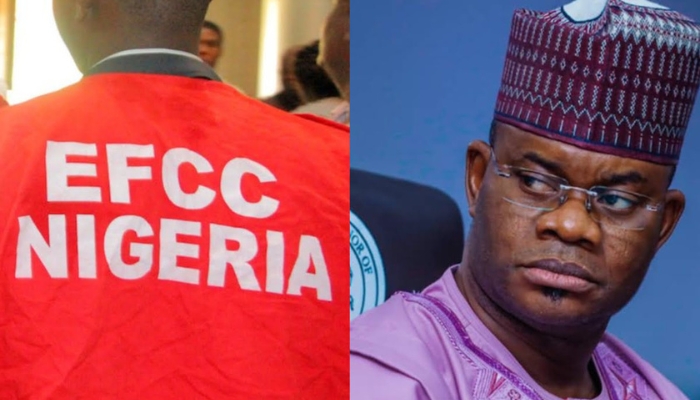
The Federal High Court in Abuja on Thursday rejected a move by the Economic and Financial Crimes Commission (EFCC) to cross-examine its own witness in the ongoing alleged money laundering trial against former Kogi State governor, Yahaya Bello.
Delivering his ruling, Justice Emeka Nwite held that the EFCC could not legally cross-examine its witness without first declaring him hostile, describing the prosecution’s position as “misconceived.”
“I must agree with the learned counsel to the defendant that the prosecution can only cross-examine after it has declared the witness a hostile witness,” the judge ruled. “The argument of the learned counsel to the prosecution is misconceived… This honourable court is not shutting the prosecution from re-examining the witness, but must restrict itself to pages 1, 14 and 15 of Exhibit 19. The prosecution is not allowed to re-examine the witness outside the pages prescribed.”
Read also: Yahaya Bello: Court adjourns to June 26 for ruling on EFCC’s bid to cross-examine its witness

The EFCC’s legal team, led by Kemi Pinheiro, had sought to cross-examine Nicholas Ojehomon, the Commission’s third witness and an internal auditor at the American International School, Abuja. Ojehomon previously told the court there was no wired transfer of fees from the Kogi State Government or any local government to the school’s account.
He had also read from a Federal Capital Territory High Court judgment which held that there was no order directing AISA to refund money to the EFCC, nor any declaration that the money in question was proceeds of crime.
The day’s proceedings took a dramatic turn when Pinheiro, during a dispute over scheduling further cross-examination, labelled the case against Bello as political.
“We are not prosecuting a bank official here, but a political figure, one who had even aspired to contest for presidency,” he said.
The judge responded sharply: “Political? If that is the case, then those handling political cases should prepare to take over the matter.”

Following the court’s ruling, Pinheiro withdrew a question previously posed during the re-examination of Ojehomon. The EFCC then proceeded to present its fourth witness, Mshelia Arhyel Bata, a compliance officer with Zenith Bank, who appeared under subpoena.
Bata confirmed to the court that the seven sets of bank documents tendered by the EFCC included certificates of identification as required. The court admitted the statements of account of the Kogi State Government House Administration and six others as exhibits.
The witness testified that prior to the Central Bank’s full enforcement of the cashless policy, the withdrawal limit for government accounts was pegged at N10 million.
Read also:FG files criminal charges against Natasha Akpoti; Akpabio, Yahaya Bello listed as witnesses
Reviewing transactions from May 23, 2016, the prosecution pointed to a cash withdrawal made by one Abdulsalami Hudu. Bata explained, “It is a cash withdrawal of ₦10 million in accordance with the then maximum threshold allowed for cheque withdrawal per transaction.” He noted that there were nine such withdrawals on the same date.
On January 30, 2018, the bank records showed 10 separate credit transactions totalling approximately N1.092 billion. When asked to calculate total withdrawals, defence counsel Joseph Daudu, interjected: “He (Pinheiro, SAN) knows that they are for security votes.”
Nonetheless, Bata proceeded to aggregate the withdrawals, stating: “The total amount is ₦1.968 billion across different dates.”
The witness also reviewed account inflows and outflows between May 2 and May 19, 2018.
Following the EFCC’s examination of Bata, Justice Nwite adjourned the matter to Friday, June 27, for cross-examination by the defence.