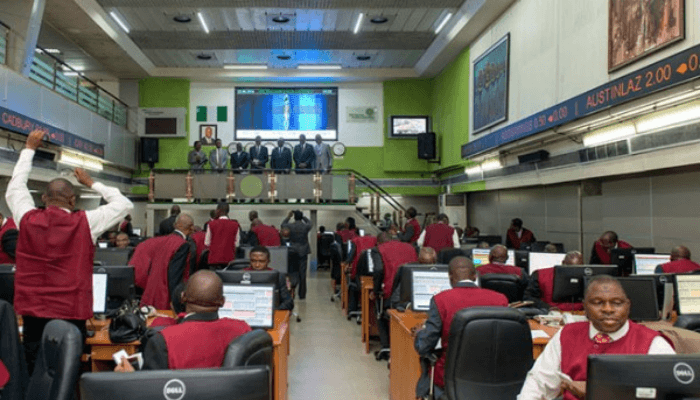
Despite record positive take-off to this week’s trading, some market watchers expect investors will still stay off equities to take advantage of rising interest rates in the fixed-income market. This recent bearish bias shown in their outlook for equities this week comes as they also favour investors treading cautiously on the Nigerian Bourse.
Nigeria’s equities market had in the trading week to Friday, October 21 closed in the red zone as the All-Share Index (ASI) decreased by 6.67percent week-on-week (WoW) to 44,396.73 points.
Market watchers saw how the huge dip in the market last week was driven majorly by decline in share price of Airtel Africa Plc. Airtel Africa decreased by N487.80 or 27.10percent week-on-week (WoW) from N1,800 to N1,312.20.
“Last week, the bears dominated the domestic equity market for three out of five trading sessions of the week. We saw sell pressures across the market as investors continued to favour fixed-income instruments over the stock market, given the rising yield environment. Notably, price depreciation in large-cap stocks, Airtel Africa (-27.1percent), MTNN (-2percent) and Nigerian Breweries (-9.6percent) drove the local bourse southwards,” Lagos-based United Capital analysts said in their latest weekly investment views.

Read also: Market gains N35bn as week opens
While they expect bearish sentiment to continue to dominate the market “as investors stay off equities and take advantage of the rising interest rates in the fixed income market”, they however foresee some bargain hunting in stocks that have underlying fundamentals “as investors look to take positions ahead of the third-quarter (Q3) 2022 earnings season”.
While the market’s year-to-date (YtD) return fell to 3.93percent last week, Airtel Africa decreased by 27.10percent with other major laggards like MRS (-9.76percent) and Nigerian Breweries (-9.58percent), while Fidelity Bank was up most by 10.14percent), BUA Cement (+9.73percent) and PZ Cussons (+9.52percent).
The market’s performances across the NGX indices were broadly negative. The NGX-30 Index led the decline by -5.68percent, followed by NGX Insurance Index (-3.72percent), NGX Oil & Gas Index (-1.45percent) and NGX Consumer Goods Index (-0.88percent) while the NGX Industrial Goods rose most by +3.22percent, NGX Banking (+1.15percent), and NGX Pension (+0.58percent).
“As we have observed many times over the past few months, rising Naira market interest rates have set the stage for investors to rotate out of equities and into fixed income securities, and therefore point to a correction in the equity market,” said Coronation research analysts in their October 24 weekly update.

“We thought the correction would come, and we raised the notional cash position in the Model Equity Portfolio from 7.9percent at the end of August to 26.7percent currently. The correction has come, later than we thought but more violently than we thought. We will reassess our portfolio in the light of index weights (which have changed a lot due to Airtel Africa’s correction),” they said.
Vetiva research analysts said in their October 24 market report that with the current macroeconomic conditions still adversely affecting the market, “we still expect cautious trading sessions amid lower market participation.”
Meristem research analysts who noted increased buying activities in the market in two consecutive weeks (improvement in market breadth and market turnover), however, highlighted that low system liquidity, and the T-bills auction could prompt the flow of funds from the equities market. “Overall, barring selloffs on any heavyweight ticker, we expect the market to close in the positive zone,” Meristem research analysts said.