|
Getting your Trinity Audio player ready...
|
Nigeria has one of the largest gas reserves in the world. Proven reserves are recorded at 200.79 trillion cubic feet (TCF), while unproven reserves at 600TCF. Only about a quarter of Nigeria’s proven reserves are being developed or produced despite having the largest gas reserves in Africa. Exports, domestic markets, field use/reinjection and flare, are means of utilising gas in Nigeria.
Existing active gas-producing reserves are in the Niger Delta region of Nigeria. From 2001 to 2018, total gas produced was 45,753.81 billion standard cubic feet (BSCF), with associated gas (AG) making up 65% of production.
Gas Abundant but Power Deficient
In Nigeria, electricity generated and supplied to the transmission grid comes from two primary sources of energy: gas and water. Gas dominates the grid electricity generation mix, accounting for an average of 80% of electricity generated for 2018 and 85% for 2019.

Electricity generation for Nigeria’s grid still faces several issues including inadequate gas supply, poor water management, dispatch coordination, and unavailability of transmission and distribution network infrastructures. Inadequate gas supply is responsible for the largest share of constraints. Between 2015 and 2019, over 50% of electricity constraints was due to unavailability of gas for generation. Another aspect of inadequate gas supply that has affected power generation is the geographical distribution of supply. All 232 producing fields and 2,616 wells which produce Nigeria’s hydrocarbon are located in the Niger Delta Basin, leaving the inland basins unexplored and lacking supply. The result of limiting exploration to the Niger Delta is the restriction of thermal generation plants to the South, leaving the much larger landmass of the North without thermal electricity generation infrastructure. In effect, wheeling generated power over thousands of kilometres to the North increases the cost and reduces the quality of power.
What Can Nigeria Benefit from Inland Gas Exploration?
Gas remains an abundant reserve that can be further harnessed for power generation and proves itself as a cheap and clean alternative to other hydrocarbon sources. The untapped potential for gas to power generation in Nigeria is enormous and will only increase with population. Therefore, exploring inland gas basins for power generation would enable a more efficient electricity network, set the framework for the development of industrial clusters and ensure gas supply security for the domestic market.
Enabling Distributed Generation
The Nigeria Electricity Supply Industry stands to benefit from the exploration of inland basins. Gas production in inland gas basins would enable inland gas-powered electricity generation plants.
These plants can be collocated with gas infrastructure, thereby reducing the cost of transportation and enabling the security of supply for power generation. Such arrangements would allow for distributed generation, which could generate power for areas within proximity that require shorter transmission distances as they feed the grid at medium voltage level. The benefits of such arrangements include reduced infrastructure costs, reduced technical losses, security of electricity supply, improved grid stability and additional generation for productive use. It would also be easier to establish more bi-lateral Eligible Customer agreements between generation companies and customers.
Read Also: SEPLAT multi-billion naira ANOH gas project set to transform energy sector

Encouraging the Development of Industrial Clusters
Inland gas exploration and production would enable power generation to serve industrial clusters. For a developing economy such as Nigeria, industrialisation should drive economic growth. At the same time, adequate power supply would enable the development of robust manufacturing sectors and improve both foreign and local investments. The exploration and development of inland natural gas basins can serve to provide power for industrial clusters and feedstock for gas-based industries. An example of where gas availability has enabled industrial growth in Nigeria is the production of fertiliser for agriculture. The Indorama Eleme Fertilizer and Chemicals Limited is the largest producer of urea fertiliser in Sub-Saharan Africa. The company could accomplish this feat due to proximity to adequate natural gas as feedstock and for power. In the same vein, professionals can establish more industries in other parts of the country with the exploration of inland gas.
Improving Gas Security for the Domestic Market
The prevalence of associated gas production over non-associated gas increases the vulnerability of gas to crude oil market conditions. The decrease in worldwide crude demand brought about by the COVID-19 pandemic has resulted in an over 35% drop in demand, invariably reducing crude prices. Developing inland gas basins would limit the dependency of gas availability to crude oil market forces. Irrespective of the prices and demand for crude, the gas industry would be able to operate on its terms as long as the right regulatory and contractual frameworks are in place.
Gas should be available for power supply irrespective of irregularities caused by external factors.
Is There Enough Promise to Continue Inland Exploration?
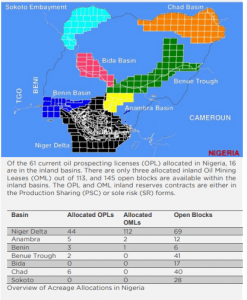
Nigeria has seven basins including the Niger Delta, Anambra, Benin, Benue Trough (Gongola), Bida, Chad and Sokoto Basins. Apart from the Niger Delta where extensive exploration and production is performed, there has only been minimal exploration in Benue Trough, Benin, Anambra and Chad basins.
The gas production potentials of some of the inland concessions have been proven through exploration activities including seismic surveys and drilling of exploration wells. Anambra Basin, in particular shows significant promise for gas development. Savannah Petroleum has discovered significant gas reserves in OPLs 905, 907 and 917 of Anambra Basin. Orient Petroleum’s seismic surveys for OPLs 915 and 916 indicate at least five hydrocarbon fields. Orient has also begun production from OPL 915. The Nigeria National Petroleum Corporation has also discovered hydrocarbon in Benue Trough. For these concessions, the nature of the gas reserves in the inland basins is such that they can
accommodate 30MW – 100MW power plants.
What is now required is to unlock the potential benefits by exploiting the gas resources for power generation. Some of these reserves in these basins have the potential to contribute significantly to the growth of distributed power generation in Nigeria; however, the right framework should be in place to increase the attractiveness of the domestic market to gas producers. To enable further inland exploration for power generation, the Federal Government of Nigeria needs to strengthen Nigeria’s legal, regulatory, and fiscal frameworks, and encourage the willing seller-willing buyer contracting model. These considerations are in addition to increasing power sector liquidity and the ability of generation companies to pay gas suppliers. Factors to consider in enabling the environment for inland gas exploration include the fiscal framework, regulations, commercial and financial implications and technical considerations. Next week’s article will address these considerations.