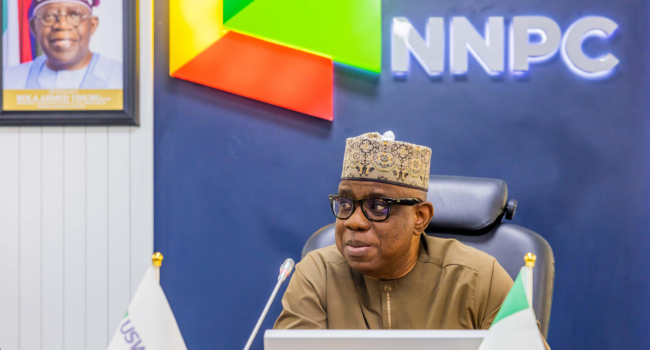
Bayo Ojulari, chief executive officer of Nigerian National Petroleum Company Limited (NNPC), says Nigeria’s state-owned refineries collapsed because successive managers prioritised financing and engineering contracts over the hard work of running the plants.
Ojulari made the remarks at the just-concluded Nigerian International Energy Summit, where he argued that the system rewarded deal-making, not long-term performance.
“The reason our refineries have not worked is that we focused on the first two: financing and EPC,” he said, referring to engineering, procurement and construction contracts. “Anybody who finances a project expects margins and profitability. EPC contractors do their work, get paid and move on.”
He said NNPC then carried the burden of operating the facilities for decades — without ever building the capacity to do so.

“You, as NNPC, are left for the next 20 to 40 years to run those refineries. And we’ve never really focused on that.”
Ojulari noted that discussions often shifted to operations and maintenance (O&M), but warned that this too became another layer of contracting rather than a solution.
“O&M becomes another contract. So you end up with financing, EPC, O&M — all of them taking money from the system without any skin in the game,” he said. “There’s no way to sustain a business like that. The system was designed for taking, not for putting anything back.”
Read Also: Belabouring in Leadership: How women leaders can own their voice
According to him, the current NNPC leadership has decided to reverse that approach by putting operational readiness at the centre of refinery projects.

Drawing from his experience in the international oil industry, Ojulari said successful projects embed operations thinking from day one.
“For those of us who spent years building multi-billion-dollar facilities for the IOCs, we know this principle,” he said. “The day you start a project, you appoint an operational assurance person who stays with it from the beginning and ensures what you deliver can actually be operated.”
He cited his time at Shell, where he served on the commissioning team for Qatargas. He said his team audited operational readiness long before construction began and again when work reached about 90 per cent completion.
Those reviews, he explained, exposed operability risks early enough to fix them through training, staffing and systems.
“You might spend two to three years designing a project and another three to five years building it,” he said. “But you will operate it for 25 to 50 years. So where should your focus be?”
Ojulari added that NNPC previously treated these issues “with kid gloves”, a stance he said the company can no longer afford.
He also disclosed that NNPC is discussing a possible partnership with a Chinese firm on one of the state-owned refineries, as the company seeks a more sustainable operating model.