For too long, many Nigerians have underestimated the power of politics. There is a common belief that as long as the economy is thriving, politics can be ignored. But history tells a different story. Extractive politics—where power is concentrated in the hands of a few—inevitably leads to extractive economies that enrich elites while leaving the majority behind.
Before examining the unfolding crisis in Rivers State and its wider implications for Nigeria’s economy, it is worth considering the insights of a seasoned public servant on the relationship between politics and economic development.
Shamsuddeen Usman, former Minister of Budget and Economic Planning and author of Public Policy and Agent Interests: Perspectives from the Emerging World, once admitted that he had underestimated the impact of politics. “When I was in the private sector, I used to say that if only we could get the economy right, everything would be alright. Now, with my experience in the public service, I say if we do not get the politics right, nothing will be alright,” he said in an interview on Arise TV.
Usman’s realisation echoes the findings of Daron Acemoglu and James Robinson, who spent 15 years researching and writing Why Nations Fail. Their core argument is that politics will always trump the economy. When political institutions are weak, any economic progress is at risk of being reversed.

Rivers State: A case study in extractive politics
When Nyesom Wike, now Minister of the Federal Capital Territory, openly declared that he had funded the nomination forms for every candidate in his party, many failed to see the gravity of his admission. “I paid for the nomination forms of everyone who contested the PDP ticket for governor, House of Assembly, and National Assembly seats,” he said.
This practice is a textbook example of extractive politics, where a single individual controls the political landscape, ensuring that only his anointed candidates secure party tickets. This is not unique to Rivers State; similar power structures exist across Nigeria. In such a system, wealth is generated and extracted primarily by the political elite, leaving the masses to scramble for whatever remains.
“Beyond economic inequality, extractive politics also threatens property rights,” said a Political Economist. Political instability fuels factional conflicts, with rival groups vying for control of state resources. The crisis in Rivers State today is a direct consequence of this political model.
Consider the recent dispute over the appointment of commissioners in the state. The power struggle between Governor Siminalayi Fubara and Wike’s loyalists led to a prolonged standoff in the State House of Assembly. The situation escalated to the point where President Bola Tinubu had to intervene, effectively declaring a state of emergency.
For businesses and investors, this kind of political uncertainty is deeply troubling. The economic consequences were immediate—Shell Nigeria, for instance, suffered significant financial losses before the Trans-Niger Pipeline was eventually restored. This instability sends a clear message: in Nigeria, political turbulence can derail even the most strategic investments.

A lesson from history: The fall of the Maya civilisation
This scenario is not without historical precedent. Acemoglu and Robinson recount how the Maya city-states—once home to advanced writing systems, sophisticated calendars, and groundbreaking architectural achievements—collapsed under the weight of their own extractive institutions.
Despite their economic and technological progress, the Maya rulers concentrated power within a narrow elite, using it to extract wealth at the expense of the broader society. Over time, this led to incessant warfare among competing factions, each seeking to seize control of state resources.
As political instability worsened, the economic prosperity of the Maya cities crumbled. The society that had once built grand monuments and pioneered cement-making ultimately fell to ruin, undone by internal conflicts over power and wealth.
What is happening in Rivers State today bears striking similarities. Governor Fubara in 2024 claimed that the state’s Internally Generated Revenue (IGR) had increased by over 100 percent. However, Isaac Kamalu, the former Commissioner for Finance and a Wike loyalist, disputed this, alleging that the figures were inflated.
This is not merely a disagreement over numbers—it is a battle for control of the state’s financial resources. The infighting led to an impeachment attempt against the governor, further destabilising the state. Amidst the political chaos, Nigeria’s largest oil pipeline was bombed. Though it has since been repaired, the damage to investor confidence is immeasurable.
The consequences of institutional failure
How can a single individual bankroll every political office holder in a state? This is only possible because Nigeria’s institutions are weak, allowing politicians to monopolise power unchecked.
The judiciary, which should act as a check on executive and legislative excesses, is itself compromised. Senate President Godswill Akpabio and former Senate President Ahmed Lawan were not legally eligible to contest for legislative positions after running for the presidency, yet they retained their seats—aided by the judiciary.
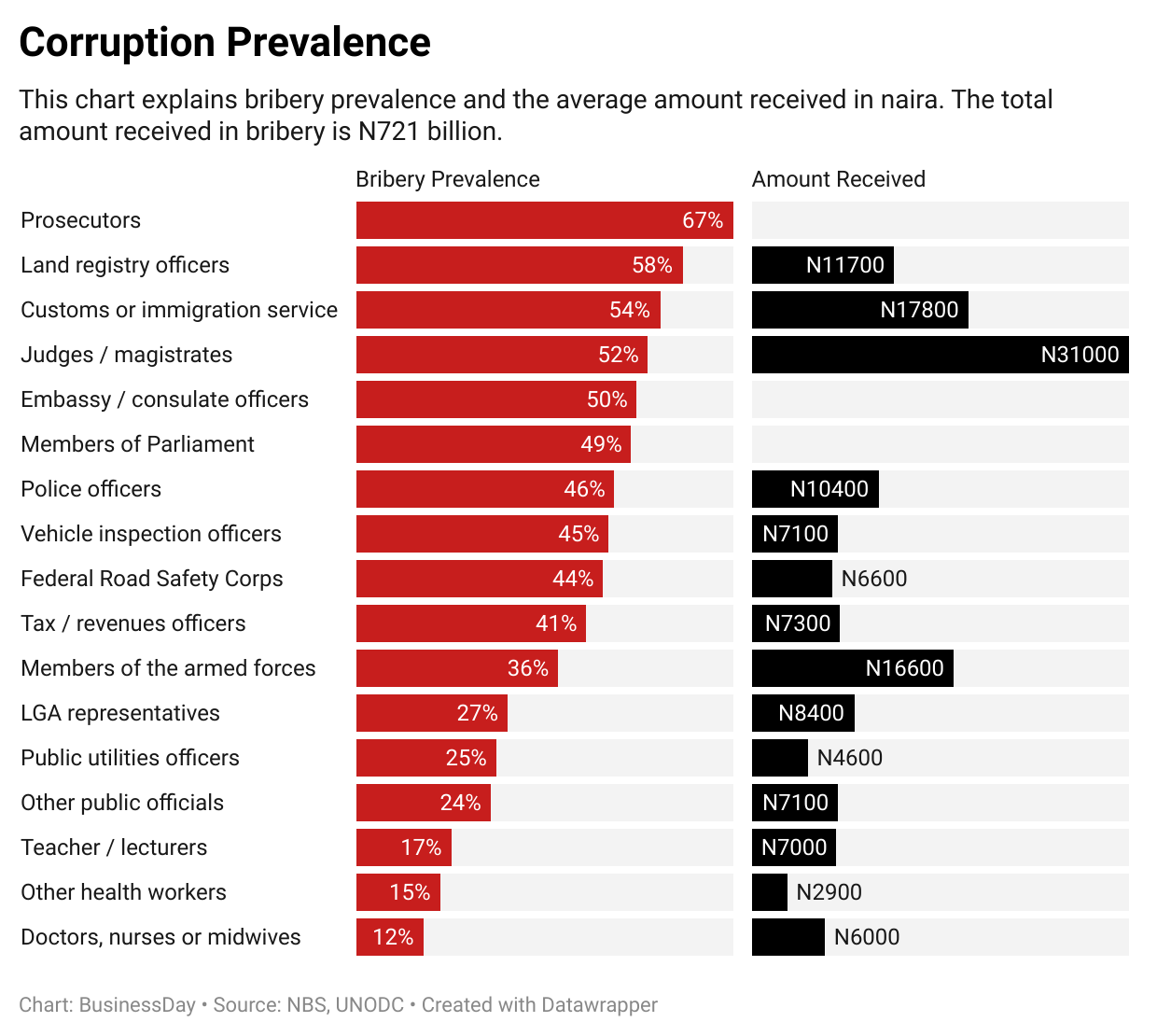
Dele Farotimi, a prominent lawyer and activist, has described Nigeria’s judiciary as “hopelessly compromised” and incapable of dispensing justice. His statement aligns with findings from the United Nations Office on Drugs and Crime (UNODC) and the National Bureau of Statistics (NBS), which reported that the judiciary received the highest bribes in Nigeria in 2023.
Goodluck Jonathan, the former Nigerian president, also warned about the dangers of a compromised judiciary while commenting on President Tinubu’s decision to sack the Governor and his deputy in Rivers state. According to him, the judiciary knows the right course of action—to uphold the Constitution by telling the President that his decision on Rivers State is legally unjustified—but is merely pretending “No businessman can bring his money to invest in a country where the judiciary is compromised, where a government functionary can dictate to judges what judgment they will give. No man brings his money to invest in that country because they are taking a big risk,’ Jonathan said.”