Nigeria’s creative industry involving music, film, fashion, design, and other forms of media production, principally led by the private sector has become a socio-economic factor, contributing significantly to the country’s GDP.
Industry sources said the motion picture and music recording industries alone contributed approximately N154 billion (roughly 96 million euros) to Nigeria’s GDP in 2023.
But the Institute of Chartered Secretaries and Administrators of Nigeria (ICSAN) known for championing corporate governance, acknowledges that the industry, powered by individuals and private sector is growing but it has yet to reach its peak.
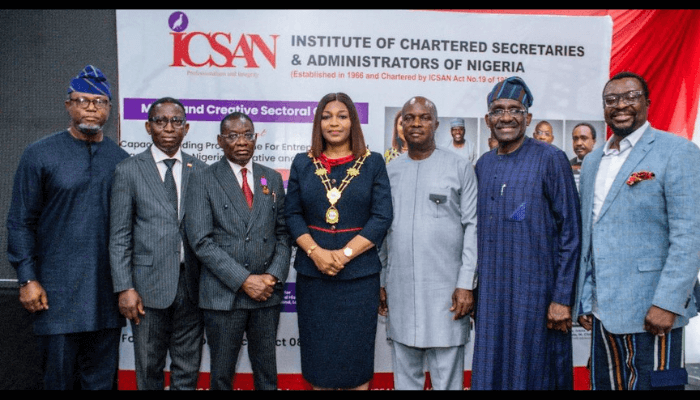
With this in mind, the institute recently in Lagos organized a fee-free capacity-building programme for aspiring and existing entrepreneurs in the creative and media industry in Nigeria, among other interested stakeholders. The programme had the theme: “Driving Sustainable Development in Nigeria’s Creative & Media Industry”

Funmi Ekundayo, ICSAN President explained that the programmed was designed to theme to generate ideas on how to make the already encouraging creative and media industry in Nigeria to consolidate on its gains.
She noted that Nigeria has witnessed phenomenal growth in the industry, “with a sizeable number of youths using their talents not only for personal success but also to contribute values entertainment and media output and increase the GDP of the country”.
Quoting expert view, Ekundayo said Nigeria is leading the African art market which is estimated at $13 billion.
She also referred to PwC Global Entertainment and Media Outlook 2024-28, report which classified the Nigerian media industry, encompassing the film, music, art, entertainment, and content creation sectors, as the fastest-growing creative industry globally.
Read also: ICSAN officially lays foundation for its N3.5 bn secretariat in Lagos

The PwC report also projected the industry to generate $14.8 billion in revenue by the end of 2025.
Nigeria is home to the world’s largest young population and continues to leverage this numeric strength to leapfrog its media industry, which has been projected to witness more groundbreaking success.
According to her, the Institute believes it has obligation to encourage the expansion of the frontiers of knowledge in the creative and media sector (among other sectors), to maximize the potential of the talented youths and young people and channel their creative energy into national productivity pool.
Also speaking, John Momoh, Chairman, Channels Media Group, underscored the importance of the creative and media industries as powerful engines of economic growth and national identity.
Momoh said that to encourage the industry, investment from government and private capital from both local and global were critical.
Nosike Agokei, a governance expert, stressed the importance of good corporate governance and ethical practices in promoting and managing successful ventures in the creative and media industries.
Agokei said effective corporate governance system in both industries had many advantages such as stakeholders’ protection, risk mitigation, accountability, compliance and others.