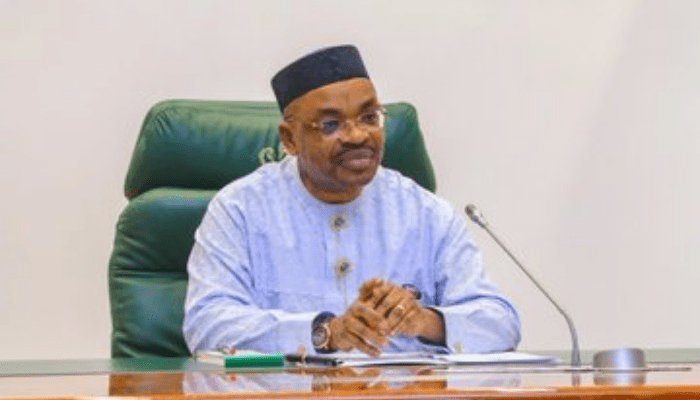
Akwa Ibom government has given reasons why the economic sector received the highest allocation in the next year’s budget saying it was a deliberate policy to boost the rapid industrialization of the state.
The state government proposed a total budgetary outlay of N435.652billion for the 2021 Financial Year as against the approved revised provision of N366.000billion of 2020.
Tagged “Budget of Economic Reconstruction,” its breakdown showed that the economic sector got N267.557 or 61.4% being the highest and was followed by the administration which got N100.018 or 23.0% of the budget.
The budget which is made up of N158.403 billion or 36.4 percent for recurrent expenditure, N50.285 billion or 52.1 percent for consolidated revenue fund charge also has a capital expenditure of N225.964 billion or 52.1 percent of the budget.

READ ALSO: Moving Nigeria forward: Time for shared responsibility?
Linus Nkan, commissioner for finance who made this known during an interaction said with the economic sector taking the lion share of the budget, it would facilitate the “opening up of new areas of growth and development through intense and coordinated efforts to increase our internally generated revenues and be less dependent on allocations from the Federal Government.”
He said education, which he described as a key component of the Human Capital Development of our Completion Agenda would be given pride of place in the state to ensure pupils and students would compete with their peers from other states of the federation.
“Our children must be made ready to compete with their peers and distilled to be a part of the global march to apply science and technology to create jobs and wealth for themselves. Our children are highly gifted and innovative and we must provide the enabling environment for them to achieve their potentials.
According to him, the state government will intensify its investments in healthcare delivery by completing among other key elements, which include the construction and commissioning of the General Hospitals in Ikot Abasi and Ikot Ekpene respectively as well as remain proactive in ensuring that the incidence of communicable diseases is greatly reduced.

“Our infrastructure renaissance will continue to receive critical attention. We must continue to invest heavily in Land, Air and Sea infrastructure in addition to massive road infrastructure as can be seen from the economically viable dualised roads so far constructed throughout the three Senatorial Districts of the state,’’ he said.
The finance commissioner noted that the “realization of Ibom Deep Seaport Project in the life of this administration as was the case with Ibom Air would add to the pride of the state adding that
“Our strategy for the development of this state has been the need to rapidly industrialize the State, create employment and wealth opportunities for our people.”
Maintaining that the state government would accelerate the pace of continuously attracting viable firms and factories that would help with the strategic and sustainable developmental plans, he added that it would no “spare no expense in ensuring that our state continues to enjoy the peace and development that we are nationally known for.”
The 2021 budget is predicated on an oil benchmark of $40 per barrel at a production rate of 1.86 million barrels per day, with an estimated exchange rate of N379/US$, an inflation rate of 11.95% and GDP growth.
The total projected recurrent revenue for 2021 is estimated at N255.003 billion as against the approved revised provision of N203.556 billion for 2020 which is N51.447 billion or 25.3% higher than the 2020 revised provision while the recurrent expenditure for the 2021 Fiscal Year is proposed at N208.688 billion.