|
Getting your Trinity Audio player ready...
|
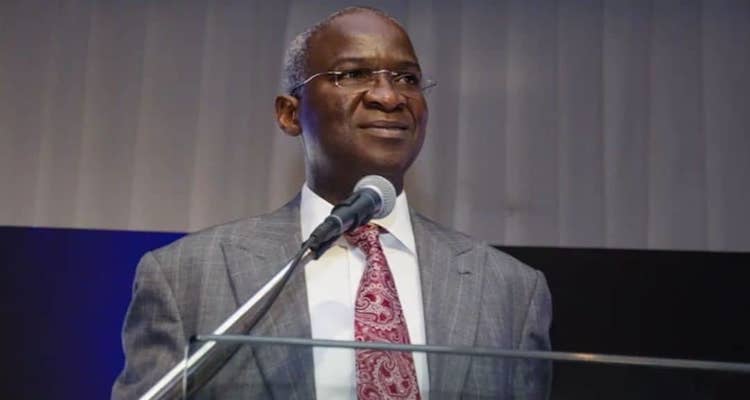
Nigeria’s private sector is largely within the Micro Small and Medium Enterprises (MSME) category, and can hardly make enough money for infrastructure funding, minister for Works and Housing, Babatunde Raji Fashola has said.
Fashola in an exclusive interview with BusinessDay, said “When you dimension our private sector, you find that almost 60 percent of it is made up of Micro Small and Medium Enterprises (MSME), family businesses. So where is the money to build infrastructure? When I hear private sector, we talk as if we’re not mindful of the real private sector.
“Then, those who even have the capacity, how many of them are owing AMCON? So, if they are already owing, where is the money they’re going to give to the government? The famous private sector, over 300 of them were bailed out by this government in 2015. About N5 trillion was how much we used to bail them out so that they won’t pull down the entire system,” he said.
Nigeria is said to need at least some $2.3 trillion over the next 30 years to fix huge infrastructure and has over the years pushed for private capital mainly through the Private Public Partnership (PPP) model.

But several years after the PPP initiative, the country is still mired in the dearth of infrastructure just as debts mount and budgetary allocations remain just insufficient.
In 2008, for instance, Federal Government created the Infrastructure Concession Regulatory Commission (ICRC) to regulate PPP efforts and address Nigeria’s physical infrastructure deficit which hampers economic development.
With an executive order, President Buhari in 2019 also introduced the Road Infrastructure Development and Refurbishment Investment Tax Credit Scheme which seeks to encourage PPP intervention in the construction/refurbishment of road infrastructure projects in Nigeria in exchange for a 50 percent tax rebate.
Fashola highlighted several other efforts to spur private capital, however, the funds are hardly enough to match what is required.
“How many private sector operators really can do something? How many businesses make N1 billion turnover? Let’s say profit on a turnover of N1 billion is just roughly about ten percent that is N100 million. Let’s say tax is 20 percent, which road can N20 million build?

“So I think we need to do some more internal analysis of where capacity lies. So, you’ll see the Lafarge, you’ll see the NLNG, you’ll see the BUA, you’ll see the TNTL, the Dangotes. Those are some of the heavy hitters; the Flour Mills and a few others who have that level of financial strength,” Fashola explained.
Nigeria also faces the challenge of raising capital from abroad as most countries presently struggle with meeting their own funding needs on account of pressure on available lean global resources.
Fashola cited Europe where many businesses have shut down, on the back of the COVID-19 pandemic. “You think the grass is greener on the other side? They don’t have money, they too are borrowing money. Don’t let anyone deceive you. The only country that was writing development cheque on a continuous basis was China. They are now slowing down. Europe is borrowing from them, they are now locking the door. Britain has borrowed some amount in massive billions of pounds. So what are you talking about? America is spending on stimulus. Where do you think the money is coming from,” he queried.
He said we all have a responsibility not to create an impression that government is not putting enough effort.
According to him, “All the economies of the world are struggling. UAE, you know how many people Emirate sacked last year- 20,000 people. So, grass is not greener on the other side.
“So let us be clear about it, all economies are struggling. That does not close the door to Foreign Direct Investments (FDI) but also check at the time when there was prosperity, relative to now, how many of the FDI that came into Nigeria went into real estate? They were portfolios. That’s the footprint.
“So, the first thing we want to get back is the portfolio investment, as things settle down, they feel safer, the temperature is not too hot and it’s not too cold, may be a few of them will venture into the real estate and the HDMI showed a lot of promise because we have people all over the world, so we’ll keep our fingers crossed,” he said.
An economist, Paul Alaje, however, believes that the problem is not entirely with the private sector, but that the country has failed to drive PPP model due to the shoddy handling of government over the years.
Alaje said, “That we need Public-Private Partnership cannot be overemphasised. We have seen what happened in Lagos, particularly Apapa-Oshodi Expressway, where we have seen the private sector come to partner with the government in road construction. But that has been limited because the credit most cities put has a cap that most companies can’t meet up to.
“Since the tax credit policy came up, the Federal Capital Territory (FCT) has further relaxed that cap for most companies who are in real estate and are thriving to support the government in road construction. However, government will need to further lower the entry barrier, and the government will need to bring it lower so we can have more and more organisations, he said.
“I really do not think that we lack a functional private sector. I think what we need to do is to become innovative in achieving this because, for instance, when you build rail that are adjoining businesses around the rail system that guarantees revenue, and we don’t need to borrow.
“I also don’t think we need to borrow. I think the thinking of those in authority has been aligned to the quick fix, the quick approach to funds that is why we are not generating enough resources and revenue.”