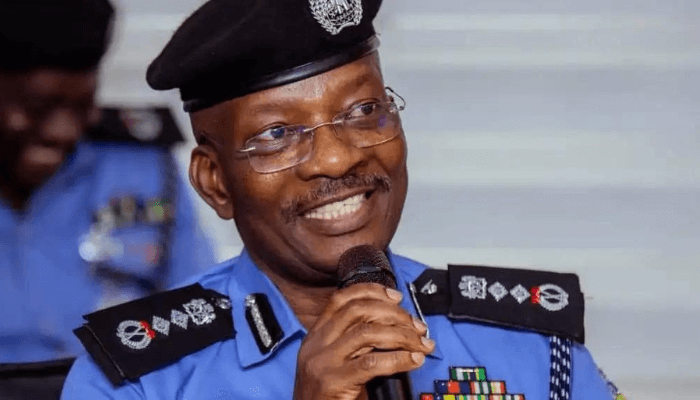
Kayode Egbetokun is the Inspector-General of Police of Nigeria, appointed on June 19, 2023. On Tuesday, news broke that he had been forced to resign. There is no public communication about the news yet.
A career police officer with more than three decades of service, he has held key operational, investigative and administrative positions across the country.
Born on September 4, 1964, in Erinja, Ogun State, Egbetokun combines an academic background in mathematics, engineering analysis and security studies with extensive experience in law enforcement leadership.
He graduated from the University of Lagos, Akoka, in June 1987 with a bachelor’s degree in Mathematics. He later obtained a master’s degree in Engineering Analysis in 1996.

He briefly lectured in Mathematics at Yaba College of Technology.
Reas also: What to know about appointed Tunji Disu, newly appointed IGP
He earned a postgraduate diploma in Petroleum Economics from Delta State University in 2000 and a Master of Business Administration from Lagos State University in 2004.
He also holds a PhD in Peace and Security Studies from Al-Hikmah University, Ilorin, Kwara State.
Egbetokun enlisted in the Nigeria Police Force on March 3, 1990, as a Cadet Assistant Superintendent of Police.

In 1999, as a Deputy Superintendent of Police, he was appointed Chief Security Officer to Bola Tinubu, the then Governor of Lagos State,
Over the course of his career, he served as Commander of the Rapid Response Squad (RRS), Lagos; Squadron Commander, Mobile Police (MOPOL); head of the Anti-Fraud Unit, FCT Command, Abuja; Chief Superintendent of Police, Administration, Lagos State Command Headquarters, Ikeja; Area Commander, Osogbo, Osun State Command; and Area Commander, Gusau, Zamfara State Command.
He later became Deputy Inspector-General of Police supervising the South-West geo-political zone and headed the Force Criminal Investigation Department (FCID), Force Headquarters, Abuja, from April 6, 2023.
On June 19, 2023, he was appointed Inspector-General of Police by President Bola Tinubu, succeeding Usman Alkali Baba.
In 2024, his continued stay in office generated controversy after he attained the mandatory retirement age of 60 on September 4.
His tenure was subsequently extended following amendments to the Police Act.