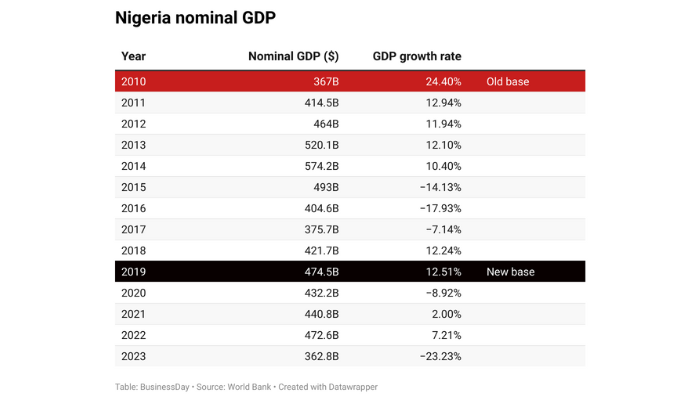
As Nigeria prepares to release its rebased GDP figures, concerns are growing over the potential misinterpretation of key indicators such as tax-to-GDP and debt-to-GDP.
This is critical, given that the previous numbers will reduce as the economy expands.
It is even more pivotal as underground economic activities—including prostitution and drug trafficking— will be reflected in the new GDP estimates.
GDP rebasing is a statistical exercise that updates the base year to measure new sectors and the activities in the economy.

As economies evolve, an outdated base year may fail to capture structural changes and emerging sectors, including shifts in production patterns, technological advancements, and the emergence of new industries. By rebasing the GDP, economic data become more reflective of present realities, improving decision-making for policymakers, businesses, and investors.
Read also: Rebased GDP, CPI must reflect economic realities, engender public trust BudgIT
Nigeria’s most recent GDP rebasing, set to be released any moment from now, will shift the base year from 2010 to 2019. According to the Nigeria Bureau of Statistics (NBS), the choice of 2019 was based on relative economic stability compared to the years after it, which saw disruptions such as the COVID-19 pandemic in 2020, currency devaluation, and fuel subsidy removal in 2024.
However, some experts have debated whether 2019 is the ideal base year, given that global economic shocks were already beginning to unfold. The new GDP figures will provide fresh insights into the structure of Nigeria’s economy and are expected to influence key macroeconomic indicators.
Why is GDP rebasing necessary?

Rebasing is essential to ensure that GDP estimates reflect current price levels and economic structures, rather than rely on outdated assumptions. This is particularly important in an economy like Nigeria’s, where sectors such as fintech, e-commerce, and digital services have expanded significantly since the last rebasing. The updated GDP figures will offer a more accurate measurement of these activities, allowing for better international comparability and more precise economic analysis.

Concern over misinterpretation of numbers
However, beyond improving statistical accuracy, GDP rebasing has broader policy implications. One area of concern is how it affects Nigeria’s tax-to-GDP and debt-to-GDP ratios. A larger GDP denominator will likely reduce these ratios, leading to claims that Nigeria is undertaxed or has a sustainable debt burden even when the country is currently on a borrowing spree.
However, as Muda Yusuf, the CEO of the Centre for the Promotion of Private Enterprise (CPPE), said in a recent discussion, “not all components of GDP generate tax revenue.”
Agriculture and informal trade, for example, contribute significantly to GDP but yield minimal government revenue. Policymakers must be cautious in interpreting the new figures to avoid misleading conclusions about taxation and fiscal policy.
How is GDP rebasing done?
The rebasing process follows internationally accepted statistical frameworks. In Nigeria’s latest rebasing exercise, several steps have been undertaken.
Selection of the Base Year: The NBS chose 2019 as the new base year due to the availability of comprehensive economic surveys and relative macroeconomic stability.
Data Collection from Multiple Sources: Key datasets include the Nigerian Living Standards Survey (2019-2023), the National Business Sample Census (2021), and the National Agricultural Sample Census (2020). These provide updated insights into household spending, business activities, and agricultural output.
Application of Global Standards: The rebasing process follows international guidelines such as the System of National Accounts (SNA) 2008, the International Standard Industrial Classification (ISIC, Rev. 4), and the Supply and Use Table (SUT) methodology to ensure comparability with global economic data.
Expansion of Sectoral Coverage: Previously underrepresented sectors such as digital commerce, fintech, modular refineries, and outsourced employment have been incorporated into GDP calculations.
A key debate surrounding Nigeria’s rebasing process is its fixed-base approach, where GDP is updated every five years, as opposed to the chain-linked approach, where GDP is continuously adjusted to reflect annual changes.
Read also: Iweala warns tit-for-tat tariff war will have consequences on global GDP
Many Francophone West African countries use the chain-linked method, which some experts argue provides a more dynamic and responsive economic measure. There are calls for Nigeria to consider adopting this approach to improve data accuracy between rebasing periods.
What to expect from Nigeria’s GDP rebasing
While the final numbers will be released any moment from now, certain trends are anticipated based on the methodologies used and sectoral shifts observed over the past decade. The rebased GDP is expected to show structural shifts in Nigeria’s economy. Some sectors, such as real estate and digital services, may see increased contributions, while traditional industries like crude petroleum could decline in relative importance.
It is also seen affecting macroeconomic indicators. The tax-to-GDP ratio will likely decline due to a larger GDP figure, potentially sparking debates about taxation policy. Similarly, debt-to-GDP and per capita income figures will be adjusted.
It will also highlight high-growth but low-weight sectors. Some industries, such as metal ore mining and rail transport, may report significant growth rates but contribute little to overall GDP, raising concerns about how aggregate growth rates are interpreted.
Implications for policymakers and businesses
The rebased GDP figures will have significant implications for both the public and private sectors.
For businesses, updated economic data will enhance strategic planning by providing a clearer picture of sectoral trends and investment opportunities.
However, as panellists in the discussion noted, GDP figures alone do not tell the full economic story. While some sectors may exhibit high growth rates, their real impact on employment, productivity, and government revenue will remain a crucial factor in policymaking.
Additionally, the issue of state-level GDP estimates have been raised, with experts advocating for more detailed subnational economic data.
While the NBS has made progress in compiling state GDP figures, only 24 states currently have detailed estimates. Expanding this effort would improve regional economic planning and investment distribution, experts say.
As discussions continue, one key takeaway is the importance of frequent updates and methodological improvements. Whether through a shift to chain-linked calculations or the expansion of state-level GDP tracking, ensuring that Nigeria’s economic data remains relevant will be crucial in driving informed decision-making in both the government and the private sector.
Read also: Three things Nigeria must do to achieve 5.5 percent real GDP growth rate in 2025 – Omisakin
What is CPI rebasing?
Consumer Price Index (CPI) rebasing is the process of updating the basket of goods and services used to measure inflation. it ensures the index reflects current consumer habits and economic realities.
“Rebasing is a very vital exercise that ensures our economic indicators are accurate, reflecting the updated structure of our economy,” Adeyemi Adeniran, statistician general and CEO of the NBS, said recently.
“It’s done to absorb the new ministries that the new government just created, upgrade the CPI basket and change the methodology of CPI and GDP,” he added.
CPI rebasing helps provide more accurate data on price changes, ensuring policymakers, businesses, and individuals can make better informed decisions.
What changes were made in methodology?
The new CPI basket now includes updated items, modern classifications, and improved methods that align with international standards, making the data more reliable than ever.
Also, because shopping habits change over time, the CPI basket has increased from 740 to 934 items.
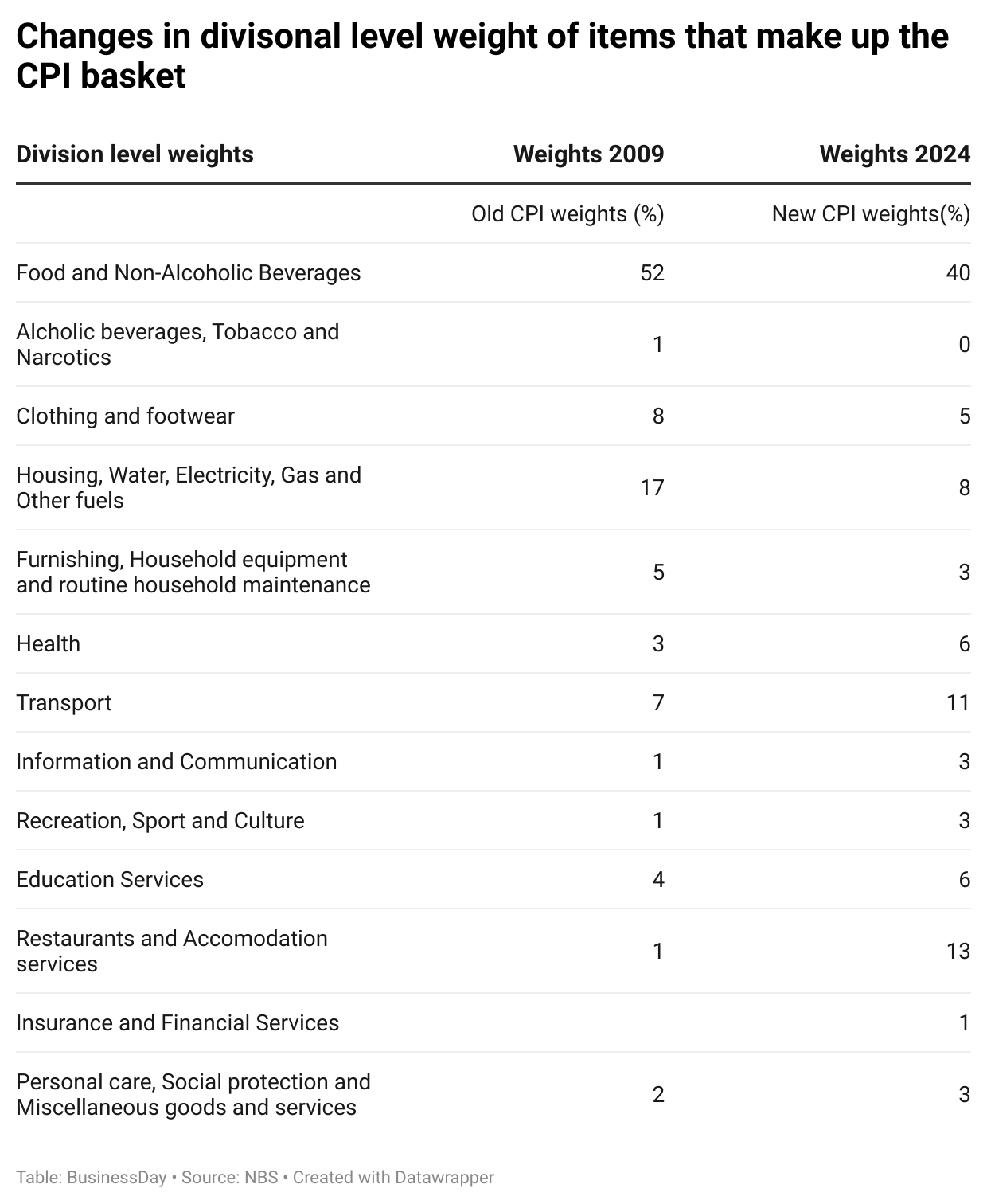
The divisional level weights of CPI have also adjusted from 12 to 13, with the addition of financial and insurance services. The percentage of existing weights were also adjusted to fit present-day realities.
Divisional level weights refers to the weighting assigned to each major category (division) of goods and services within a CPI, essentially showing how much each division contributes to the overall CPI calculation based on its relative importance in consumer spending.
Some of the divisional weights include: Food and beverages, health, transportation, as well as information and communication.
In the new methodology, food and non-alcoholic beverages weight was reduced to 40 percent from 52 percent.
What year was made the base year and why?
The NBS revealed that the base year adopted for the new methodology for the CPI is 2024.
The new reference periods are: 2023 for the weight reference period and 2024 for the price reference period (base year).
Additional indices
In addition to the regular indices computed by the NBS, the following special indexes will be computed in the rebased CPI.
The new indices include: Services index, energy index, farm produce index, and food index.
Read also: CBN predicts 4.17% GDP growth in 2025, insists Nigeria reforms paying off
Sources of data for CPI rebasing
The sources of data for the household expenditure on consumption of goods and services were the 2023 Nigeria Living Standards Survey (NLSS), the 2024 Survey of rare items, and Administrative statistics (CBN, National Insurance Commission (NAICOM), NBS National Accounts and Trade Divisions.
Other adjustments to 2024 CPI
Some other adjustments include: Migrating to the COICOP 2018 version, digitisation of price data collection, and conduct of National Census of Retail Outlets, with the inclusion of online retail outlets