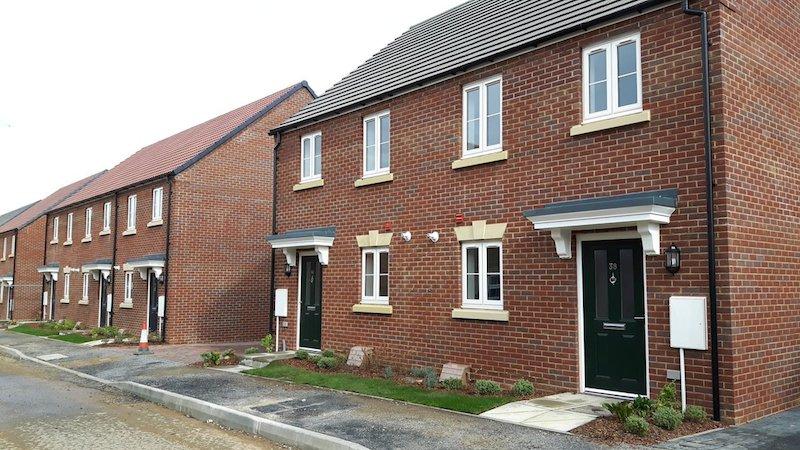
As the Federal Government thinks of its economy and new ways of generating revenue beyond Covid-19, now is good time for implementing existing housing schemes that have been waiting to be attended to.
Housing has been identifies as one of the growth areas and that must have informed the decision of the Central Bank of Nigeria (CBN) to include affordable housing among the four key sectors of the economy it wants to make funding intervention in as part of efforts to save the economy.
In recent time, the federal government, through the Central Bank of Nigeria (CBN), has been intervening in the housing sector with programmes, policies and initiatives that are aimed at getting more Nigerians, especially the low income earners, on the property ladder.
One of such interventions is the Family Home Finance (FHF). Another is the Federal Integrated Staff Housing (FISH) and then the new My Own Home scheme which is an offshoot of the Nigeria Housing Finance Programme (NHFP) set up by the Federal Government and implemented by CBN with the support of the World Bank.
Report has it that part of federal government’s plans for the housing sector is to introduce public private partnership scheme that seeks to increase access to housing finance. To achieve this, the CBN once selected 34 primary mortgage banks (PMBs) and four commercial banks to facilitate access to housing finance for low-income earners in the formal and informal sectors.
That move was meant enable those banks along with nine other micro finance banks to drive the My Own Home scheme whose main objective, in line with the parent NHFP, is to catalyse the growth of the housing sector through de-risking housing finance value chain and improving access to finance.
The scheme is also aimed to increase access to housing finance and housing in Nigeria and to inspire young Nigerians to key into mortgage process and start owning homes.
The 34 selected PMBs and others were to benefit from a Housing Micro-finance Fund estimated at $15 million, and also from a $10million Technical Assistance Fund. Unlike the conventional mortgage, My Own Home allows beneficiaries to use the loan for purchase of land, incremental building or renovation.
There is need now, more than ever before, for strengthening the housing sector by setting up sustainable framework by mortgage originators such as financial institutions to access long-term refinancing and NHFP is expected to create the enabling environment for that. It is also expected to scale-up mortgage and housing finance awareness through mortgage literacy, customers’ right, responsibilities and education.
Adeniyi Akinlusi, the MBAN President, is of the view that the scheme will revamp the housing finance sector and also make access to housing finance a lot easier. He says that NMRC will be providing long-term refinancing of mortgages and standardising mortgage procedures.
According to him, most initiatives that are solely funded and run by the government as social housing programmes are usually not successful and sustainable. “My own Home, being a PPP is likely to succeed going by our experience with other PPP programmes such as NMRC, infrastructure provision and even the pension scheme reform, which also have private sector stakeholders.”
The beauty of this scheme is that it offers mortgage guarantee that allows borrowers with insufficient or no equity contribution to access mortgage for home ownership. Besides, it will increase lending to low-income earners in the formal and informal sectors through microfinance banks for incremental housing construction or housing improvement.
The scheme has its challenges but Akinlusi reasons that, despite the challenges, public awareness is gradually being created, although there is no available statistic on the extent of coverage yet, adding that more would still need to be done in this direction.
Government believes that this scheme has the interest of every Nigerian, but being a new initiative, there is still no statistics to quantify the response of Nigerians to it. It still needs some time to take firm root and have imprint on the minds of the public.
The major challenges of initiatives like this are funding and sustainability which, in the opinion of the MBAN president, will depend on the NHFP and how it will be able to synchronise the scheme to generate public interest that would make it run on “auto-pilot.”
Expectation is that this product will provide a platform for potential mortgage clients who do not have the required equity contribution, that is, initial deposit of 20 per cent of the value of a property, for a mortgage but have the capacity to make the regular payments, to access a mortgage on the basis of a third party guarantee.
The good news then is that homeowners with insufficient or no-equity contribution can approach their lenders for a mortgage guarantee and the mortgage guarantee firm will insure only the equity contribution required so that the lender can advance the full value of the mortgage loan for the property.
Fears, however, remain that the country’s unfriendly investment climate, which is affecting the mortgage industry, could impact this scheme negatively. Akinlusi shares this view, listing high and volatile exchange rate, traditionally stringent operational guidelines for mortgage banks and general difficulty in doing business in Nigeria as potential risks, adding also issues of Foreclosure Law and inhibitions from the Land Use Act 1978.
Nigeria’s very low mortgage penetration, which is less than one per cent, is affecting the operators and factors responsible for this include dearth of titled property on which mortgage could be created as mortgage creation is always hinged on the certainty of title to land; high cost of title registration/transfer, usually 15 per cent of property value, but as high as 22 per cent in some states, as well as non-automation of government process in registration and land titling.