



|
Getting your Trinity Audio player ready...
|
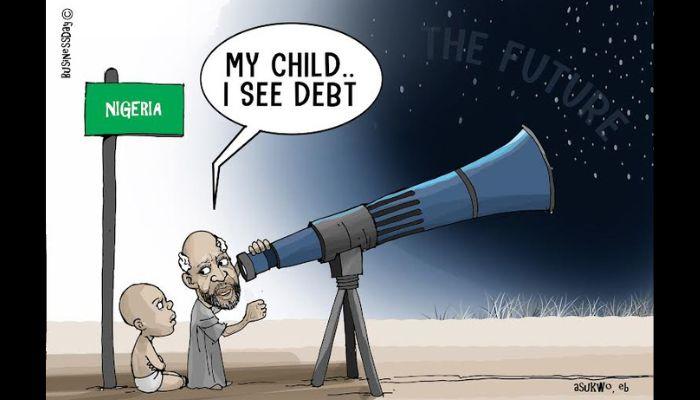
Nigeria’s total public debt has risen by N27.72 trillion to N149.39 trillion in one year, largely due to a weak naira that’s continued to balloon the country’s external obligations.
Data from the Debt Management Office (DMO) show that Africa’s most populous nation’s debt increased by 22.8 percent year-on-year as of March 31, 2025 compared to N121.67 trillion recorded in the prior period last year.
On a quarterly basis, the country’s debt surged by N4.72 trillion or 3.3 percent from N144.67 trillion as of December 31, 2024, signaling both fresh borrowings and the impact of a weakening currency on foreign debt obligations.
The rising public debt stock continues to raise concerns about the nation’s debt sustainability, particularly in view of underperforming revenues.

Read also: Debt pressure mounts as FG misses revenue target by 31%
In a bid to reduce borrowings and boost the country’s revenue base, President Bola Tinubu recently signed four landmark tax reform bills that are expected to unlock investment and increase the nation’s tax-to-GDP ratio.
The federal government is also increasingly engaging in concessionaire financing and public private partnerships to cut its exposure to external debt. But pressures still persist.
Nigeria’s external debt, though rose marginally in dollar terms ($42.12 billion to $45.98 y-on-y) soared by 26 percent in naira terms as devaluation takes a toll on the country’s foreign debt.
The debt obligation jumped to N70.63 trillion from N56.02 trillion in the same period in 2024, even though it saw a modest growth on a quarterly account by N344 billion.

Read also: Nigeria’s tax reforms set to unlock billions in investment, revenue
Nigeria continues to face a debt crisis due to its weakened currency that’s made loan repayments somewhat a burden. The naira shed more than 41 percent of its value in 2024.
While the currency has witnessed some recent stability, it is still weak, piling pressure on servicing the country’s debt stock.
Domestic debt also maintained an upward trajectory, rising to N78.76 trillion or $51.26 billion at the end of March 2025.
According to the DMO, the composition of the total public debt showed a near-even split, with domestic debt accounting for 52.7 percent and external debt making up 47.3 percent.
Read also: Nigeria’s debt hits record N145trn on rising borrowings
This represents a slight shift from the structure recorded in March 2024, when domestic debt had a higher share of 54 percent while external debt stood at 46 percent.
A report by CardinalStone earlier in the year had predicted that Nigeria’s debt may balloon to N187.79 trillion by the end of this year.
The analysts said the surge would be fueled by the issuance of a dollar-denominated domestic bond ($900.00 billion), regular borrowings through Nigeria Treasury Bills (NTBs) and bonds, and the country’s recent return to the Eurobond market to raise $2.20 billion.
It added that the country has Eurobond maturities averaging $1.33 billion annually over the next decade. Including coupon payments, total annual debt servicing costs could average $2.24 billion.
Although the current public debt-to-GDP ratio is slightly below the IMF’s 60 percent benchmark for emerging market countries, the nation’s weak revenue profile and FX volatility risks could further escalate debt levels, straining the already strained economy.





