For Isaac Ghinai, it was a red alert. In late January, a woman aged in her 60s who had just returned from Wuhan in China was admitted to hospital in the Chicago area with coronavirus symptoms, the second known case in the country.
Days later, her husband was also admitted to hospital after testing positive. As he had not travelled abroad with his wife, this meant one thing: he was the first known person to contract the virus while in the US.
That news set Dr Ghinai and a team of 20 other health officials on a hectic scramble to track down exactly where the couple had been in recent days and who they had met. “It was a big, dawning realisation that we were doing the first [human-to-human] Covid-19 transmission event known in the US,” he says.
Dr Ghinai is what is known as a contact tracer, one of a team of epidemiological fieldworkers who map out the movements and meetings of individuals who have recently tested positive for an infectious disease, be it Ebola, tuberculosis — or the novel coronavirus.

An officer of the Epidemiological Intelligence Service, which is part of the US Centers for Disease Control, or CDC, he is currently working in Illinois. The service deploys between 130 and 160 people at any one time, usually spread across the globe, but for now they have all been recalled to the US to deal with the pandemic at home.
Contact tracers such as Dr Ghinai will be an essential component of most viable plans to end the coronavirus lockdowns and reopen economies across the world.
The discussion about exit strategies has largely focused on two capabilities that will be needed to prevent new outbreaks of infections once people go back to work — extensive testing to spot new infections and smartphone apps that can provide a record of an infected person’s recent locations.
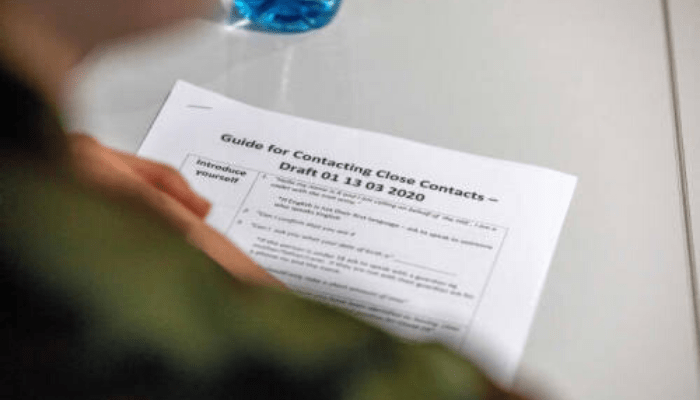
However, there is a third element that has generated much less attention — the manual work that is needed to trace new infections. The new health apps will be, at best, a partial solution to mapping an outbreak because they can often provide only clues about possible contacts. In order to ensure that newly infected people do not spread the disease, health authorities will also need much more detailed information about their movements and encounters.
That means governments will need to hire huge teams to do the detective work of compiling the contacts of new patients, using follow-up interviews to check for symptoms of the virus and potentially getting in touch with their contacts as well.

Health authorities are only beginning to come to terms with the scale of resources required to mount an effective manual contact-tracing operation — as countries such as Taiwan, South Korea and Singapore did earlier this year.
Johns Hopkins University’s Bloomberg School of Public Health estimates that the US will need to hire at least 100,000 people to handle contact tracing, at a cost of about $3.6bn. Tom Frieden, a former director of the CDC, has said the figure could be three times higher.
Speaking last week, the current director of the CDC, Robert Redfield, said that there would have to be a substantial expansion in the number of public health workers able to conduct contact tracing once the economy reopens.
“We can’t afford to have multiple community outbreaks that can spiral up into sustained community transmission,” he told NPR. “It is going to be very aggressive, what I call ‘block and tackle’, ‘block and tackle’.”
Dr Ghinai’s hectic January in Chicago demonstrates the sort of painstaking legwork that is required. On the basis of just two initial infected individuals, the team he works with monitored almost 350 contacts, which included people at their workplaces and at the shops, and healthcare facilities they had visited.
These contacts then received automated emails twice a day inquiring about symptoms. If they didn’t respond or showed signs of the illness, officers would call them. The Illinois Department of Health also used data from acute care hospitals to match other possible contacts.
In the end, 75 other people were tested for Covid-19, although the only two to be positive were the original couple. Dr Ghinai says this was partly down to the aggressive tracing.
“The hardest part is for folks to give you a complete list of people they’ve shared [spaces] with,” says Eric Pevzner, the head of the EIS, who is currently deployed to Utah. “Often, when you repeatedly interview someone they’ll have forgotten a cousin’s boyfriend. That’s the real challenge — it’s the couple of people” who don’t recall all the locations they have been to. “And if you don’t evaluate them, it’s really hard to stop the spread.”
In the US, UK and other western countries now reeling from the impact of the pandemic, contact tracing was deployed at the start of the outbreak but had become a secondary tool by February and March, when the numbers of new infections overwhelmed the capacity that is currently in place.
More recently, contact tracing teams have been focusing on locations where population densities bring a higher risk of the illness spreading, such as prisons and care homes, in an effort to control outbreaks in those places.
“The congregate settings are the most challenging, where you have hundreds of people sharing a space or a dining room or a toilet,” he says. “It’s very difficult to define who is at risk and who is a contact, and to work out where the virus may have been introduced from.”
Even amid the turmoil of the past two months, however, there have been some successful examples of manual contact tracing that have helped blunt the spread of the disease.
In the small town of Vò, near Venice, a group of researchers operating from a local school between February and March conducted an epidemiological experiment that coupled aggressive testing and contact tracing to bring down the rate of new coronavirus infections to zero. The project had begun as a last-ditch effort to contain the virus, but yielded one of the most complete epidemiological pictures of the spread of the disease in a small community.
Vò is where the first Italian death from coronavirus was recorded in February, and it was one of the first places in the country — which has suffered one of the worst outbreaks in the world, with more than 20,000 deaths — to go into strict lockdown.
Stefano Merigliano, a University of Padua professor of medicine who directed the effort on the ground, says there were groups of about 16 people each doing contact tracing inside the school over three days. “We got there at 9 in the morning, and people were already queueing outside.”
The testing unearthed asymptomatic cases of people who were unaware of their disease but still contagious. Once they had found out who in the population was infected with the virus, contact tracers, who included recent graduates and Red Cross nurses formerly deployed to war zones, outlined the spread of the disease in a series of maps. For the most part, people involved were volunteers.
Understanding where the virus had spread enabled officials to isolate potential new cases. As a result, scientists were able to bring the rate of infection down from 3 per cent to 0.3 per cent, says Andrea Crisanti, an Imperial College London professor who also worked on the study.
The first cluster in Vò was in a café. Authorities believe it can be traced back to a woman returning from Germany.
“In strict quarantine and lockdown, you don’t need contact tracing: you know where everyone is and has been,” says Prof Crisanti. “But as soon as people start moving again, contact tracing becomes essential.”
The methods deployed by contact tracers are not unlike those used by detectives. “We would take names, and their most frequent contacts,” says Dr Merigliano. “It’s a public hygiene principle that’s been known since the 1950s: find the sick, isolate them, and divide the sick from the healthy. Whether it’s Ebola, Sars, or whatever it is.”
Dr Ghinai says it is crucial to win the confidence of the infected patients — given that they are being asked to hand over potentially deeply private information about their lives. “One very important thing is to build rapport and have people completely trust you and then take the time to listen,” he says. “Often you get a lot of things with a single question . . . And one thing we found very helpful is pulling up a calendar and asking: ‘Where did you have lunch, where were you then?’”
Surrounded by disease and potentially death, it can also be emotionally challenging work. Dr Pevzner describes tracing contacts for a household in which the father had been in hospital. While he was in touch with the family, the mother and daughter also tested positive.
“She let us know that her husband had died. It was just crushing. Now the mother was positive, the daughter was positive, the son was negative and he was isolated in the basement,” he says. “None of them were able to see the father. The mother and daughter couldn’t even console their brother and son. It was like Ebola in Africa: the family not being able to mourn and not being there for one another for fear of transmission,” he recalls. “It’s devastating.”
Dr Ghinai describes cases when infections had spread during a birthday party and at a funeral — the sorts of large family gathering that are now not permitted or heavily restricted under social distancing regulations.
“It’s heartbreaking that they don’t mourn together,” he concedes. “But so important.”
The issue that governments face is the scale of the contact tracing operation they will need to have in place once they decide that the rate of new infections has fallen sufficiently to allow economies to reopen. The theory is that a mixture of testing and contact tracing can quickly capture new outbreaks, allowing for infected patients to be isolated before they pass on the virus.
That, however, will require a lot of manpower. While New Zealand has deployed only 190 health workers to trace contacts in a country of 4.9m people, the World Health Organization says that the Chinese authorities sent 9,000 contact tracers just to Wuhan alone, as they sought to control the outbreak in the city with a population of 11m.
The Johns Hopkins report, which recommends that the US hire 100,000 people to do contact tracing, concludes: “While this figure may be stunning, it is still the equivalent [in per capita terms] of less than half the number employed in Wuhan City.”
The CDC estimates that it currently has only around 600 people doing such work across the US, however both the federal government and states are already scaling up. Massachusetts, for instance, has announced plans to hire another 1,000 people to do contact tracing. In Utah, authorities are recruiting health department staffers without a science background to help with tracing in the next phase.
In the UK, there is growing pressure to significantly expand tracing as the debate about relaxing the lockdown intensifies.
“The UK urgently needs to reinstate contact tracing and implement it as widely as possible to identify where the virus is and regain local control over the epidemic before lockdown can safely be lifted,” says Tim Colbourn, an associate professor at University College London’s Institute for Global Health. “With wide enough contact tracing, testing and isolation, additional periods of lockdown may also be avoidable.”
Yvonne Doyle, director of health protection at Public Health England, says contact tracing is still taking place. “While we no longer follow up every case, we are focused on specific places, such as residential settings, to protect those most at risk of infection,” she adds.
She said the health authorities have plans to scale up contact tracing rapidly, although PHE and the Department of Health and Social Care declined to provide specific numbers.
Linda Niccolai, a professor of epidemiology at Yale and the director of Connecticut’s emerging infections programme, says she was called in to mobilise a group of volunteers to assist the city of New Haven, where Yale is based.
While there have been challenges, she says the main added benefit of contact tracing is the outreach to the community. “People appreciate the phone calls,” she says.
“Once we’re on the downside of the curve, contact tracing will become really important, especially as social distancing and self-isolation procedures get lifted and people start going back out into the community,” she says.
“This virus is with us now.”