|
Getting your Trinity Audio player ready...
|
The United States has approved the export of some of its most advanced artificial intelligence chips to G42 of the United Arab Emirates and to Saudi buyers, a move that sharpens Washington’s tech cooperation with the Gulf at a time of rising competition in global computing.
The Commerce Department said it had authorised both countries to purchase the equivalent of up to 35000 Nvidia Blackwell chips. The decision, it said, will reinforce America’s lead in AI while supporting partners that Washington considers central to its long term technology strategy.
Read also:US, UAE unveil multi-trillion dollars AI, aviation, energy deals as Trump visit
“These approvals will promote continued American AI dominance and global technological leadership,” the department said, citing President Trump’s July 2025 AI Action Plan. It added that the clearances were tied to strict security and reporting rules that the department’s Bureau of Industry and Security will monitor on an ongoing basis.

The move coincided with the first visit to the United States by Saudi crown prince Mohammed bin Salman since 2018, a timing officials read as a signal of Washington’s support for both Saudi and Emirati ambitions to build major AI industries.
Read also:UAE president meets OpenAI CEO to discuss AI collaboration – Reuters
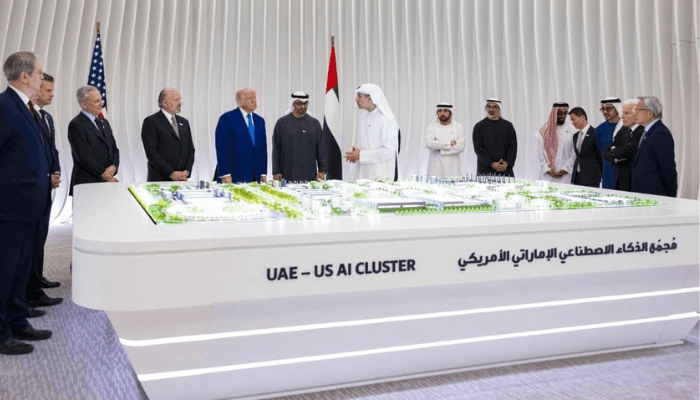
For the UAE, the approval is a major boost for G42, the Abu Dhabi based, state linked technology group that has become the country’s primary AI champion. The licence allows the firm to advance work on Stargate UAE, a planned one gigawatt computing complex being built for OpenAI and backed by Oracle, Cisco, Nvidia and SoftBank. The project anchors a wider US UAE AI campus expected to reach five gigawatts of capacity and give the region access to low latency computing at a scale not available today.
Bing Xiao, G42’s chief executive officer, described the approval as a turning point. “Today we move from planning to execution with strength, setting a new global standard for secure and high performance computing. What we build in the UAE will be fully mirrored in the United States,” he said.
The chips will operate under G42’s Regulated Technology Environment, a framework designed in line with US export controls. The company says the system makes the UAE the only country in the region applying this level of compliance.

Read also:UAE president meets OpenAI CEO to discuss AI collaboration Reuters
Khaldoon Khalifa al Mubarak, chairman of the UAE Artificial Intelligence and Advanced Technology Council, said the decision underlined the depth of the partnership. Technology, he said, has become “a platform for economic stability, regional security and long term cooperation.”
The licence also fits into a broader web of US Gulf deals. Both countries have signed AI partnership agreements with Washington, and the UAE earlier this year pledged to invest $1.4 trillion in the United States over time. The crown prince’s visit to Washington was aimed in part at securing deeper economic and security ties.
The approval further entrenches G42’s relationships with Microsoft, AMD, Qualcomm and Cerebras. The company runs three of the world’s top 500 supercomputers and this year activated Maximus 01 in New York, which debuted at number 20 globally. Its operations now span Abu Dhabi, France and several US states.
G42, chaired by Sheikh Tahnoon bin Zayed al Nahyan, the UAE national security adviser, also plans to build one of the world’s largest data centre hubs in the Emirates using US technology. The first phase of Stargate UAE is due to go online in 2026.
By securing access to the newest generation of American chips, the UAE and Saudi Arabia have moved further into the global contest for computing capacity. Washington, for its part, has shown it is willing to back their ambitions as long as the technology stays within controlled and broadly aligned partners.