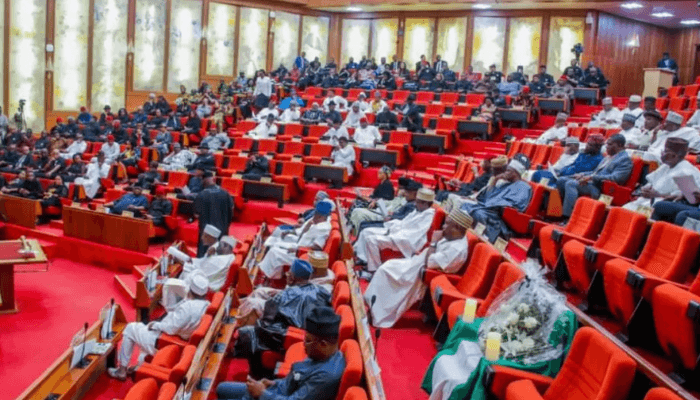
The House of Representatives on Tuesday advanced 39 constitution amendment, most of which aimed at reforming Nigeria’s judiciary and electoral system, passing them for a second reading.
Of these, 10 bills focus on judicial reforms, while 13 are designed to overhaul the electoral system. The House suspended its rules to facilitate their second reading during plenary.
Judicial Reforms
Among the bills passed for a second reading is a Bill for an Act to alter the Constitution of the Federal Republic of Nigeria, 1999, making recommendations by the National Judicial Council mandatory for the removal of heads of Nigerian courts. The bill, sponsored by Abbas Tajudeen, the House and Marcus Onobun, seeks to amend Section 292(1)(a)(i) and (ii) of the constitution.

The Bill seeks to alter Section 292(1)(a)(i) and (ii) of the constitution of such that the heads of Nigerian courts shall only be removed from office upon prior investigation by the National Judicial Council of the allegations laid out in the address by Senate or the state legislatures respectively carried out and concluded within six weeks in line with the Supreme Court judgment in Elelu-Habeeb & Anor. v. A-G of the Federation & 2 Ors. (2012) 13 N.W.L.R.
The House also advanced a bill to establish the Ecclesiastical Court of Appeal for the Federal Capital Territory, Abuja, and similar courts across the states to adjudicate Christian religious matters.
Additionally, a bill was passed to make the Court of Appeal the final appellate court for governorship, National Assembly, and State House of Assembly election petitions, thereby removing the Supreme Court from such appeals.
Another bill proposes to confer original jurisdiction on the Court of Appeal in matters relating to the office of a governor or deputy governor.
The House also passed a bill to grant the Federal High Court jurisdiction to try offences arising from violations of the Electoral Act and other related laws.

Furthermore, a bill was advanced to ensure a smooth transition for substantive heads of courts in Nigeria and strengthen the procedure for removing judicial officers, thereby safeguarding judicial independence. Another bill aims to curb the excessive concentration of powers in the office of state chief judges.
To improve efficiency in the judiciary, the House advanced a bill to expand the number of justices on the Supreme Court, ensuring a faster dispensation of justice. Additionally, a bill was passed to provide for the presumed resignation of the Chief Justice of Nigeria, justices, and judges of certain courts under specific conditions.
Another bill seeks to increase the composition of the Code of Conduct Tribunal from three to seven members, ensuring representation from each geo-political zone in Nigeria.
Read also: Reps propose 23 bills to reform Nigeria’s judiciary, elections
Electoral Reforms
In the area of electoral reform, the hosue advanced a bill seeking the establishment of a Political Parties Registration and Regulatory Commission, which would be responsible for registering, regulating, and monitoring political parties.
Another electoral reform bill seeks to mandate that general elections for the President, Governors, National Assembly, State Houses of Assembly, and Local Government Area Councils be conducted simultaneously on the same date, as determined by the Independent National Electoral Commission (INEC) in consultation with the National Assembly.
Additionally, a bill was introduced to amend Sections 68(1)(g) and 109(1)(g) of the Constitution to require the official resignation of lawmakers from their political parties before defecting to another party.
Another bill proposes the compulsory resignation of national and state executive members of political parties who intend to contest elective positions.
The House also passed a bill to ensure that all election appeals arising from election tribunals are determined before the swearing-in of elected officials, including the President, Vice-President, Governors, Deputy Governors, and members of the National and State Assemblies.
Further electoral reforms include a bill to grant INEC the power to conduct Local Government Area Council elections, removing this responsibility from state electoral commissions.
Conversely, another bill seeks to establish the National Local Government Electoral Commission as an independent body responsible for organising, conducting, and supervising elections for chairpersons and councillors across Nigeria, including the Federal Capital Territory. This reform aims to ensure the credibility, transparency, and fairness of local government elections while promoting grassroots democratic governance.
Additionally, a bill was passed to relieve state Independent Electoral Commissions of the power to conduct local government elections, transferring this authority to INEC.
Other electoral reform bills include proposals to regulate election timelines, extend the Court of Appeal’s original jurisdiction to cover governorship and deputy governorship election petitions, and alter the National Assembly’s power to adjust election tribunal timelines.
Another Bill sought to amend Sections 143(2)(a) and 188(2)(a) of the Constitution.
Others
The others bills proposes amendments to the legislature and seeks inclusive governance. They include:
A Bill to alter the Constitution to Provide for the establishment of State Police and Local Government Police; a Bill to make provision for the Chief Justice of Nigeria to make Proclamation on the Inauguration of National Assembly.
A Bill to Specify the Time Within Which the Executive Shall Present to the National Assembly any Treaty Between the Federation and any Other Country for Enactment; A Bill to alter the Oath Taking of the Members of the National Assembly and Members of Assembly in Sections 52, and 94 of the Constitution of the Federal Republic of Nigeria.
A Bill to to remove transitional Law-Making Powers from the Executive Arm of Government; A Bill to establish the FCT House of Assembly; A Bill to regulate the Application of Regional and International Human Rights Treaties Ratified by Nigeria; A Bill to
Provide for Uniform Standards and remove ambiguity.
A Bill to provide for Special Seats for the Physically Challenged Persons in Nigeria’s Federal, State and Local Government
Areas, and Legislative Houses; A Bill to provide for Six Special Seats for Special Interest Groups in the House of Representatives and for Related Matters.
A Bill to ensure Gender Equality in the Composition of the Federal Character Commission; A Bill an Act to Alter the Constitution of the Federal Republic of Nigeria 1999 to Permit Public Servants to engage in Healthcare Education, Production and Services beyond Farming.
A Bill to Provide for the Recognition and Development of the Geo-Political Zones in Nigeria; A Bill to Change the Name
of the Auditor-General of the Federation to Auditor-General of the Federal Government; A Bill to Remove the Restriction Placed on Power and Duties of the Auditor-General of the Federation and States by Sections 85(2) and 125(2) Respectively and to Insert New Sections in the Constitution that Shall Provide for the Financial Autonomy of the Offices of the Auditor-General of the Federation and of the States.
A Bill for an Act to strengthen the Office of the Auditor-General of the Federation and the Auditor-General of a State.