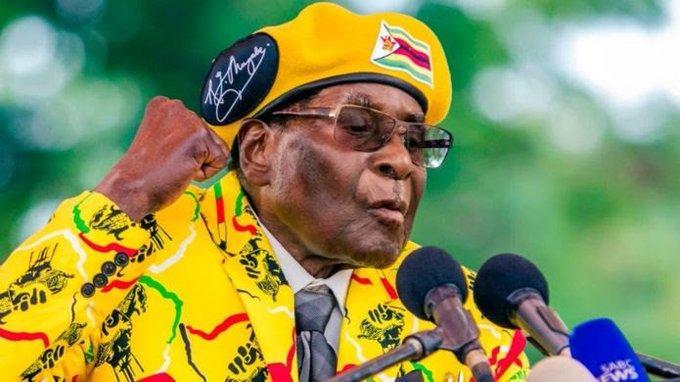
The Federal Government of Nigeria has commiserated with the Government and people of Zimbabwe over the death of Robert Mugabe, the former President of Zimbabwe from 1980-2017. The former President died after a protracted illness on Friday 6th September, 2019 in Singapore at the age of 95.
A statement signed on Friday by the Spokesman of Nigeria’s Ministry of Foreign Affairs, Ferdinand Nwonye, praised Mugabe as a notable icon in the liberation struggle in the continent and Africa. He stressed that Africa and the world “owe a huge debt of gratitude to this highly intelligent and courageous leader who fought and sacrificed so much to liberate his country and free his people from minority white occupation.”
The statement said further that Mugabe was also in the vanguard of the fight to free several countries of Southern Africa from apartheid and colonialism. It added that the departed statesman will also be remembered for leading his country to great heights after independence until the economic sanctions imposed by western countries on account of the expropriation of land occupied by white Zimbabweans, crippled his country economically.
“He was a true pan-Africanist and true patriot. Africa has indeed lost one of its finest” the Nigerian government said.

Mugabe was a hero in the struggle against colonial rule and his enormous efforts were instrumental in bringing about the end to colonial rule and independence for his country in 1980 through the Zimbabwe African National Union Patriotic Front (ZANU PF) party.
He led Zimbabwe from 1980 until he was ousted from power in a military coup in November 2017, ending his over 30- year rule.
Mugabe was born on 21 February 1924, in what was then Rhodesia. During the liberation struggle he was imprisoned for more than a decade without trial after criticizing the government of Rhodesia in 1964. While serving his prison term he was chosen as president of the Zimbabwe African National Union (ZANU), of which he was a founding member
His reign became increasingly controversial in the last decade as he was criticized for abandoning the ideals of the struggle. He was in constant altercation with the West over his controversial policy of land seizure from White Zimbabwean farmers, which he said was to address the injustice done his people.