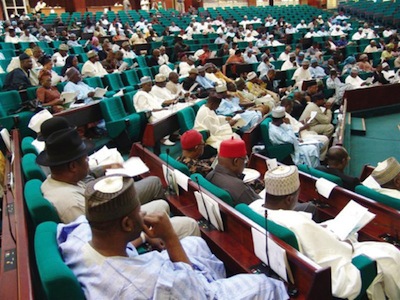
Members of the House of Representatives on Tuesday endorsed the enactment of a new legislation that will compel the Federal and State Governments to ensure regular review of national minimum wage.
The lawmakers stated this during the consideration of the amendment of the National Minimum Wage Act, Cap. N61, Laws of the Federation of Nigeria, 2004, which scaled through second reading, as sponsored by Femi Gbajabiamila (APC-Lagos).
The bill which seeks to make provisions for periodic review of the national wage every five years and for other related matters, came on the heel of agitation by the organised labour for the upward review of the current N18,000 national minimum wage to N56,000.
With the new amendment, Minister of Labour and Employment may by order published in the Federal Gazette review the minimum wage any time before 5 years from the day of last review in the event of some supervening circumstances in the interest of the national economy and Nigerian workers

In his lead debate, Gbajabiamila who blamed the continuous clamour for increased minimum wage by workers across the country on inflation, adding that the first review shall be effective from January 1, 2017 irrespective of the day the bill comes into force.
“Section 1 of the Principal Act is hereby amended in sub-section 2 by inserting immediately after the word ‘whatsoever’ in line 2 a proviso to read as follows: Provided that the minimum wage in sub-section 1 of this section shall be subject to periodic review every 5 years and the first review shall be effective from the 1st day of January, 2017 irrespective of the day the bill comes into force.
“Section 2 of the Principal Act is hereby amended by inserting immediately after sub-section 2 a new sub-section 3 to read as follows: “The Minister may by order published in the Federal Gazette review the minimum wage any time before 5 years from the day of last review in the event of some supervening circumstances in the interest of the national economy and Nigerian workers.
“Provided that in the event that this sub-section is activated by the Minister, the next periodic review contemplated under section 1 shall be 5 years after the review under this sub-section.”
The Majority Leader also stressed the need to review Section 9 of the Principal Act by inserting immediately after paragraph a new paragraph as follows: ‘Review’ means either maintaining status quo which shall not be maintained for two consecutive periods, or upward review.

“It is unfortunate that there is no law that compels or mandates the government to review workers’ salaries periodically.
“It is rather done at whims and caprices of the government no matter what the situation. This review is not a privilege but fundamental right of the citizens.
“You cannot say you are fighting corruption without giving the people the leeway to put bread on their tables,” Gbajabiamila stressed.
In her remarks, Nkeiruka Onyejeocha, chairman, House Committee on Aviation expressed optimism that the bill will help to prioritize the well-being of Nigerian workers.
Onyeojeocha (PDP-Abia) added that review of workers’ salary would encourage efficiency within the public service.
On his part, Rotimi Agunsoye (APC-Lagos) who described the current N18,000 national minimum wage as inadequate for the survival of an average Nigerian worker, argued that failure to review the minimum wage could further trigger corrupt practices among workers.
Following the overwhelming support for the bill, Speaker Yakubu Dogara referred the bill to the House Committee on Labour, Employment and Productivity for further legislative action.
KEHINDE AKINTOLA, Abuja