The Central Bank of Nigeria (CBN) on Tuesday retained its benchmark interest rate at 13.5 percent in consideration of the improving growth occasioned by increased credit to the economy.
The Monetary Policy Committee (MPC) decided by a unanimous vote to maintain the policy rate to 13.5 percent and to hold all other policies constants. Consequently, cash Reserve Ratio (CRR) was retained at 22.5 percent, the Liquidity Ratio at 30 percent as well as the asymmetric corridor around the MPR at +200 and -500 basis points.
However, analysts are sceptical about the direction of the foreign exchange and external reserves. “Given recent pressure on inflation, it was always something of a forgone conclusion that the MPC would hold the MPR steady,” Razia Khan, managing director, Chief Economist, Africa and Middle East Global Research said.
“The real question is around whether investors will be appeased by the messages on the FX rate. Is there tolerance for FX reserves going down as well as up, and will investors ‘buy’ the CBN’s message around the ongoing commitment to FX stability? We think, for now, these messages are received clearly by all stakeholders,” Khan said.

Nigeria’s external reserves have declined by 11.52 percent to a five month low of $39.95 billion as at November 21, 2019 from a peak of $45.15 billion as at July 5, 2019, data from CBN indicated.
Loans and advances have risen by over N1.1 trillion between June to October 2019, following the CBN’s directive to banks on Loan to Deposit Ratio (LDR).
Gross Domestic Product (GDP) grew by 2.28 percent (year-on-year), in real terms, in the third quarter of 2019 compared to the third quarter of 2018 which recorded a growth of 1.81 percent, according to the National Bureau of Statistics (NBS).
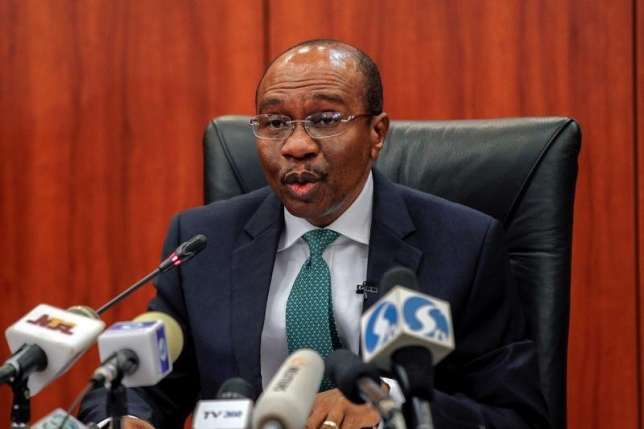
Announcing the decision of the Monetary Policy Committee (MPC) meeting, which held its last two days meeting in the year in Abuja, Godwin Emefiele, governor of CBN said the MPC noted with pleasure the positive outcomes of actions already taken by the Apex bank.
These actions he said have boosted credits to the agric and manufacturing sector, hence the positive outcome on the GDP. The MPC is hopeful that the loan to deposit ratio incentive must be sustain as interest rate being paid by borrowers has so far dropped by up to 400 basis points between June and now.

“This has happened with corresponding decline in Non-Performing loans (NPL) to 6.5 percent at the end of October 2019. The MPC is of the view that sustaining the MPR in its current level is critical to the empertois of growth before deciding on any proper able variations,” Emefiele said.
The MPC also feels that holding its current policy position offers pathways for appraising the effect of orthodox policy to encourage lending by the banking industry without varying the policy rate as the downside risk and caution on inflation looks stable.
Emefiele noted the MPC’s advice to the Federal Government to sustain the closure of Nigeria’s land borders.
He said sustaining the border closure would ensure the government uses the opportunity to create jobs and keep industries alive.
In August, President Muhammadu Buhari ordered the partial closure of Nigeria’s border with the Benin Republic to curb smuggling of rice and other commodities, and also directed the CBN to stop providing dollars to import food items in a bid to ramp up local farm production and attain full food security.