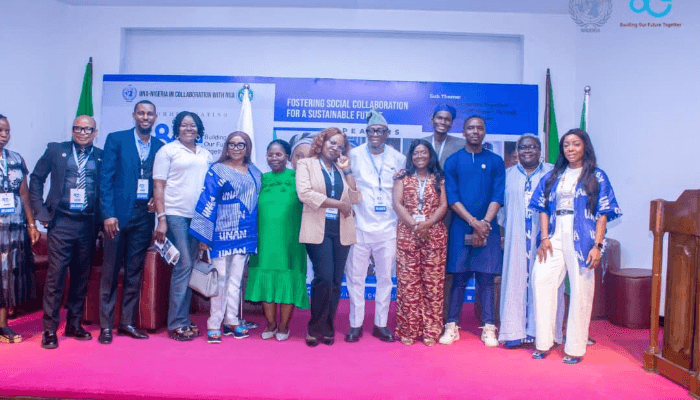
As the United Nations (UN) celebrates 80 years, the United Nations Association of Nigeria (UNA-Nigeria) has highlighted education, innovation, and inclusive action as key drivers to fast-track Nigeria’s progress toward achieving the Sustainable Development Goals (SDGs).
Making the assertion was UNA-Nigeria President, Oluremi Olutimo, who emphasised that collaboration and creativity were indispensable to achieving the 2030 Agenda.
Olutimo, who is a professor, spoke at the UNA-Nigeria Day 2025 celebration themed “Fostering Social Collaboration for a Sustainable Future.”
He said, “The world cannot hit the target of the 2030 Agenda by working alone, especially after the setback caused by COVID-19.”

The professor underlined that “every partnership needs structure, trust, and clarity” based on his experience overseeing a $70,000 project in Liberia through an international partnership lead by Poland. To ensure that no one is left behind, he urged Nigerian businesses and organisations to embrace digital transformation, align with the SDGs, and implement inclusive policies.
Olutimo reaffirmed the importance of empathy and knowledge in sustainability while describing how he stepped in to assist a student who was struggling financially to finish her postgraduate studies.
Similarly, Lanre Amodu, deputy vice-chancellor of Covenant University, representing Vice-Chancellor, Professor Timothy Anake, reaffirmed the university’s commitment to advancing peace, innovation, and sustainability through research and strategic partnerships.
“As an institution dedicated to knowledge creation and global impact, Covenant University shares in the UN’s vision for a peaceful and prosperous world,” Amodu who is a professor said, affirming the university’s openness to collaborations promoting SDGs such as peace, global education, and inclusive research.
Director of Studies, Efem Ubi, who represented the Director-General of the Nigerian Institute of International Affairs (NIIA), described Nigeria as “a vital, pounding heartbeat” in the global system.

He underscored the nation’s contributions to peacekeeping, diplomacy, and development, while cautioning that the world continues to face complex challenges; from poverty and famine to climate change, terrorism, and digital disruption.
Ubi, who is a professor, reiterated the NIIA’s partnership with UNA-Nigeria as part of its mission to turn Nigeria’s potential into actionable global influence, even as he urged stakeholders to go beyond rhetoric and build meaningful collaborations that include marginalised voices.
Chairman of the UNA-Nigeria Board of Trustees, Ambassador Ayo Olukanni, equally urged leaders and citizens alike to translate SDG discussions into measurable outcomes.
Recalling his experience at UN climate talks in Nairobi, he shared the story of a small island nation of just 1,500 people fighting for survival as rising seas threatened their home.
“It was not theory it was real. Our journey in the UN system has always been about service, learning, and bridge-building,” he said.
Gender equality took centre stage in a rousing address by Founder of Premier Services LLC, Ngozi Dike, who declared that empowering women and girls remains essential to achieving the SDGs.
“When a woman heals, a nation rises,” she declared, noting that over 351 million women and girls worldwide still face systemic oppression.
She enjoined Nigerian leaders to back their commitments with concrete laws guaranteeing safety, access, and opportunity for women and girls.