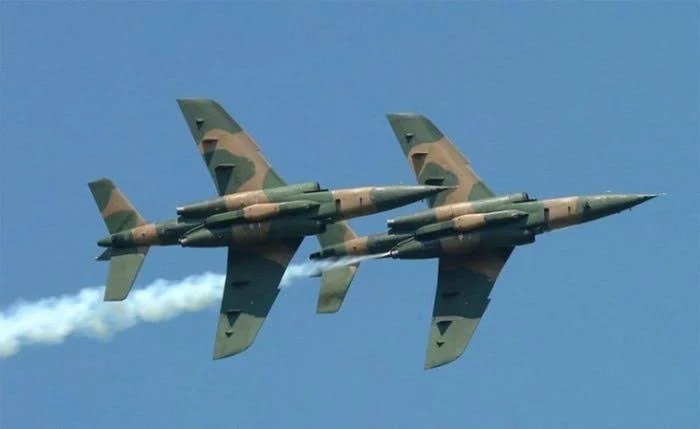
The Nigerian Air Force (NAF) has received international commendation for its leadership in safeguarding civilian lives during military operations.
This recognition came during the recently concluded United Nations (UN) and Tunisian Defence Forces–sponsored Conference on the Protection of Civilians, held in Tunis, Tunisia.
According to a statement signed by Ehimen Ejodame, Director of Public Relations and Information, the gathering which drew over 100 participants including senior military officials, UN representatives, and civil society leaders from across Africa.
It noted that NAF was celebrated for its forward-thinking approach to civilian harm mitigation.

“Delegates praised the Force for integrating leadership oversight, personnel training, and comprehensive data systems into its operational planning.
“These measures, they noted, serve as a model for modern air forces navigating complex conflict environments.
“Central to the recognition was the Nigerian Air Force’s Civilian Harm Mitigation and Response-Action Plan (CHMR-AP), which has become a cornerstone of its evolving operational doctrine”, the statement read.
It further noted that participants at the Conference acknowledged the NAF’s strategic efforts to tackle issues such as target misidentification and confirmation bias, while also establishing a clear communication structure to manage responses to civilian harm incidents.
Representing Hasan Abubakar, Chief of the Air Staff (CAS), Edward Gabkwet, Director of Cooperation and Coordination at the NAF Civil-Military Relations Branch, underscored the Force’s constitutional and moral duty to protect civilians.

He reaffirmed that the commitment to civilian protection is enshrined in Nigeria’s 1999 Constitution and is integral to the NAF’s mission.
Abubakar also stressed that military success must not be pursued at the expense of civilian lives.
He noted that Nigeria’s air operations are guided by a philosophy of both precision and compassion, and emphasised that any military gains made without regard for civilian harm could ultimately lead to long-term strategic setbacks.
According to the Air Chief, the lessons of past conflicts have shown that failure to prioritise civilian protection can undermine broader national and regional security goals.
“Since the unveiling of the CHMR-AP, the NAF has moved swiftly from conceptual planning to full-scale implementation”, he added.
The Air Chief explained that the Force has established dedicated oversight structures to monitor the plan’s execution.
“These include the inauguration of a Civilian Harm Mitigation and Response Board, the activation of a Civilian Harm Assessment Cell to lead investigations into reported incidents, and the creation of a specialised department within the Air Warfare Centre focused on training and capacity development”, he mentioned.
He also highlighted that the Air Force had begun field-level engagement to embed civilian considerations directly into its operations.