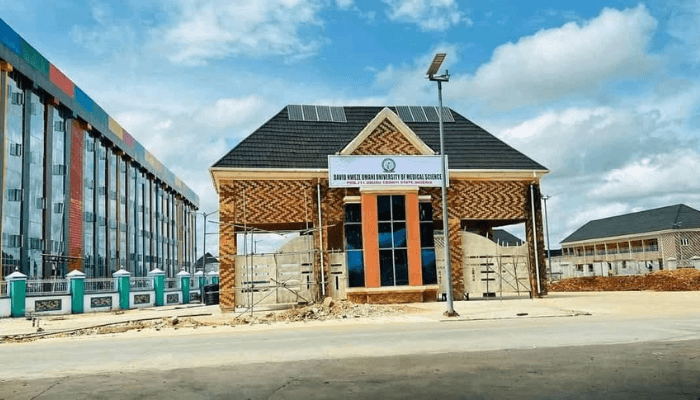
The long, winding queues outside the Eye Centre of David Umahi Federal University of Health Sciences (DUFUHS), Uburu, capture in a single frame the quiet revolution happening in Ebonyi State. Here, men and women, young and old, wait patiently not just for treatment, but for the gift of sight itself.
Since February 2025, the university has rolled out its Free Eye Care Initiative and Eye Research Programme, domiciled at the Institute for Eye Health and Visual Sciences Research (IEHVSR). In just seven months, the centre has provided over 2,400 free eye treatments and performed 179 surgeries, restoring sight to hundreds who might otherwise have gone blind.
Jesse Uneke, the Vice Chancellor, said the project is far more than a medical outreach. It embodies the university’s tripartite mandate of training, research, and community service. “A university should not just exist in name,” he said. “It must impact its host community before talking about reaching the world.”
The Eye Centre is housed in a state-of-the-art facility equipped with modern diagnostic and surgical tools. What makes it extraordinary, however, is not the technology but the fact that every service from consultation to medication, eyeglasses to surgery, is free.

Eye care in Nigeria is notoriously expensive. Cataract surgery costs between ₦250,000 and ₦800,000 in private hospitals. Glaucoma medications average ₦4,000 to ₦8,000 per visit. Even eyeglasses can cost as much as a family’s monthly food budget. Yet at DUFUHS, all of this is given without charge.
For Theresa Idenyi, an aged farmer, the free cataract surgery she received in March is nothing short of a miracle. “Before the operation, I couldn’t look at the sun. My eyes poured water, and I could not go to farm,” she recalled. “Now I see clearly even without glasses. Everything here is free. I thank God for this university.”
Her story is not unusual. Of the 2,412 patients treated so far, 54 percent are women. According to Prof. Uneke, the reason is clear: “Women suffer disproportionately from eye problems. They are exposed to smoke from firewood, to dust in rice mills, quarries, and sawmills. Many lack protective gear. And because women are often breadwinners in rural households, when their sight fails, the whole family suffers.”
In rural kitchens where firewood is still the main cooking fuel, smoke exposure causes cataracts and other eye diseases. Market women, stone crushers, and petty traders face constant dust exposure. For many, the Eye Centre represents their only hope for treatment.
Emmanuel Onah, a consultant ophthalmologist at the centre, has witnessed firsthand the transformations. “We have operated on over a thousand cases since February,” he said. “Some patients had been blind for years because they could not afford surgery. In other places, what we do for free here costs hundreds of thousands of naira.”

The initiative is powered by the DUFUHS Health Endowment Fund, established in January 2025. Unlike many programmes that rely solely on government allocations, this one is sustained by donations from philanthropists, politicians, organisations, and even university staff themselves.
Earlier this year, DUFUHS staff contributed ₦25 million from their own salaries to support the project. “Even cleaners who had benefitted from free surgeries put in their contributions,” Prof. Uneke revealed. “That shows the level of commitment.”
Corporate backing is also growing. The NNPC recently sponsored 80 free surgeries, underscoring how public-private partnerships can strengthen health systems. “This is a model for how Nigeria can tackle preventable blindness,” Prof. Uneke said.
Beyond treatment, the Eye Centre doubles as a research powerhouse. Its team is collecting data on cataracts, glaucoma, refractive errors, diabetic retinopathy, and other common eye diseases. Findings will help shape national health policy and strengthen the implementation of the 2019 National Eye Health Policy.
Onah, Acting Director of the Eye Centre, stressed this dual role: “We are not just treating; we are documenting, analyzing, and publishing. The knowledge we generate here will guide future interventions across Nigeria and Africa.”
The centre is also a vital training ground for DUFUHS students. Medical and nursing students now gain hands-on experience daily. “Every clinic day sees over 100 patients,” Onah said. “This gives our students exposure you cannot get from textbooks.”
Patients are not only from Ebonyi. Many now travel from Enugu, Cross River, Benue, Delta, and Imo States. “People are hearing about the centre because it is free and effective,” Dr. Sunday added. “Word of mouth travels faster than any publicity.”
The most compelling evidence of impact lies in personal stories. An elderly widow from Ohaozara, blind for five years, regained her sight after a free cataract surgery. Her first words were: “Now I can see my grandchildren again.” A young woman who dropped out of school due to poor vision received eyeglasses and has since returned to class.
These stories highlight the gender angle. Women, who often put their families’ needs before their own, are now at the forefront of this healing revolution. “When you restore a woman’s sight, you empower her economically and socially,” Prof. Uneke said. “She goes back to farming, trading, and caring for her family. The ripple effect is enormous.”
The project has also strengthened confidence in the university’s vision. Prof. Uneke insists this is only the beginning. “We have 16 more specialised centres planned for Cancer, Renal, Dental, Neuroscience, and others. Each will ensure that the immediate community is the first to benefit.”
Already, DUFUHS is gaining recognition nationally and internationally for its model of community-based research and service. Health experts describe the Eye Centre as a blueprint for how Nigerian universities can blend academic excellence with practical solutions.
Challenges remain, especially the overwhelming demand for services. “Every day, new patients troop in,” Onah said. “Sometimes we extend clinic hours. The need is massive, and we rely on more partnerships to sustain this momentum.”
Still, the energy at the centre is palpable. Patients share laughter in the waiting hall, grateful staff work extra hours, and volunteers lend a hand. It is a place where medicine meets compassion.
For Mrs. Idenyi and hundreds like her, the Eye Centre is not just a hospital; it is a place of hope. “They gave me back my sight,” she said softly. “And with it, my life.”
As Ebonyi’s women return to their farms, markets, and households with clearer vision, the impact of DUFUHS radiates far beyond the clinic walls. What began as an experiment in community service has become a movement for empowerment, equity, and health justice.
For many in rural Nigeria, the Umahi University Free Eye Care Initiative is proof that blindness need not be a death sentence. It can be reversed free of charge with dignity restored.