The news was everywhere on the internet on Monday, in local and international media. CNN, BBC, New York Times, Voice of America and other major international media reported it. It was also widely reported by the African media, especially as it involved Nigeria and South Africa.
In Nigeria particularly, it was the biggest news of the week, online and offline. Online, it literarily broke the Nigerian internet space. Offline, it was a major front-page headline for all but a few Nigerian newspapers on Tuesday. Even as this report was being wrapped up on Friday, it was still trending from different angles.
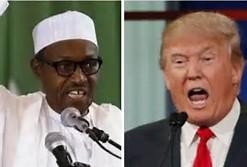
It was the news that United States President Donald John Trump had a telephone conversation with Nigerian President Muhammadu Buhari on Monday.
Quoting a statement by the Nigerian government, BBC reported that the phone call between Trump and Buhari had taken place.
In summary, Buhari congratulated Trump on his election as US President, and on his cabinet; the two leaders discussed ways to improve cooperation in the fight against terrorism through provision of necessary equipment; Trump commended Buhari for rescuing 24 of the Chibok Girls and the strides being taken by the Nigerian military and encouraged Buhari to keep up the good work; Trump assured Buhari of US readiness to cut a new deal in helping Nigeria with military weapons to combat terrorism; Trump invited Buhari to Washington at a mutually convenient date.
But while BBC, like many other media, was very sparing in its headline “Trump and Buhari hold ‘cordial’”, New York Times elaborately said, “Trump Speaks With Nigeria’s President, Who Hasn’t Been Seen in Weeks”. NYT accentuated the fact that Buhari’s “countrymen have not heard from him in weeks”, adding, “Many of them have been wondering: Where is our president, and how is he doing?”
The Trump-Buhari telephone conversation had been widely publicised even before it took place. Reports had it that Donald Trump was scheduled to speak via telephone to two African leaders, Nigeria’s Buhari and South Africa’s Jacob Zuma, in what Geoffrey York, a journalist with The Globe and Mail, referred to as Trump’s ‘Africa Day’. The call to Buhari was scheduled for 9:45 am Washington time or 3:45 pm Abuja time.
Trump had earlier spoken with Egyptian President Abdel Fatteh Al-Sisi and had reportedly met physically with Republic of Congo’s Sassou Nguesso in January, days before he took office.
Nigerians in doubt
Since the news broke on Monday, many Nigerians have remained unrelentingly doubtful that the telephone conversation took place. For them, it was another fat lie orchestrated by the ruling All Progressives Congress (APC) and the cabal in the Buhari Presidency to keep Nigerians perpetually in the dark about the president’s true health status.
Reacting to the report , a Nigerian online who simply identified himself as Peter said, “Have we not seen more of this type of photoshop orchestrating Buhari as being alive and kicking? Is talking on phone with President Trump enough proof that he is alive? Why did he not speak to the Nigerian people to at least dispel the rumour surrounding his death? Enough of all this gimmick. Let us call a spade a spade.”
Some Nigerians have also asked for evidence of such telephone conversation, such as the audio recording, arguing that relying only on a statement from Femi Adesina, media aide to Buhari, could be misleading.
Some analysts, however, say if on the strength of a statement from South African President Zuma’s office we believe that Trump and Zuma spoke, a statement from Buhari’s office is enough to accept that Trump spoke to Buhari.
Another source of concern for Nigerians was that in the conversation which Adesina said was “cordial”, Trump never inquired about Buhari’s health. They argue that if actually Trump spoke with Buhari at this time, such weighty issues as anti-terrorism war wouldn’t have been the focus.
Larry Iloh, a Nigerian resident in Brighton, United Kingdom, in a post on his Facebook wall, said the whole telephone conversation saga could have been well orchestrated by Buhari’s men to divert attention from the president’s health to a purported phone call.
“So, even from his hospital bed or medical vacation bed, where he was not able to communicate with his spokespersons on the true state of his health, he found great strength to defy doctors’ orders and had a lengthy convo with the Almighty Trump, the Diversionary Tactician-in-Chief,” Iloh wrote.
“One thing strikes odd, though; in that lengthy phone convo with Trump, how come there was no mention of Trump wishing Buhari quick recovery, or does Trump think London is the residential home of Nigerian presidents?” he said.
International Society for Civil Liberties and the Rule of Law (InterSociety) reportedly said it was most unlikely that Trump spoke with Buhari on phone, noting that Adesina’s statement announcing the phone conversation was “grossly one-sided, circumstantially untenable, diplomatically blundered and grossly un-Trump-like”.
“If the Nigerian president is that bodily agile and mentally coherent, why is he not on seat in Nigeria? Not even the defence of ‘doctors’ advice and results of medical tests’ can keep a hale and hearty president off his presidential seat for three weeks running, if he is truly hale and hearty, to the extent of having such weighty diplomatic conversations with the world No. 1 President at this point in time,” it said in a statement.
Alleging that this might be an extension of trending presidential falsehood, InterSociety said if at all Trump called Buhari at this time, it could only be sympathetic calls and on health grounds, arguing that Buhari transferred presidential powers and functions to Vice President Yemi Osinbajo and so such weighty diplomatic calls should have been appropriately directed to the Acting President.
It contended that the statements from the Nigerian presidency were “monolithic in source”, having only come from Adesina’s mouth, and that until the White House and the US Department of State authorities speak in concurrence and authoritatively from Washington DC confirming all that Adesina claimed Trump told Buhari, Nigerians must ignore such statements or accept them with a pinch of salt.
Curiously Trump, known for his vast use of Twitter, had made no tweet about the phone conversation with Buhari, either from his personal account @realDonaldTrump or the official account @POTUS, even though he had tweeted about the visit of the Canadian Prime Minister Justine Trudeau.
White House confirms call
On Wednesday, reports came that the long-awaited confirmation by Trump’s White House had finally happened. According to the report, which was carried mainly by local media, Trump’s Press Secretary Sean Spicer told journalists during a press briefing in the White House on Tuesday that Trump had a telephone conversation with a number of world leaders on Monday, including Nigeria’s president.
“In addition to his in-person meetings with the prime ministers of Japan and Canada, the President also recently had phone calls with the presidents of Tunisia, Peru, Nigeria, Colombia and South Africa,” Spicer was quoted to have said.
But in spite of this, Nigerians have remained apprehensive, insisting, like the Apostle Thomas in the Bible, that until they hear Buhari’s voice, until they see him face to face, they would not believe.
Why Nigerians are apprehensive
Nigerians are afraid that a repeat of history might be in the offing. They are apprehensive that issues surrounding Buhari’s ill health are being handled the same way that of late President Umaru Yar’Adua was handled between 2009 and 2010. After Yar’Adua was flown to Saudi Arabia for medical treatment in 2009, where he spent several months until his death in May 2010, the cabal in his presidency had politicised his illness and kept Nigerians in the dark about his true health status, throwing the country into an avoidable political crisis.
President Buhari left Nigeria for a vacation on January 19, exactly one month today. He was due back on February 5, but his office issued a statement on the same date informing that his vacation had been extended indefinitely to allow for further medical examination and treatment. Nigerians have since been asking to know exactly how their president is faring; they have also been asking the president to speak to them to reassure them that all was well with him.
But it has all been like water poured on stone. Buhari’s aides have blatantly refused to provide details about his health condition or even to speak to Nigerians in a decent way. Instead, those in the presidency have continued to sing in discordant tones – from one extreme of denying the president’s illness and claiming he was “hale and hearty” to asking Nigerians to pray for him. The lack of clarity on the issue has continued to spur rumours that the worst could have happened to Mr. President.
Trump spoke to Buhari, so what?
Meanwhile, some Nigerians are asking why it would be such a big deal assuming that Trump actually spoke with Buhari, saying chatting with Trump on phone was not an accomplishment.
Those in the know, however, say it is really a big deal if the telephone conversation actually happened. They say it signals the beginnings of cordial diplomatic ties between Nigeria and the US under the Trump presidency.
But critics say the snag is that there were more of attempts by the Nigerian government to score cheap political goal locally than to make diplomatic gains in the whole Trump-Buhari telephone conversation brouhaha.