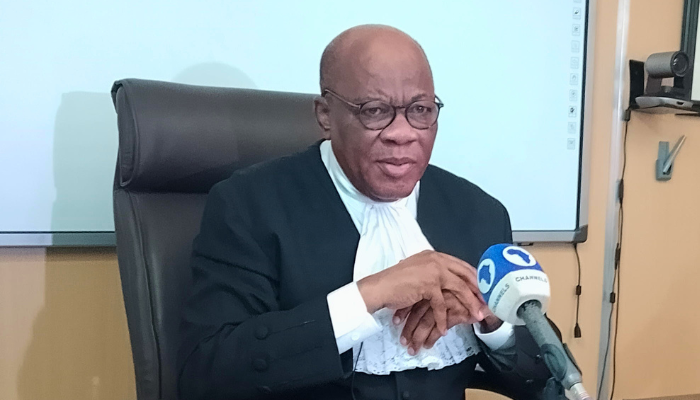
Olisa Agbakoba, Senior Advocate of Nigeria (SAN), has said that it was imperative for President Bola Tinubu to carry out fundamental governance restructuring for his policies to yield the desired impact on the citizens.
The Senior Advocate of Nigeria noted that
without functional political governance at all levels, economic interventions will continue to produce disappointing results.
Agbakoba stated this in a statement on Thursday to mark the second year anniversary of the Tinubu’s administration, saying that the President must do a reversal and embrace fundamental restructuring of governance structures.
“Without functional political governance at all levels, economic interventions will continue to produce disappointing results regardless of their technical merit.

“Nigeria’s challenge is not economic—it is political. The system of centralized economic planning has created a dual economy where a small elite captures enormous value through rent-seeking while over 200 million Nigerians remain trapped in unproductive informality.
Read also: Agbakoba condemns mandatory voting law, says he’d choose jail instead
Agbakoba stressed that the flawed political system which is concentrated centrally has impacted negatively on policy implementation and execution over the years and called for a shift.
According to Agbakoba,” Everyone knows that Nigeria operates a deeply flawed, over-centralized political system that cannot be characterised as a federal system. The result is 774 local governments and 36 states (90% of Nigeria’s governance architecture) fully depend on the Federal Government. Local and state governments are primarily collection points for federal allocations rather than centres of productive governance.
“The result is that economic activity is artificially concentrated at the federal level while the natural drivers of bottom-up economic growth (local governments and states) remain dormant and excluded. The administrative governance structure is a huge hindrance to economic development.

“The administrative system is not designed to enable optimal economic performance but rather to control and regulate economic policy by layers of bureaucratic interference. Private sector is stifled by lack of innovation and entrepreneurship.
“The bureaucracy is simply too unwieldy to deliver optimal results to drive investment and economic growth. More critically, this centralized economic planning excludes majority of Nigerians from economic participation. Over 200 million Nigerians are trapped in an informal sector that is unproductive and disconnected from formal economic opportunities.
“The political system allows the extraction of enormous economic value by rent-seekers and plutocrats who position themselves at the centralized checkpoints of resource allocation”.
Speaking further, Agbakoba called for urgent legislative reforms in the country, he noted that the basic problem with President Tinubu’s policies was that it was poorly implemented.