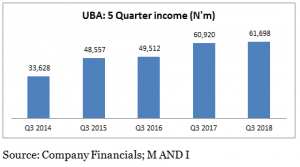

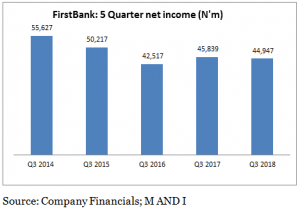
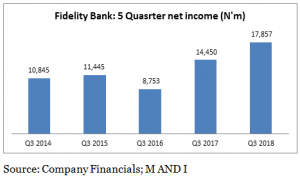
Profit of Nigerian largest lenders has been improving since the 2016 prerecession period, thanks to the combination of higher crude oil prices and a benign foreign exchange environment.

The banks are Zenith Bank Plc, Access Bank Plc, Fidelity Bank Plc, First City Monument Bank (FCMB) Plc, Guaranty Trust Bank (GTBank) Plc, Stanbic IBTC Holdings Plc, First Bank Nigeria Holdings Plc, Sterling Bank plc, Wema Bank Plc, and United Bank for Africa (UBA) Plc, Unity Bank Plc, Union Bank Plc, and Diamond Bank Plc.
For the first nine months through September 2018, 13 banks made a profit of N537.27 billion, which represented a 14.13 percent increase from the N501.550 billion recorded in the corresponding year of 2017.
However, profit decreased by 11.31 percent to N428.50 billion in 2016 from N483.15 billion in the corresponding period of 2015, a period when the sudden drop in crude oil prices from above a $100 per barrel to near $40 forced banks with heavy exposure to the sector to write off loans that began to go bad.
The uptick at bottom line means lenders have surmounted the headwinds that undermined earnings during the era of severe dollar scarcity that tipped the nation in its first recession in 25 years as customers are paying back interest on money borrowed.
Also, some lenders have taken a haircut in 2016 on Non-Performing Loans (NPLs), a proactive strategy that validated their risk management strategy. Many of them, especially the big ones, have reduced lending to the oil and gas sector.
For instance, the cumulative Non Performing Loans of (NPLs) of 10 lenders have fallen by 16.15 percent to N1.01 trillion from N1.21 trillion as at September 2017, according to data gathered by Markets and Intelligence.
Global ratings agency Flitch has upgraded Tier 1 lenders, thanks to sound financial metrics, reasonable capital buffers, and franchises.
Fitch Ratings has revised the Outlook on Zenith Bank’s (Zenith) Long-Term Issuer Default Rating (IDR) to Stable from Negative and affirmed the rating at ‘B+’. It upgraded United Bank for Africa Plc’s (UBA) Long-Term Issuer Default Rating (IDR) to ‘B+’ from ‘B’. The Outlook is Stable.
The ratings agencies revised the Outlook on Guaranty Trust Bank Plc’s (GTB) Long-Term Issuer Default Rating (IDR) to Stable from Negative and affirmed the IDR at ‘B+’.
A breakdown of the profit figures of some big players in the industry validates the recent elevation.
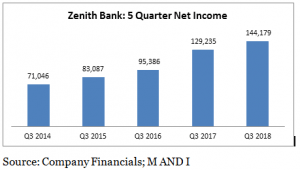
For instance, Zenith Bank’s net income stood at N144.17 billion as at September 2018, this compares with N129.23 billion, N95.38 billion, 83.08 billion, and N71.04 billion recorded in the corresponding period of 2017,2016,2015 and 2014 periods.
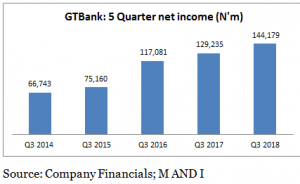
GTBank’s net income stood at N144.17 billion in September 2018, this compares with N125.57 billion, N117.681 billion, N75.16 billion and N66.73 billion recorded in the corresponding period of 2017,2016,2015 and 2014 periods.
But one of the leading global rating agencies, Moody’s Investor Service, in a recent report, pointed out that the smaller banks or the tier 2 banks, are operating with weaker capital buffers, which indicate vulnerability of these banks.
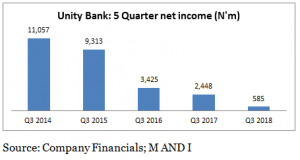
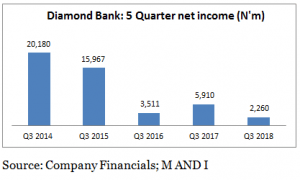
Of course some of the these small lenders are beleaguered as Unity Bank’s net income has been falling like pack of cards and it is the brink of technical insolvency as accumulated loses have overwhelmed shareholders’ fund.
Unity Bank’s net income slumped to 585.84 million in September 2018, from N2.44 billion in 2017, N3.42 in 2016, N9.31 billion in 2015, and N11.05 billion in 2014.
Diam0nd Bank’s net income has been ebbing as net income fell to N2.26 billion in September 2018, from N3.70 billion in 2017, N5.91 billion in 2016.
Investors and analysts are more concerned about the ability of banks replicating the growth momentum this year as falling yields on treasury bills since August 2017 could be challenging for the industry.
Yields on treasury bills now are around 15 percent, which compares to around 22 percet for the most part of last year.
“There may not be very significant improvement in profitability going forward as the economy is not expanding. I have not seen any sector the banks have lent to,” said Johnson Chukwu, managing director and CEO of Cowry Asset Management Ltd.
“The interest rates on treasury yields have been falling, although there has been gradual uptick in the yields in recently. The impact of the increase will only be felt my year end,” said Chukwu.