|
Getting your Trinity Audio player ready...
|
In the first part of this article, I examined the rapidly developing indigenous secondary art market, beginning with a brief history and ending with its growing influence on the international auction market. Answers were proffered to some pertinent questions including, why are higher values often achieved for South African modernists when compared to their counterparts from Sub-Saharan African and why does contemporary artist Njideka Akunyili Crosby hold the record for the highest selling work at auction for a Nigerian artist? In this concluding part, we revisit these issues in greater detail.
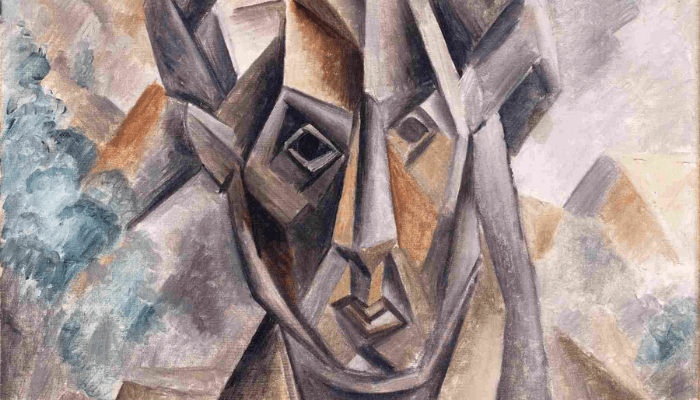
In 1897, a British punitive expedition sacked the ancient city of Benin, burning the oba’s palace and forcefully removing thousands of artworks, majorly in bronze. These were first art works from Africa to gain global recognition. Displaced from their historical and socio-religious contexts, they journeyed mostly to the ethnographic museums of Europe and North America, where they influenced the birth of modern art—marked by a radical departure from the prevailing strict academic style—at the turn of the 19th century (1860-1970), through artists like Pablo Picasso who borrowed heavily from their geometric and psychologically expressive forms. Since then, these works, as well as other traditional sculptures from Africa have been ascribed values by the West, dependent not on their artistic merit but on their use in rituals. In other words, the interpretations of the classical archetypes, produced in abundance by artists today don’t hold much monetary value.
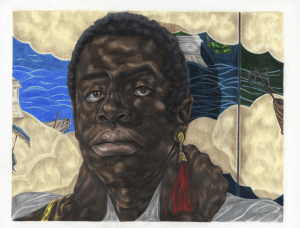
Nanban
2020
colored pencil, graphite, and ink on Dura-Lar
60 x 47.5cm
©Toyin Ojih Odutola, Courtesy the artist and Jack Shainman Gallery, New York
Read Also: Warner Music, Audiomack unveil licensing deal for African artists
As earlier mentioned, modern art owes its existence to the abstract forms of traditional African sculpture. Ironically, Western accounts of art preclude other modern art developments in other regions of the world, notably Africa. Clearly, the pioneering efforts of modern artists like Ben Enwonwu, widely credited with fusing traditional aesthetics with Western conventions of representation, have been largely ignored—their works dismissed as pale copies—forgetting that modern art has its firm roots in Africa having been first influenced by classical African sculpture.

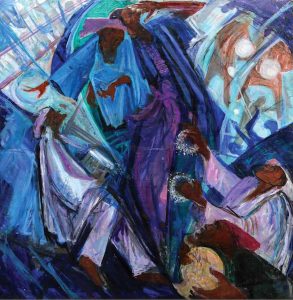
Baraje
2011
oil on board
119.375 X 117.5cm
However, the exclusion of modern experiments in Africa from the canon of modern art has come with its consequences. One of which is the existence of modern art in a vacuum, with contemporary art developments achieving more prominence. Arguably, the result is that on the average, significant artists working today are likely to achieve increasingly higher prices at auction for their work as more critical attention is focused on them. This assertion is evidenced by recent sales achieved by artists like Njideka Akunyili Crosby and Toyin Ojih Odutola who reside in the diaspora. To lend further weight, modernists like Enwonwu based mainly on the African continent contended with barely existent infrastructure to promote their work including representation from professionally-run galleries and exposure provided by advances on the Internet and social media.
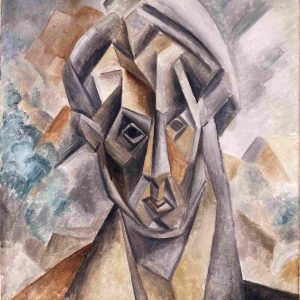
1909
©Estate of Pablo Picasso / Artists Rights Society
South African artists of the modern era like Irma Stern stand out as an exception because they didn’t spent most of their working lives outside South Africa. Several experts deduce that post-apartheid, wealthy and influential South Africans consciously reintegrated and projected their country onto the world stage following years of exclusion, by promoting their art and culture. These efforts together with an attendant and relatively more sophisticated support structure may have directly impacted positively on the staggering prices achieved by South African modernists on the international art market.
Having discussed extensively the rising value of Nigerian art, I will in the next article talk about the factors affecting the value of an artwork, collecting and art as an alternative asset class. Stay glued.