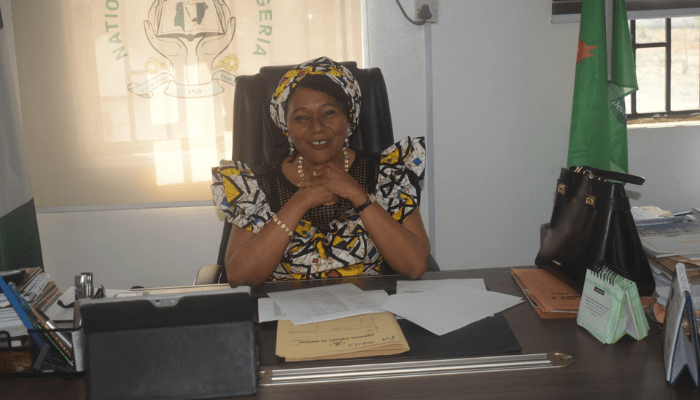
Professor Chinwe Anunobi, Chief Executive Officer of the National Library of Nigeria, in this exclusive interview with Ruth Tene Natsa, has said that despite the challenges faced by the monument, the National Library is a national heritage that must be preserved for the future generation and for the sake of posterity… excerpts
Share with us your experience as the Chief Executive Officer of the National Library?
I was appointed in September 2021 and met the place in a terrible state. The environment was a mess, but I am not blaming my predecessor because the funding of the National Library is abysmally low. Nobody is paying attention, considering it as just a library, and many will say, We are now in an E-world; nobody is talking about books. But the National Library is not just a library; it is a national heritage. Every country prides itself on its national library. The United States does not play with its Library of Congress. Britannica of Italy, France, Ireland and even the newly completed Dubai National Library. China just established its own national library and seeks to overthrow the US. But in this part of the world, they look at the National Library as just a library.
What is the mandate of the National Library?

The National Library was established in 1964. In fact, we just celebrated our sixtieth anniversary in November 2024. The mandate of the National Library is to collect every documentary resource that is produced in this country and house it for posterity, and now that the E has come, to put such records in print and electronic formats as they do in the Library of Congress. The number one mandate of the National Library is as a bibliographic centre.
Another unique mandate is to have branches in all the states of the Federation. We currently have 34 branches, including the FCT. We have a presence in three states but do not have branches in Delta, Anambra, Kebbi, and Zamfara.
Another mandate is to promote the culture of reading; this is not a function of the National Library but public libraries. However, during the establishment of the National Library, supported by the US, seeing a country yet to come up, reading-wise, and with few public libraries, the National Library had to fill in the gap.
“The money people pay for international standard numbers is for administration, and we send it back to the international centre.”
There is also the issue of certification. There is no record of certification you can offer in court, except if it is coming from the National Library. So, we acquire all national newspapers and store them in the National Library. Anyone needing any certification or exhibit must come to the National Library, where we bring it, stamp it and sign it so that it will be accepted in the court. That is why the new building of the National Library is supposed to be the stack; it has eight floors of 24 volts. Because these are where we are going to store all the resources emanating from this country.

When you say the National Library is supposed to be a repository of history, do you have Nigeria’s records of the past 60 years?
Yes, we have those deposited. Then in the late 90s and 2000s, Nigerians stopped giving the government. When we go, they say the government press does not publish anymore, that you have to go and buy, but the legal positive responsibility is that anybody publishes anything, and they need documents. If it is federal, deposit 25 copies to the National Library, state 10 copies and individuals that publish, three copies. It is expected that we distribute the 25 copies to the regional and state libraries. And then the same thing with state copies. But the individual copies we must keep for posterity. Presently, we have close to 14 million, distributed all over the country because we are IDPs.
What do you mean by being IDPs?
We do not have a national library structure as I speak to you. The place we currently are is rented and highly dilapidated, as can be seen. The government pays heavily for us to be here.
Apart from the budgetary allocation, is there any IGR from the National Library?
The National Library is usually funded because it is a social service. It is also a library for research. It is a library where you find more staff than users because the staff are busy keeping the heritage, processing it, and organising it, with very few people needing materials for research coming in. More so, when we are staying in a rented apartment, we are boxed in. If we had our building, we could think of other activities that could help us generate funds, such as renting out our auditoriums, but as it is, we do not generate anything. The money people pay for international standard numbers is for administration, and we send it back to the international centre.
What have been your challenges?
Lack of funding is a challenge; every month, I am giving 30 million to maintain, transform, and provide the needed services. As it is, since January 1 till date, the government has not given one naira to any agency, so it is not peculiar to the National Library, and because we do not generate funds, we cannot do anything. Meanwhile we are supposed to maintain the 34 branches. Many of which are dilapidated.
Sometime in late 2000, USDF, Universal Service Provider, gave computers, internet service, and big generators to 18 of our branches, but we do not have the resources to run, maintain, or even change them into alternate power.
And also, the branches are supposed to be the learning environment; they’re supposed to be an outlet where people can go and read. We are transforming the user’s interest from print to electronic, but where are the funds to transform them?
The first generation gave us a standard library with shelves and tables and chairs. Now there is a need for us to provide internet, computer facilities, and power. We do not have the resources to do that. We have documents from the 50s, gifted to us by the colonial masters. They are deteriorating in the strongroom we have in Lagos.
I initiated digitisation, not only for presentation but also to open it up to people, but transition is very expensive. I subscribed to e-processing tools. However, if the internet is not strong or there is no light, they will not be able to do so. The processing tools have to be acquired. We have acquired the e for Lagos and Abuja, but the internet is not strong because we are only relying on the galaxy.
Every year, we travel to have the conference of directors of national libraries all over the world. When I introduce myself. The first question they ask is, What about the National Library of Nigeria? Has it been completed? The construction contract was given in 2007, and construction began in 2008. But I think the present administration is making progress to have the work completed.
Have you sought any PPP arrangements or international support?
The National Library is the country’s heritage. Currently, the minister approved that we can have an endowment fund and see if people can bring our funds, because it’s important that we digitise the deteriorating heritage of this country.
In 2021, UNESCO announced the international decade of indigenous languages so that the indigenous people will bring to the fore the knowledge packed in indigenous languages to develop local medicine, science, and technology. Following a mapping of languages, we found Nigeria has 506 living languages. We recently produced a compendium of an alphabet somewhere of 42 languages in Nigeria. And it is shocking that of all the about 30 million resources we have in the National Library, only 5,000 are in indigenous languages. All others are in English and even Chinese.
The indigenous people in the village may not be able to document or tell their history in English, and if the national library is not there to keep all these resources, it will forever die. So, my idea is that we must go digital. We must preserve and open them up. The challenges are overwhelming.
What are you looking to achieve in the time you have left?
Two major things, which are to continue to have our resources preserved, and that will be through digitisation and opening them up. We want the branches to start having a day of reading the constitution.
I am planning what you call the newspaper locator and to open it up so it can tell the branches the locations and dates newspapers can be found.
I am also motivating and mentoring the staff of the National Library. They need to be reading and writing, and they need further training so they can begin to present papers; it is a bonus I am passionate about.
Everybody is talking about computer smarts, GPT, and AI, but it is only what is available on the internet that GPT will respond to, so my advice to Nigeria is for us to go back to the roots, and one way of doing it is to ensure that schools have libraries.
In the university, the professors and the lecturers have a role. When I was a graduate assistant at the university, and I was deployed in the library, the lecturers gave students assignments and said, Go to the library, turn the newspapers, and get information. That helps in developing critical writing ability and desire to read. Even at homes, there are private libraries.
Keep the phones aside. If you want your children, you want your family to be serious with life, have screen time and have time to read. This will develop the brains of the children. This will develop the brains of adults. By the time adults get to 70, loneliness will set in; their companions will be the books, and if they have not developed the capacity to read, loneliness will kill them because when reading, the characters in the books become companions.
Tell us about the successes and achievements you have had.
We are engaged in the digitisation and development of the National Repository of Nigeria (NRN). I have digitised 6,000 weak materials from 2022 and developed the Virtual Library services because during COVID, the National Library was asked to develop the Virtual Library of Nigeria, which I have done. The constraint I have is the lack of funds to subscribe as well as automate library operations and services using the Koha software. The OPAC holds 69,812 volumes of collection as of January 2025. We have subscribed to online cataloguing, automated ISSN application and issuance and developed ISBN verification.
We have also enhanced the branch library environments, provided library services to the hard to reach and enhanced the literacy sensitisation and encouraged documentation of family heritage in indigenous languages, expanded and strengthened the National Library Archive and collaborated with secondary schools to ensure establishment and management of libraries for the promotion of reading.
We are collaborating with so many; we signed an MOU with Bulgaria in resource sharing, collaborated with Coderina Technology to train youths on robotics in NLN branches and initiated the process of developing an authority file for Nigeria in collaboration with AfLIA and supported by Wikipedia, Germany, among several others.