Recently, the National Assembly was in the news for the wrong reason. It was widely reported that the workers in this public outfit embarked on an industrial action again, following the inability of the management of the National Assembly to implement the agreed revised conditions of service.
Although the industrial action has been temporarily suspended, activities at the National Assembly were grounded while the strike lasted. The workers have promised to resume the industrial action by month end if the National Assembly does not implement the agreement.
Acting under the aegis of the Parliamentary Staff Association of Nigeria (PASAN), they based their current industrial dispute on an MoU signed on March 21, 2020, based on the adjustment of the minimum wage by the Federal Government of Nigeria.
In the light of the foregoing, it is possible to see the picture of a beleaguered Nigerian worker who faces pressures from various directions
But despite the fact that the Federal Government has released funds for the implementation of the new salary scheme, the management of the National Assembly has refused to take action.

With the above development, it is now clear to all and sundry that the current administration is good at reneging on agreements. It should be recalled that the Academic Staff Union of Universities (ASUU) is currently on strike because the Federal Government refused to implement the agreement it reached with ASUU in 2009. This is highly condemnable.
Economic realities support the demand made by PASAN for the payment of the salary increase agreed with the management of the National Assembly. Prices of goods have risen considerably in the marketplace in the last few years. This means that Nigerian workers are worse off now than they were a few months back.
The increase in food prices is caused by many factors. The crises in the north east, north west and north central Nigeria have driven many farmers out of their farms. This has caused food shortages. Yet population continues to grow, implying that more people need certain food items today more than those they needed in the past. The simple law of economics says, prices of food items, or any item at all, will rise if demand surpasses supply.
The prices of imported food items have equally risen. This is due to the rising energy prices across the world and the Russian-Ukrainian war. Crude oil and natural gas prices have risen to record high this year, owing partly to the rebound in the global economy after many countries opened up their economies after COVID-19 lockdown.
With most Nigerian manufacturers relying on the importation of raw materials, the upsurge in energy prices has directly and indirectly raised their production costs, which are treated as indirect tax to be passed on to the final and hapless consumers.

In the last publication of the National Bureau of Statistics (NBS) on the prices of staple food items in the country, Abuja, the Federal Capital Territory (FCT), emerged as one of states with the highest costs of staple food items in the country.
Read also: ASUU strike more complicated than Nigerians think – FG
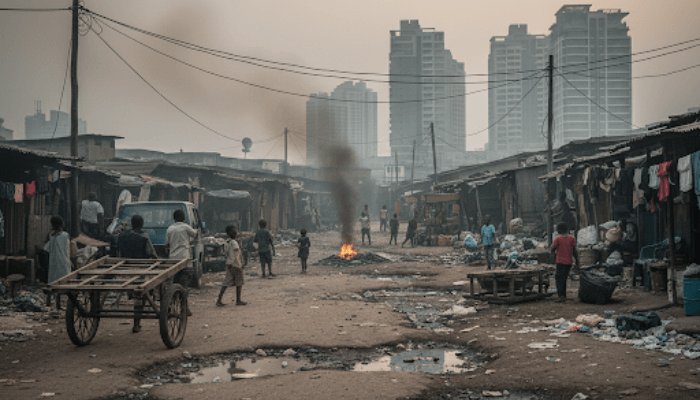
In the light of the foregoing, it is possible to see the picture of a beleaguered Nigerian worker who faces pressures from various directions. The purchasing power of Nigerian workers has been greatly reduced. And findings have shown that most of them are net borrowers, since their disposable incomes fall short of meeting their basic needs.
Thus, some of these workers will find it difficult to pay their children school fees, get adequate healthcare facilities which will further worsen the life expectancy of these hapless Nigerians.
A country with this kind of dismal situation will have problems of underdevelopment. This is so because national savings are essential to capital formation. Workers can only save after they must have met all their basic needs. But the current state of affairs does not empower them to save. This indicates that, as long as this continues, investors in need of surplus funds to either set up new businesses or expand their current operations will find it difficult. Therefore and indirectly, the non-implementation of the agreement reached with PASAN affects, not only the PASAN members, but the entire Nigerian economy.
If the Federal Government has not released funds for its implementation, that would have been a different case. But getting the money and not deploying it for what it is meant for deserves condemnation. It amounts to the maltreatment of Nigerian workers by the management of the National Assembly. At a time when we have just celebrated Democracy Day, the appropriate authorities should sit up and do what is needful for these workers. This is certainly one way in which Democracy Day can acquire some meaning beyond the comfortable fancies and indulgence of our largely, self-serving politicians.