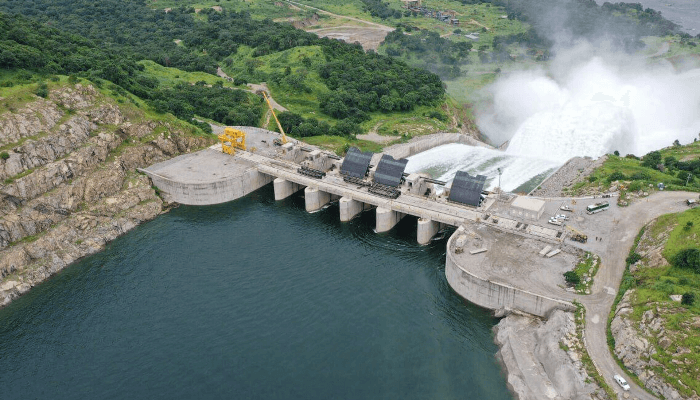
Six months ago, the Grand Ethiopian Renaissance Dam – the biggest, most ambitious architectural project on the continent of Africa – was commissioned.
That the commissioning of a multi-billion-dollar project in a poor African country, a project that had been fourteen years in the making, was attended with barely a whimper in the world press was reflective of the pall of uncertainty that continues to envelope the huge power-generating, flood-controlling architectural masterpiece, even after it has commenced operations.
The Grand Ethiopian Renaissance Dam is an accomplishment that Africa should be celebrating, as a display of its can-do spirit.
Discord and a determined antagonism from entrenched interests who once vowed it would only happen over their dead bodies have been in the air from the moment the idea was mooted. Threats of violent destruction continue to rage, even after the commencement of the generation of hydroelectric power for the people of Ethiopia.

A few days ago, Donald J Trump, the stopper of many wars and FIFA Peace Prize laureate, offered to mediate between Ethiopia, proud builders and owners of the dam, and their aggrieved downstream neighbours, principally Egypt.
The history of American ‘mediation’ started as far back as 2019, when Treasury Secretary Steven Mnuchin facilitated negotiations between the neighbours on the Blue Nile as the dam neared completion. He recommended that final testing and filling of the dam should not proceed without an agreement between the two nations.
In 2020, the USA suspended part of its economic assistance to Ethiopia as punishment for not toeing the American line.
In October of the same year, President Trump, in his first term, openly sided with the Egyptians, saying
‘It’s a very dangerous situation…they’ll blow up that dam…’.

To which Ethiopia’s President Abiy replied
‘Ethiopia will not cave into pressure of any kind…’
A lot of other tough talk and threats have attended the realisation that GERD has become a living reality.
Egyptian President el-Sisi in 2022 said
‘I’m telling my brothers in Ethiopia, let’s not reach the point where you touch a drop of Egypt’s water, because all options are open…’
The people of Ethiopia, a country made up of proud and ancient nationalities who sometimes give the impression of being perpetually at each other’s throats in civil strife, are united by one thing – pride that they have built this massive life-transforming national project in the teeth of determined opposition from powerful enemies. They have a shared belief that, beyond utility, it is a national monument to be defended with every ounce of their being. In an extraordinary display of patriotism, many ordinary citizens contributed their personal money to the fund for the project – salaries, life savings, and jewellery, after the project’s opponents had lobbied on the world stage to cut off the usual sources for international borrowing,
Ethiopia was forced onto its own resources.
The contract for the project, $5 billion – a relatively modest cost for such a gargantuan undertaking – was awarded to the Italian company Salini Impregilo – later to be known as Webuild- in 2011.
Perhaps to weave a myth around the achievement, the government officially claimed that 15,000 Ethiopians died in the 14-year course of the construction. Many people consider the figure an exaggeration.
The GERD is the only major dam in the world that is surrounded by an elaborate air defence system, with elements procured from Russia and Israel.
Just to illustrate how real and enduring the danger was, on the 3rd of June, 2013, at a meeting of Egyptian leaders with some International Water experts, hosted by then-President Morsi, there was an open discussion of options on how to destroy the Ethiopian dam. Among the options discussed was that Egypt might provide support for anti-government rebels fighting in Ethiopia. Unbeknownst to Morsi and other Egyptian government officials, the meeting was being streamed live, and all the world, including the Ethiopians, got to hear of their sinister plans.
GERD is located on the Blue Nile, a river that has, from ancient times, coursed through Ethiopia to supply vital water to the Nile Basin in Egypt, as well as to Sudan. The Egyptians are viscerally opposed to the dam, fearing that the water supply required by their citizens for irrigation and general life would be greatly diminished. Several meetings and interactions with international experts over the years have failed to allay their fears. The other major stakeholder, Sudan, has a more ambivalent stance, worrying about the effect that water flow regulation would have on its territory, but also seeing the likely benefits in the form of hydroelectric power that may be exported to it.
Nothing illustrates the skin-deep nature of the ‘brotherhood’ between black Africa and the Arab nations of the north of the continent than the sentiments and rhetoric surrounding the GERD. The unhelpful, often biased ‘mediation’ of certain countries, including the USA, has ended up generating more heat than light. The Grand Ethiopian Renaissance Dam has come to stay, and the world must accept it as a fait accompli. Even Donald Trump, who has not hidden his support for Egypt, would balk at the prospect of sending stealth B52 bombers to take out what is now an African symbol and masterpiece of development thinking.
The Ethiopian Dam is now on the Blue Nile, like it or lump it. The neighbouring stakeholders – Egypt – a favoured member of Trump’s ‘Board of Peace’, and war-ravaged Sudan, which has a lot on its plate currently, will have to get together to agree on how to share power and water from this African masterpiece, and how to make it work in the best interests of all their peoples. Discussions will have to be in the cordial, respectful language of equals, every one of whom has a bounden desire to survive and thrive on the continent of Africa.