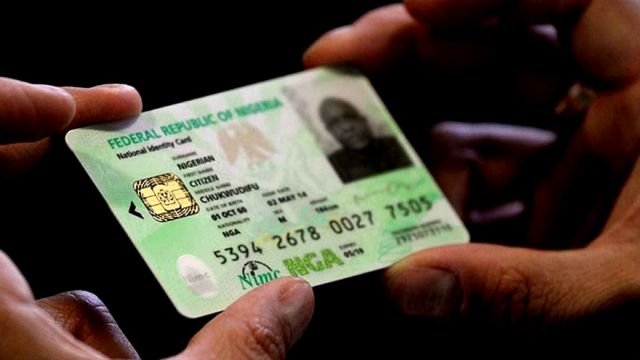
The handling of the national identity card project by the ministry of communication and digital economy, and the National Identity Management Commission (NIMC) has been nothing short of a disaster. The Federal Government should forthwith find competent people to run the project as the present managers embody incompetence.
We understand the rationale for a national identity. It is necessary in a country like Nigeria with vast ungoverned spaces in the north and borders as porous as a pasta strainer. The orgy of violence in the northern part of the country, the mindless killings in the middle belt attributed to bandits, kidnappings and the rising tide of cybercrimes call for a holistic national identity programme.
However, Nigeria’s quest for a national identity management system has been challenged by the familiar problems of incompetent managers and corrupt government officials who only see it as opportunity to steal.
In 2010, the Board of the National Identity Management Commission (NIMC) signed an agreement with two private firms – Chams Consortium and One SecureCard Consortium (which included Mastercard) to provide data capture and related services for a national identity database.

The Chams Consortium was mandated to implement the NIMC project on a Build, Transfer and Operate basis, which spans conceptualization, design, development, execution and management of the front-end operations of the proposed systems. The Consortium will deploy biometric data capturing machines to enroll Nigerians, issue multi-purpose smart cards thereafter, which will serve a range of purposes, especially as data to be stored on the chip includes personal information, biometrics, residency reference numbers for immigration e-passports, and driver’s license. The consortium will also provide card acceptance devices, among others services, with the aim of recouping its investment in 12 years.
The project ended in fiasco with parties dragging each other to court. Chams claimed the government reneged on its contract and stole its database, the NIMC claimed that Chams was incompetent and the whole thing dissolved into a giant charade that ended up wasting billions of public funds with little or nothing to show for it.
However, the issue now is not really the absence of biometric data of Nigerians but having people grossly unfit to manage the process. For the past ten years that the NIMC has taken over the process, it has only registered about 40million Nigerians. Millions of these are yet to be issued identity cards.
The various government ministries and departments, and private institutions hold realms of data belonging to Nigerians but the people managing them cannot link them up into a seamless platform. The Federal Road Safety Commission, the National Population Commission, The Nigerian Immigration Service, state governments, pension fund administrators, banks and other financial institutions, and Independent Electoral Commission all hold vast amounts of data of Nigerians, many in unsecured formats.
Last week, the minister and the NCC ordered network operators to block the lines of customers who do not link with their National Identification Number with their SIMs. Predictably, many Nigerians condemned the obnoxious directive. It was not just that the order was derisory, it opened a window into the minds of the characters hired by this government to write regulations and explain why regulatory and political risks for businesses represent their worst threat.

What informed the manic urgency to order mass registration in the midst of the second wave of a deadly pandemic? How do you tell restaurants and bars to close shop while thousands flock NIMC offices to register for NIN? How is a ministry for the digital economy in 2020 unable to link bank verification numbers with NIN? Is there even a strategy to ramp up NIMC’s capacity to accept these registrations?
Barely three weeks after another government agency, the Nigerian Center for Disease Control (NCDC) warned against large gatherings due to COVID-19 and days after the Lagos state government, the city with the most business activities and subscribers had warned about large gathering, another government agency issued an order designed to cram vast amounts of people into tight spaces.
Since the ill-fated decree, the minister and NCC have issued directives canceling N20 SMS charge, approving new registration centres and further extending the deadline. This is not listening to Nigerians – as they never really matter to their marauding rulers- this is merely the result of a dystopian thought process. That the order has the potential to ruin the telecoms sector, one of the few sectors that has seen a modicum of growth in this flailing government, speaks volumes about their willingness to acquiesce in the face of ill-conceived regulations.