No society can thrive without a robust and reliable energy supply to drive production. Across the world, industrialisation has been built on the foundation of stable electricity—boosting productivity, lowering costs, and ultimately raising per capita income. But the question remains: is stable electricity a direct driver of economic growth, or merely an enabler that amplifies other factors?
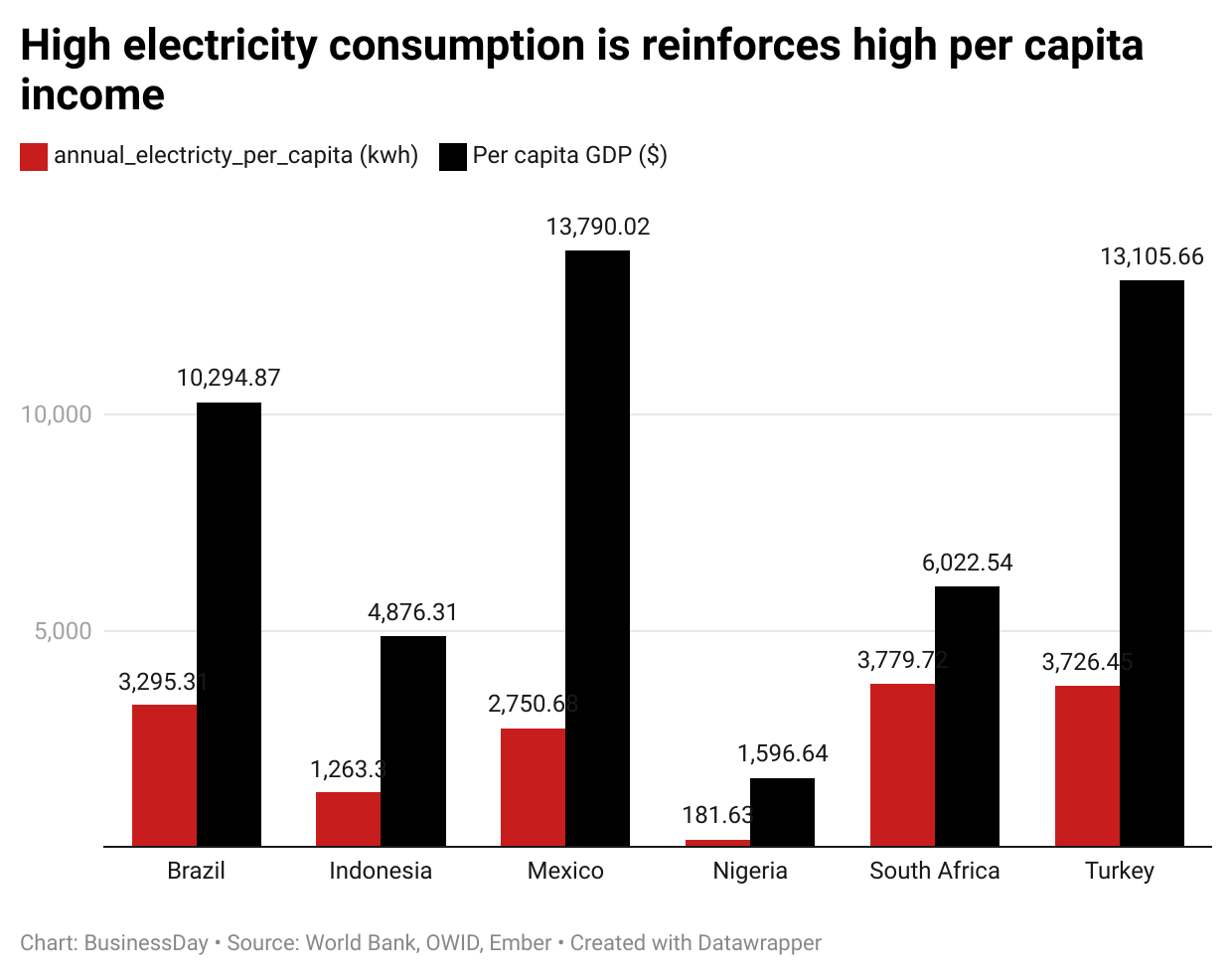
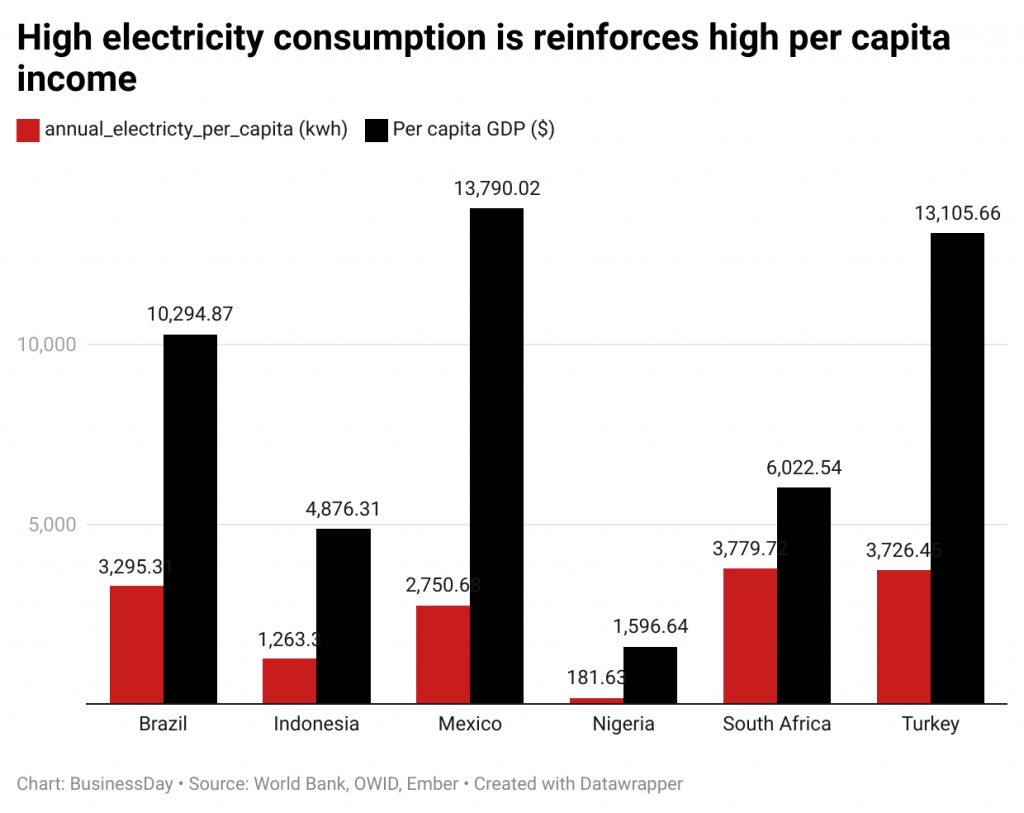
The chart below compares Nigeria’s electricity consumption per capita with that of its peers—Brazil, Indonesia, Mexico, South Africa, and Turkey. Nigeria lags significantly behind, with an annual electricity consumption of just 181.63 kWh per capita, the lowest among the countries compared. In contrast, South Africa consumes 3,779.72 kWh, Brazil 3,295.31 kWh, and Turkey 3,726.45 kWh.
The data also shows a strong correlation between electricity consumption and per capita GDP. Nigeria, with the lowest electricity consumption, has a per capita GDP of $1,596.64, while countries with higher consumption—such as Mexico (2,750.68 kWh) and Brazil (3,295.31 kWh)—have significantly higher per capita GDPs of $13,790.02 and $10,294.87, respectively.
This reinforces the argument that inadequate electricity supply is a major constraint on Nigeria’s economic growth, limiting industrial output, business expansion, and overall productivity.

POSCO: A case study in strategic electrification
One of the clearest examples of electricity’s role in industrial growth is POSCO, South Korea’s steel giant. Located in Pohang, a once-sleepy agricultural town on the country’s southeastern coast, POSCO has grown into one of the world’s most profitable steel producers. Its transformation was underpinned by strategic planning, state support, and relentless efficiency, but beneath these factors lay a fundamental enabler—electricity.
According to Joe Studwell, author of How Asia Works, POSCO’s profitability was significantly driven by access to cheap electricity, water, and gas, alongside subsidised port and rail services. These incentives were made possible through the Iron and Steel Industry Promotion Law of 1970, a policy borrowed from Japan’s successful industrialisation strategy. While POSCO has been profitable on paper since 1973, Studwell emphasises that its long-term success was deeply rooted in state-backed infrastructure, demonstrating how stable electricity and industrial incentives can accelerate economic growth.
If electricity were not crucial to industrial success, why would the Korean government have borrowed Japan’s industrial policy?

The Nigerian reality: An economy shackled by power shortages
In contrast, Nigeria’s power sector remains one of its greatest economic bottlenecks. Industries, small businesses, and remote workers alike are held back by erratic electricity supply, pushing up operating costs and limiting productivity. According to the Manufacturers Association of Nigeria (MAN), energy costs account for 35–40 percent of total production expenses, forcing many businesses to depend on diesel generators to stay operational.
The impact on manufacturing has been severe. In 2008, Dunlop ceased local tyre production in Nigeria, citing a hostile operating environment, unreliable power supply, inconsistent government policies, and financial losses. At its 46th Annual General Meeting (AGM) in Lagos, the company announced that its tyre plant would remain shut until conditions improved. Fifteen years later, those conditions remain just as hostile.
Beyond manufacturing, the lack of stable electricity is stifling Nigeria’s access to global opportunities. A young Nigerian who secured two remote jobs as a virtual assistant lost both roles because of persistent power outages. Similarly, Hannah Mutfwang, a lecturer, lost her $8-per-hour remote teaching job in South Korea due to Nigeria’s unreliable electricity. “The job wasn’t difficult, and the pay was good, but I had to quit after barely a month because of the power situation,” she recounted.
It’s not just employees who are affected. Employers are also losing confidence in Nigerian talent due to infrastructure challenges. Adewuyi Tamilore, a Canadian-based entrepreneur, revealed his frustration: “Hiring people in Nigeria can be very frustrating. If it’s not network issues, it’s power outages. Maybe I should start looking towards India or the Philippines.”
These are just a few of the countless missed opportunities that Nigerians may never even realise exist—all because of a broken electricity system. Even for those looking to upskill and embrace digital opportunities, a stable power supply is a prerequisite.
Kingsley Moghalu, former Deputy Governor of the Central Bank of Nigeria (CBN), captures this reality perfectly: “Constant electric power holds the key to Nigeria’s economic transformation. The government(s) (federal or state) that will make it happen will be the most popular in Nigeria’s history! Nigerians are industrious and innovative. They just need enabling environments to create wealth.”
His words underline a fundamental truth—Nigeria is not lacking in talent or ambition, but in the infrastructure that enables productivity and economic expansion. Without stable electricity, the country will continue to lag behind its potential.
A catalyst for growth
If Nigeria is serious about economic transformation, stable electricity must become a policy priority. With 24/7 electricity, industrial productivity would surge, businesses would thrive, and Nigerians would gain access to more global opportunities. A reliable power supply would expand the night-time economy, foster digital entrepreneurship, and attract foreign investment.
South Korea’s success with POSCO is a lesson Nigeria cannot afford to ignore. Electricity alone may not guarantee economic growth, but without it, growth will always be a struggle.