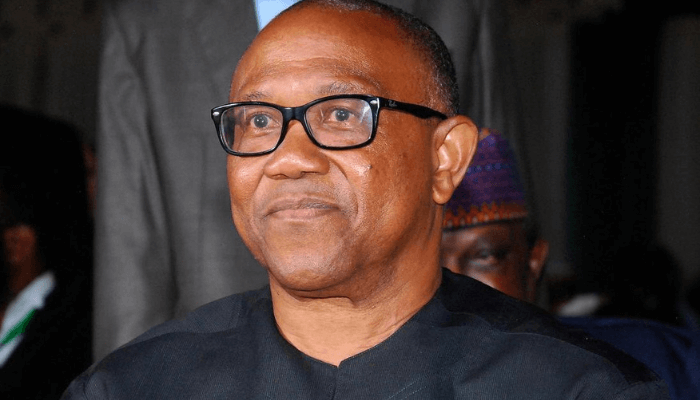
Peter Obi, the presidential candidate of Nigeria’s Labour Party, has criticised the October 30 judgement of the Supreme Court, which affirmed the electoral victory of President Bola Ahmed Tinubu, claiming that the decision of the apex court “contradicts the overwhelming evidence of election rigging.”
Obi, who came in third behind Atiku Abubakar of the Peoples Democratic Party (PDP) at the February 25, 2023 election, made this remark at his world press conference, which took place in Abuja, Nigeria, on Monday.
The former Anambra State governor backed up his accusation of the entire judicial process that upheld Tinubu’s victory on grounds of the technical glitches of the Independent National Electoral Commission’s (INEC) equipment that promised to ensure the election was free, fair, and credible, as well as the substantial non-compliance with the rules set by itself.
Obi said, “It is therefore with great dismay that the court decision contradicts the overwhelming evidence of election rigging. Firstly, on technical glitches, substantial non-compliance with the rules set by the Independent National Electoral Commission (INEC), itself, as well as matters… Identity theft and forgery have been brought to life in the course of this election matter.”

“These are hasty allegations that should not have been treated with levity. More appalling was the Supreme Court judgement, which condoned breaches of the constitution relative to establishing qualifications and, by extension, for candidates in the presidential elections.”
He admitted that this situation now shifts the moral burden of ensuring that elections are a true reflection of the will of the people to “our national conscience.”
He continued, “Our young democracy is ultimately the main victim and casualty of the courtroom drama. Without a hitch, this judgement commands a breach of confidence that Nigerians have in our judiciary. In essence, it is a show of unreasonable force against the very Nigerian people of whom the power of the constitution drives.
“The Supreme Court ruling may represent the state of the law in 2023 but does not present a demand for substantive justice. The judgement missed principles and precipes—in the rationale and premise of the Supreme Court judgement—have been clearly brought to life by the troubling remarks of Honourable Musa Dajjito Mohammed on Friday, October 27, 2023.
Read also:Labour Party chieftain alleges discrepancy in Peter Obi’s certificates

“In disagreeing very strongly with the decision of both the presidential petition court and the Supreme Court on the outcome of February 25, 2023, as declared by the Independent National Electoral Commission, as democratic who believe in the rule of law, the end stage for our quest for closure on this matter.
“As a party and candidate, Datti and I have now exhausted all legal and constitutional remedies available to us. However, this end is only the beginning of our quest to vindicate the hope of the common man for a better Nigeria.
“After all, sovereignty belongs to the people; if only for historical purposes, it behoves us to place our disagreement and deep reservation about this judgement on public record. We have long been aware of how weak our national institutions have negatively affected our democracy.
“This year 2023 has been quite remarkable and revealing. INEC displayed incompetence in the conduct of its statutory duties, and the judiciary has largely acted in defiance of constitutional tenets, precedence, and established ground rules. Political expediency has preceded judicial responsibility.
“A mechanical application of technicalities has preceded the pursuit of justice and fairness—what INEC and the Supreme Court as referees respectively shifted the goal post in the middle of the game.
“Where the value and import of INEC and the recent Supreme Court ruling end is where our commitment to a new Nigeria begins.
“Our mission has been more about anchoring a new Nigeria, and it remains unchanged. It is a nation where things will work, where the country will be led from its present waste and consumption orientation to a progression-driven economy. Our commitment is to a nation anchored on principles of prudent management of resources to quickly pull millions out of multidimensional poverty, ensuring transparency and accountability in the equitable distribution of opportunities, resources, and privileges.
“In the new Nigeria, we aim to address some of these needs by showing compassion for all those left behind by the present system.
“Going forward, we in the Labour Party and the Obedient Movement are now effectively in opposition. We are glad that the nation has heard us loud and clear, and we shall now expand the confines of our message of hope to the rest of the country.
“We will meet the people in their places where they feel pain and answer the need for hope—at market places, auto parks, town halls, board rooms, universities, and college campuses. We would carry and deliver the message of a new Nigeria.
“As stakeholders and elected Labour Party officials, we will remain loyal to our manifesto. We would continue to canvass good governance and focus on issues that promote national interest, unity, and equality.
“We would continue to give amnesty to our constitution, the rule of law, and the protection of our other liberties. We would offer checks and balances and would refer purposely in the forth coming elections to elect those who share our vision of a new Nigeria.”