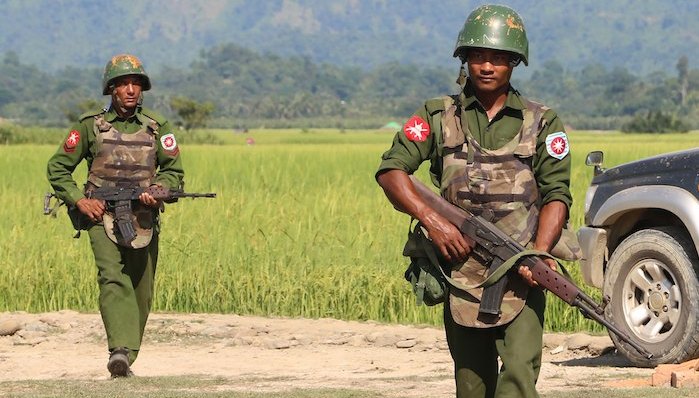
In 2017, the Myanmar military stepped up its decades-old persecution of the Rohingya Muslim minority. Described by the United Nations as “among the world’s least wanted” and “one of the world’s most persecuted minorities,” the Rohingyas Muslims in Myanmar have not only been denied the rights to free movement and of higher education by the majority Buddhist country, but they have also been denied citizenship since 1982.
Using the pretext of an attack on police at border posts in the Western coastal state of Rakhine, the Burmese military went all out to cleanse the Rohingyas. A study in 2018 estimated that the military and local Buddhist nationalists killed at least 24,000 Rohingyas and tortured around 116,000 including 36,000 who were thrown into fires. The military not only burnt down whole villages but was also accused of committing rape and other forms of sexual violence against 18,000 Rohingya women and girls.
By the time what many agencies of the United Nations, the International Criminal Court, human rights groups and governments described as “ethnic cleansing” and “genocide” subsided, over 750,000 Rohingyas have fled to Bangladesh with no hope of ever returning.
The military misread the mood of the country though and underestimated the god-like stature of Aung San Suu Kyi. Protests and resistance followed
Meanwhile, Nyanmar’s heroine of democracy, international human rights icon, celebrated Nobel peace laureate and de facto head of state, Daw Aung San Suu Kyi, remained silent and at a time, tried to create excuses for the military. The world was not only shocked but felt terribly let down by Suu Kyi, whom they had always thought was dedicated to the protection of the human rights of all people. But like New York Times Hannah Beech said in February, there is “a feeling [in Myanmar] that the Rohingyas are ultimately foreign interlopers in the country. And that in a Buddhist majority nation, there are certain people who don’t belong. And I think that Aung San Suu Kyi, as unpalatable as it might be to say, shares those beliefs.”

It is understandable to see why Aung San Suu Kyi sided with the military against the Rohingyas, even at the risk of destroying her carefully cultivated international reputation. Myanmar has been under military rule for about 50 years until 2011 when the military introduced a sort of disciplined democracy – a hybrid civilian-military system with a democratic elected government, but also a powerful military that supervises the democracy and controlling major levers of power.
Aung San Suu Kyi herself has been a major victim of the military. After her father’s (a military leader too) assassination when she was just two years old, she relocated abroad, studied and married in the UK and only returned in 1988 to champion the cause of democracy. Despite her military nobility background, she was clamped into house arrest for fifteen (15) years and never gave up until the military finally blinked in 2011. What cemented her status in Myanmar was when she chose her country over her family. The military agreed to release her to go be with her husband who was dying of cancer on one condition – that it will be a one-way ticket, but she refused. She not only became a heroine in her country, she also won the Nobel peace prize and several international human rights awards to boot and became such a charismatic figure worldwide in the mould of Nelson Mandela. But her national and international status threatened the military’s continued control of the country.
In deciding to side with the military, Aung San Suu Kyi may have reasoned that a condemnation of the genocide would jeopardise Myanmar’s nascent democracy. She was also mindful of the strong anti-Rohingya sentiments in the largely Buddhist nation. In her defence of the military action at The Hague in 2019, she did not even deem it fit to mention the word Rohingya– basically denying the humanity of the persecuted.
She did cement her powers and status at home but her international reputation took a severe beating – a factor that may have played into the hands of the military.
The last straw for the military was the November 2020 election where Suu Kyi’s National League for Democracy won a landslide. Fearing a total loss of control and with charges of genocide and ethnic cleansing hanging over their heads, the senior leaders of the military, on February 1, 2021, declared the results of the election illegitimate and sacked the government in a coup d’état.

The military misread the mood of the country though and underestimated the god-like stature of Aung San Suu Kyi. Protests and resistance followed. And like all genocidal armies do, Myanmar’s military has turned its guns on its people. Over 70 people have already been murdered since the February 1 coup. Total Marshall Law has been declared, internet and all forms of communication have been cut and a brutal regime of suppression has been launched to enable the military hang on to power. Myanmar is “controlled by a murderous, illegal regime” that is committing “crimes against humanity”, Thomas Andrews, the United Nation’s top expert on rights in Myanmar told the UN Human Rights Council in Geneva last week. Now Burmese, both home and abroad, are desperately calling on the UN and the international community to help save them from their own genocidal military.
This holds lessons for Nigerians who always support genocides against groups they do not like. Myanmar’s largely Buddhist population never liked the Rohingya Muslim minorities and were overwhelmingly supportive of the military’s attempt to cleanse the group from Myanmar. What they never knew was that a genocidal military will kill anyone standing on its way. In 1999, Victor Malu was Nigeria’s army chief and oversaw the killings and destruction of Odi in Bayelsa state. Shortly after retiring in 2001, it was the turn of his village to be subjected to the brutal genocidal guns of the army. He never recovered till he died. Massacres, killings, genocides eventually go round.