



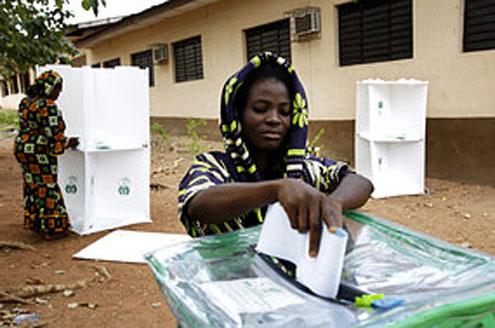
The decision by the Independent National Electoral Commission (INEC) to deploy biometric card readers into the general elections has placed the Nigerian democracy and electoral process on a higher pedestal in the global political landscape.
The country’s quest to eliminate electoral fraud, which has marred elections repeatedly in Africa, compelled the electoral body in Nigeria to deploy the card readers into the 2015 general elections.
“INEC’s decision to use technology in this election is quite impressive. The Permanent Voter Cards (PVC) are very high-tech. They are more high-tech than my voter card from the state of Virginia in the United States of America (USA),” said James Entwistle, the ambassador of the USA to Nigeria.
The impact of the technology in curbing electoral fraud was evident in the just concluded presidential elections, which many analysts described as the most closely-fought election in Nigeria’s turbulent history.

Almost all the previous elections had been marred by massive rigging in the shape of ballot stuffing, multiple and underage voting, and falsification of figures, according to local and international monitors.
In all, about 800 people died in violence in 2011 after Buhari lost to Jonathan and declared that the result was rigged. “Without card readers, anyone could use anyone else’s card,” said Yemi Adamolekun, executive director of Enough Is Enough (EiE) Nigeria, an advocacy group based in Lagos, the nation’s commercial nerve centre.
“The use of technology, including social media is increasing transparency and accountability in the electoral process, as votes of the citizenry now count,” she added.
Industry observers, however, are of the view that with the card readers, INEC had in its possession, an electronic record for the aggregate number of accredited voters and the total at each location, making it difficult for politicians and their cohorts to rig.
In view of the relative successes recorded using the PVC, BusinessDay gathered that many developing economies, with budding democracies and even the more advanced economies, are already considering borrowing a leaf from INEC, as they seek to strengthen their electoral process and good governance.

“My voter card does not have biometric. It does not have my fingerprint. The high-tech gives the process more integrity,” stated Entwistle at the International Conference Centre, serving as the National Collation Centre for the 2015 presidential election.
However, the decision by Jega, to use smart card readers attracted attacks on his integrity.
Thousand of Jonathan’s supporters marched through Lagos, on March 16, demanding the removal of Jega and a ban on card readers. Four political parties allied to PDP (People’s Democratic Party) filed a lawsuit at the Federal High Court in Abuja, saying the use of the card readers would be unlawful and would likely infringe on the rights of eligible voters.
But Jega held strongly that the card readers would help to eliminate election rigging in the country.
“How can they manipulate the election when all the information with regards to the number of voters that turned out at every polling unit is automatically captured and transmitted by the machines? We have made rigging impossible for them, as there is no how the total number of votes cast at the polling unit could exceed the number of accredited persons.”
He explained that such discrepancy in figures would be immediately spotted. “This technology will further make it impossible for any corrupt electoral officer to connive with any politician to pad-up results”, he added. “Biometric cards helped to improve transparency in elections in Ghana three years ago,” the Accra-based Coalition of Domestic Election Observers, which monitored the electoral process, said. The machines failed at 19 percent of the polling stations.
Other West African nations including Mali, Cameroon and Mauritania, have used biometric readers in recent elections, while Burkina Faso has started a new registration process requiring fingerprint identification. “The use of technology provides an opportunity to nudge the electoral process higher, reducing the scope of vote manipulation,” said Clement Nwankwo, executive director of Abuja-based policy and legal advocacy centre in an interview.
Ben Uzor




