|
Getting your Trinity Audio player ready...
|
Nigerian artists and professionals in the creative industry have been urged to adopt Artificial Intelligence (AI) to fundamentally reshape their jobs, as it is a key to career sustainability.
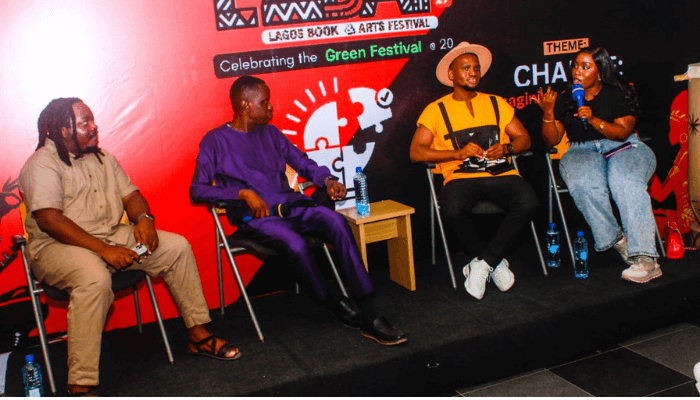
The urgent message was delivered by a panel of Technology and creative industry experts, who stated this at the 2025 Lagos Book and Art Festival (LABAF) held in Lagos, in a discussion titled ‘Building a Sustainable Creative Career in the AI Era,’ centered on navigating the profound disruptions and opportunities AI presents.
Habib Ajijola, a product growth expert and founder of Growthverse, stated the reality that “AI is coming to take your job. I think that’s the reality and the mindset you need to work with,” emphasising the technology’s rapid acceleration.
Ajijola illustrated the threat with a personal anecdote, revealing how an AI generated a project soundtrack in seconds, a task that previously took months and significant expense.

He warned that this is the end of 90 percent of corporate jingles and gigs for musicians.
Read also: Experts hinge SME market success on authentic storytelling, not big budgets
Babatope Oni, co-founder and CTO of Gigbanc, urged artists to leverage AI as a ‘Personal Assistant’ for tedious tasks, freeing up time for uniquely human creativity.
He stressed that “The people who will thrive are not those who fight the change, but those who learn to control it.” Oni advised creatives to maximise the advantage AI offers, stating that, “your unique human experience and creativity become your premium in a world of automated output.”
He concluded that those who learn to use AI will be the ones taking the jobs.

Amanda Uzoagba, an entertainment lawyer and head of licensing for Africa at Mdundo, addressed the legal challenges, noting that copyright laws are lagging behind technology.
She highlighted ongoing legal battles, asserting that an AI system shouldn’t train on materials without permission. Uzoagba, however, offered a strategic advantage for local talent, which is cultural intelligence.
“While AI can generate a script, it cannot imbue it with the authentic soul of our culture. It doesn’t understand the subtle nuances of a Lagos ‘chop breakfast,’ the cadence of a proverbial warning from a grandmother in the village, or the unspoken rules of a typical Nigerian family meeting.”
Uzoagba stated that this inherent limitation of AI is the creative’s greatest professional advantage, transforming their role.
“You are no longer just a script writer, but an essential story consultant and cultural architect, the irreplaceable human element,” she said.